
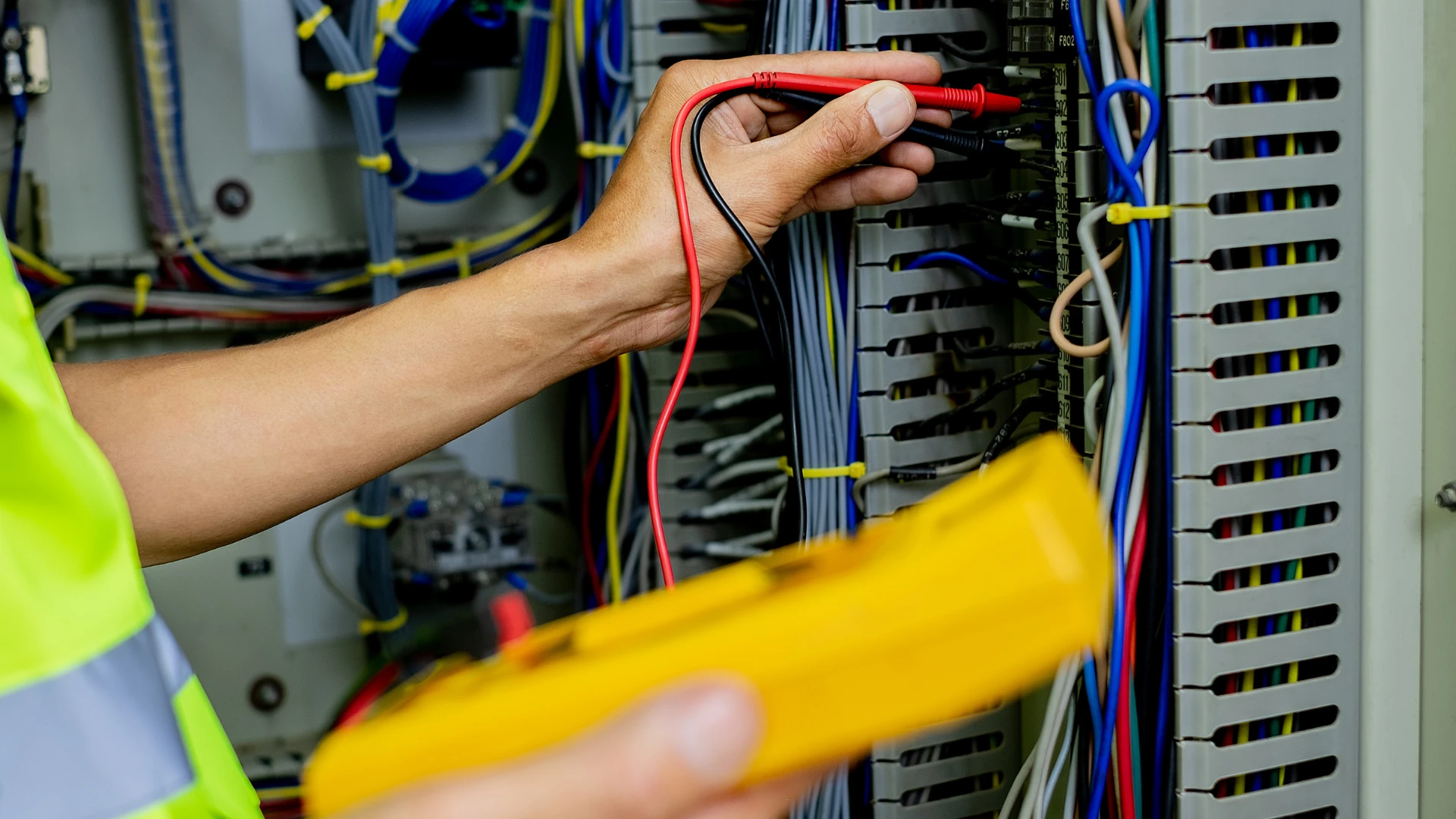
Understanding the difference between Line 1 (L1) and Line 2 (L2) is fundamental to safe, code-compliant electrical work in Ontario commercial and residential spaces. These quick insights help you apply best practices immediately and prevent costly or dangerous mistakes.
- L1 and L2 are the two “hot” wires supplying 120V each to neutral and a combined 240V between lines—powering everything from lighting to heavy machinery.
- Proper color coding is critical: Use black for L1, red for L2, and white or grey for neutral—mislabeling can cause shock risks and failed inspections.
- 120V circuits run from L1 or L2 to Neutral, while 240V equipment connects directly between L1 and L2 for safe, high-capacity power delivery.
- Never label neutral as L2—this common mistake violates Ontario code and increases the risk of electrical hazards and equipment damage.
- Split-phase systems provide both versatility and safety, letting you power regular office devices and commercial equipment with maximum efficiency from the same panel.
- Lock-out/tag-out, clear panel schedules, and CSA-approved PPE are mandatory safety steps—every service call must start with proper de-energization and identification.
- Upgrading to three-phase power unlocks higher capacity (for $15,000–$50,000+), but demands licensed expertise and strict compliance with Ontario electrical codes.
- A well-labeled, code-compliant panel saves troubleshooting time by up to 50% and keeps every project, from kitchens to office towers, safer and more reliable.
Master these line distinctions and labeling requirements, and you’ll ensure every electrical upgrade, repair, or installation delivers on Padi Electric’s promise: Powering Ontario, the Right Way—safely, reliably, and to the highest standards. Read the full article for diagrams, real-world scenarios, and actionable tips for your next project.
Line 1 vs Line 2 in Electrical Systems — What Every Ontario Property Owner Must Know Before It’s Too Late
Ever wondered why an overloaded circuit shuts down half your building—but leaves the kitchen running strong? Or why a single mislabelled wire could cost you a safety fine or failed inspection?
For Ontario property managers, business owners, and contractors, understanding Line 1 (L1) and Line 2 (L2) isn’t just a technical detail—it’s the foundation of every safe, high-performance workspace.
These aren’t just numbers in a panel. L1 and L2 are the “hot” lifelines powering everything from office computers to rooftop HVACs and commercial ovens. A simple mix-up—like treating neutral as a power line—can lead to costly downtime, equipment damage, or electrical hazards that threaten both business and reputation.
By getting the details right, you’ll unlock benefits such as:
- Maximum electrical capacity without overloads or outages
- Smooth compliance with Ontario’s safety codes and insurance regulations
- Efficient upgrades that prevent delays and inspection failures
If you’ve ever faced a sudden blackout, equipment fry-up, or failed panel sticker, you know the stakes are real. In today’s fast-paced Ontario market, being able to spot—and solve—L1 and L2 issues sets trusted pros apart from the rest.
This guide will give you what you can’t get from manufacturer pamphlets or outdated code books:
- Clear explanations on L1/L2 roles, voltage, and labeling
- Real-world scenarios to connect theory to actual projects
- Safety practices that protect both property and people
- Visual cues and color codes every Ontario electrician relies on
The difference between a “pass” and a “re-do” inspection—or a safe workspace and a headline accident—often comes down to the small details behind those panel doors.
So, what exactly happens when Line 1 and Line 2 are confused, and how do the right connections power everything from boardrooms to bakeries? Let’s pull back the panel cover and start with the essentials.
Defining Line 1 (L1) and Line 2 (L2) in Electrical Systems
Line 1 (L1) and Line 2 (L2) are the two “hot” phase conductors that provide electricity in most North American split-phase electrical systems.
Both L1 and L2 carry live current from the transformer to the building’s panel—think of them as separate power “lanes” designed to maximize electrical capacity and safety.
Core Purpose and Structure
Each line is energized at 120 volts to neutral—so L1 to Neutral is 120V, and L2 to Neutral is also 120V.
When combined, L1 to L2 delivers 240 volts; this is possible because L1 and L2 are 180 degrees out of phase with each other.
This phase difference means that when L1 peaks, L2 is at its lowest point. That’s how we safely run heavy equipment and regular office devices from the same system without dangerous overlaps.
- Typical setup:
- L1 and L2: Supply “hot” power for all commercial loads.
- Neutral (N): Provides a safe, grounded return path.
- Voltage relationships:
- L1 to Neutral: 120V AC
- L2 to Neutral: 120V AC
- L1 to L2: 240V AC
- Labeling rules: Always mark neutral as N, and never label neutral as L2. This is more than a best practice—it’s Ontario code.
Why L1 and L2 Matter in Commercial Electrical Work
In commercial spaces, L1 and L2 power everything from lights and computers to ovens and HVAC—often all at once.
Picture a busy Ontario restaurant: all the major appliances (like commercial stoves and coolers) draw 240V from L1 to L2, while lights and plug outlets typically use 120V (L1 or L2 to Neutral).
- For property managers, business owners, and contractors:
- Proper use of L1/L2 can reduce risk of overloads and outages.
- Ensures you meet ESA (Electrical Safety Authority) and insurance requirements.
- Mistakes like mislabeling increase shock risk and fail inspections—a quick fix for peace of mind.
- Key takeaway: “If you get L1 or L2 wrong, you could be risking equipment damage—or safety fines.”
Practical, Shareable Insights
- “L1 and L2 are the backbone of safe, high-capacity power in every Ontario workspace.”
- “Every 240V machine uses both lines; every standard plug uses just one. That’s strategic design, not coincidence.”
- Always use color-coded labeling, as required in Ontario: black for L1, red for L2, white for neutral.
By focusing on L1 and L2, your operations can stay safe, efficient, and compliant. If you ever see “L2” on a neutral wire—stop; it’s time to call a licensed pro.
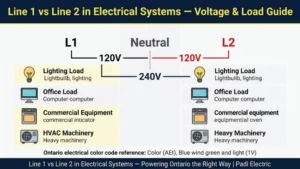
Line 1 vs. Line 2: Roles, Relationships, and Voltage Details
Line 1 (L1) and Line 2 (L2) are the two hot phase conductors in North American split-phase electrical systems.
Both are supplied from a transformer center-tap, which creates three wires entering a building: L1, L2, and Neutral (N).
In commercial setups, the transformer’s two outer taps deliver L1 and L2, while the center-tap provides the Neutral.
| Voltage Configuration | Lines Used | Typical Load |
|---|---|---|
| 120V | L1 to Neutral | Lighting, outlets, computers |
| 120V | L2 to Neutral | Office appliances, POS systems |
| 240V | L1 to L2 | HVAC, ovens, industrial motors |
| 240V (Three-Phase) | L1 + L2 + L3 | Large machinery, elevator banks |
Single-Phase and Split-Phase Loads
L1 and L2 each supply 120V relative to Neutral, ideal for standard office equipment and lighting.
When you connect L1 to L2 directly, you get 240V—this is essential for heavy-duty appliances, like HVAC systems and commercial ovens.
- 120V circuits: Connect either L1 or L2 to Neutral (N)
- 240V circuits: Connect L1 to L2, without using Neutral
This dual-voltage setup allows for efficient power delivery to both small plug loads and high-draw machinery in commercial properties.
—
Relationship with Neutral and Panel Layout
Neutral (N) acts as the grounded return path—always label Neutral clearly, never as L2.
Ontario commercial electrical panels use strict color coding:
- L1: Black or red
- L2: Red or black (must be consistent and not reused for Neutral)
- Neutral: White or grey
Following labelling codes protects electricians and building occupants from hazardous mistakes. Mislabeling can cause shock, equipment failure, or failed inspections.
—
Phase Alignment and Polarity Considerations
L1 and L2 are 180 degrees out of phase—meaning, when L1 is at a voltage peak, L2 is at its trough.
This phase split enables 240V between L1 and L2 even though each line is only 120V to Neutral.
- Alternating current (AC) has no fixed polarity post panel—wiring order of L1/L2 is interchangeable at outlets and loads.
- Unlike direct current (DC), polarity is less relevant in AC electrical panels, reducing user error in real-world wiring.
Clients should picture a panel where L1 and L2 “share” the load for 240V equipment, while each can power separate 120V devices independently.
—
Understanding and correctly labeling L1, L2, and Neutral isn’t just a matter of code—it’s about safety, reliability, and protecting every project and occupant. Clear labeling and phase awareness save lives and prevent costly mistakes.
“If you want a safe building, start by getting your lines right.” That’s the pulse of professional electrical work in Ontario.
Practical Applications: How L1 and L2 Are Used in Commercial Systems
In every Ontario commercial building, Line 1 (L1) and Line 2 (L2) are the backbone of electrical distribution, powering everything from office desktops to industrial ovens.
Picture this: Walk into a restaurant’s kitchen, and every major appliance relies on these phase conductors—some using just one, others drawing power from both for high-demand equipment.
What Needs 120V (L1 or L2 to Neutral)?
Many everyday devices in commercial spaces only require 120 volts. These include:
- Lighting circuits (fluorescent panels, LED fixtures)
- Office plug loads (workstations, computers, monitors)
- Basic appliances (microwaves, coffee makers, point-of-sale systems)
Each of these draws power from either L1 or L2 to the neutral (N) wire, ensuring flexibility and reliability.
What Needs 240V (L1 to L2)?
Heavy-duty devices need more juice—240 volts, to be exact. Common examples are:
- HVAC systems (large rooftop units, pumps)
- Cooking equipment (commercial ovens, fryers)
- Laundry equipment (commercial dryers)
- Industrial machinery (compressors, welders)
These systems connect directly between L1 and L2, harnessing the 240V available because the lines are 180 degrees out of phase.
“If it hums, heats, or spins with serious force, odds are it’s drawing on both L1 and L2.”
Diagram Callouts & Wiring Setups
In a typical Ontario panel, you’ll see:
- 120V circuits: One breaker, connected L1 or L2 to N.
- 240V circuits: Double-pole breaker, spanning L1 and L2 without using N.
Diagram callouts in real projects make it easy to spot where each voltage is used—HVAC panels labeled “L1/L2,” office plugs marked “L1 to N.”
Real-World Commercial Scenarios
Imagine a downtown office:
- Individual suites: Lighting and standard outlets wired from L1 or L2 to N.
- Server room: High-load cooling units on L1 to L2 for stable 240V.
Or picture a busy restaurant:
- Front-of-house: L1 or L2 runs point-of-sale and lighting.
- Kitchen: Ovens, fryers, and walk-in coolers wired for 240V, requiring both L1 and L2 for performance.
“One breaker, one line—120V. Two breakers, two lines—240V. That’s the secret to commercial flexibility.”
Safety & Upgrade Considerations
- Lock-out/tag-out is essential—always confirm both L1 and L2 are de-energized before panel service.
- Use panel schedule labels so staff know which line powers each circuit.
- Always follow Ontario’s electrical code for color coding and breaker placement.
A well-designed L1/L2 system gives commercial properties the muscle—and the flexibility—to keep business running safely. Mastering which line, or combination, to use is key to smart planning and safer upgrades.
Neutral vs. Line 1/Line 2: Key Differences and Safety Issues
Understanding the distinction between neutral (N) and Line 1/Line 2 (L1/L2) is fundamental for every Ontario electrical project—whether you’re a contractor, property manager, or business owner.
In a commercial split-phase system, L1 and L2 are the “hot” wires carrying live voltage from the transformer, while neutral provides a grounded return path to complete the circuit.
Picture this: In an office electrical panel, L1 and L2 each supply 120V (relative to neutral), while the voltage between L1 and L2 delivers 240V—powering large equipment like ovens and HVAC compressors.
Comparison Table: Neutral vs. Line 1/Line 2 in Split-Phase
| Feature | Line 1 (L1) / Line 2 (L2) | Neutral (N) |
|---|---|---|
| Type | Hot, live, ungrounded | Grounded return path |
| Voltage to Neutral | 120V each | 0V |
| Voltage Between Lines | 240V (L1 to L2) | N/A |
| Function | Delivers current to load | Completes circuit safely |
| Safety Caution | Never label as neutral | Crucial for shock protection |
| Common Mistake | Mislabeling can cause shocks | Overloading return path |
“L1 and L2 carry power—neutral brings it home safely.”
Mislabeling neutral as L2 is not just an oversight—it’s a major code violation that can lead to shock, equipment failure, or even fire.
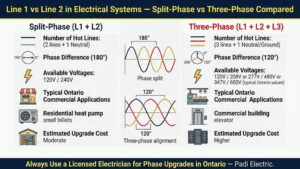
Ontario Code Compliance: Labeling, Wiring, and Panel Safety
Proper labeling and safe practices are non-negotiable under the Ontario Electrical Safety Code:
- L1, L2, and N must be clearly labeled in every panel—neutral should never be marked as L2.
- Colour coding is mandatory:
- L1: Black or red
- L2: Red or black
- Neutral: White or grey
- Key safety tips for servicing:
- Always use lock-out/tag-out procedures
- Wear CSA-approved PPE (Personal Protective Equipment)
- Test for absence of voltage every time
Common Ontario code mistakes to avoid:
- Mixing up wire colours or labels
- Installing fuses/breakers incorrectly
- Overloading the neutral wire
“You can’t cut corners with panel labels—inspection failures and safety hazards are immediate consequences.”
Real-World Impact: Why Careful Identification Matters
Imagine a commercial kitchen: a miswired neutral means an oven could receive full 240V across sensitive electronics, risking both expensive repairs and personal injury.
Correct identification of L1, L2, and N doesn’t just keep you code-compliant—it protects your investment and the well-being of everyone on site. Mistakes here cost real money, time, and safety.
Advanced Topics: Split-Phase vs. Three-Phase Systems in Commercial Properties
Understanding the difference between split-phase and three-phase electrical systems is critical for anyone planning, upgrading, or maintaining Ontario commercial properties.
Split-phase setups use three wires: Line 1 (L1), Line 2 (L2), and Neutral (N). This common North American configuration delivers either 120V (L1 or L2 to N) or 240V (L1 to L2), powering typical offices, shops, and light commercial spaces.
When Three-Phase Power is Needed
For large facilities, increased efficiency, or higher machinery demand, three-phase power (L1, L2, L3, N) is the go-to solution.
You’ll find three-phase systems in:
- Restaurants with multiple high-powered ovens or walk-in freezers
- Small manufacturing shops (motors, compressors, industrial HVAC)
- Multi-storey office towers with complex elevator banks
Three-phase can supply 208V, 240V, or 600V, adapting to various commercial loads. “Picture this: A busy bakery in Toronto powers mixers, ovens, and freezers—simultaneously—thanks to three-phase service.”
What Changes for L1 and L2?
- In split-phase: L1 and L2 are 180° out of phase—combined for 240V circuits, separated for 120V.
- In three-phase: L1, L2, and L3 are each 120° apart—enabling smoother, more efficient delivery for large motors and equipment.
In three-phase systems, no single line “pairs” with another identically to split-phase—instead, any two lines provide phase-to-phase voltage.
Upgrade Realities: Cost, Complexity, Safety
- Upgrading to three-phase:
- Can cost $15,000–$50,000+, depending on service size and wiring needs.
- Demands compliance with Ontario’s electrical code and professional engineering review.
- May require new switchgear, panels, and building permits.
- Professional evaluation is critical before any upgrade—serious shock hazards and equipment failure risks exist when phases are miswired.
“Three-phase unlocks industrial-scale performance, but every connection demands licensed expertise.”
Troubleshooting and Diagnostics: Working with L1 and L2
Common issues in both systems include:
- Voltage imbalances: One line lower than others (affects sensitive equipment)
- Tripped breakers: Can signal overloads, miswiring, or phase faults
- Miswired connections: Can damage equipment or create dangerous scenarios
Steps to diagnose L1 and L2 issues:
- Shut off power and use lock-out/tag-out procedures.
- Test voltage between each line and neutral, as well as between lines, using a multimeter.
- Check connections in panels for loose wires, rule out improper labeling, and inspect for overloading.
Tip: Call a licensed electrician if you notice unusual voltage readings, persistent breaker trips, or uncertain wiring—Ontario code requires qualified personnel for all commercial diagnostics.
A clear understanding of split-phase versus three-phase delivers power and peace of mind; when in doubt, always consult a certified pro. Your business’s safety and uptime depend on it.
Visual Aids: Diagrams and Real-World Examples
Seeing Line 1 (L1), Line 2 (L2), and Neutral (N) in action brings clarity that no technical diagram alone can provide. For Ontario business owners and property managers, recognizing how these lines power your facility boosts safety and helps avoid costly mistakes.
Core Split-Phase Panel Diagram
Picture this: You open a commercial electrical panel.
- L1 and L2 appear as two distinct wires, often with black (L1) and red (L2) insulation per Ontario’s standard color codes.
- Neutral (N) is typically white or grey, running alongside but never carrying the same current as either hot line.
- The main breaker connects directly to both L1 and L2, feeding all circuits.
A simple sketch would show:
- Two vertical bus bars: one for L1, one for L2.
- A horizontal bus or terminal strip for Neutral.
- 120V circuits tap from L1 or L2 to N.
- 240V circuits bridge directly between L1 and L2.
Tip: “If your panel wiring doesn’t match this configuration, it’s time to call a licensed electrician—fast.”
Wiring Configurations for 120V and 240V Circuits
In real commercial applications:
- 120V outlets and lighting: One hot (L1 or L2) + N.
- 240V equipment (ovens, HVAC): Both L1 and L2, no neutral needed.
From a project in Mississauga:
- Office lighting circuits use L1-to-N for consistent 120V across all workstations.
- A rooftop air conditioner draws power from L1-to-L2, delivering reliable 240V—vital for heavy-duty performance.
Ontario code requires clear labels for each conductor—never confuse neutral with a phase wire. “One mislabel and you risk failed inspections or worse: shock hazards.”
Interpreting Commercial Project Photos
When reviewing actual panel photos or walkthroughs:
- Look for color-coded wires entering the main panel.
- Check for labels (L1, L2, N) on distribution bars and breaker labels.
- Confirm that every neutral is tied to the correct bus—not looped as a “second phase.”
Every well-labeled, properly routed wire is a reflection of safe, code-compliant work and reduces troubleshooting time by up to 50%.
When you can visually distinguish L1, L2, and Neutral, every upgrade or maintenance call becomes safer and smoother. That’s the practical edge for anyone responsible for building power, from facility managers to general contractors.
Line 1 vs Line 2 in Electrical Systems — Your Clearest Path to Safe, Code-Compliant Power in Ontario
Mastering the roles of Line 1 (L1) and Line 2 (L2) isn’t just about following code—it’s about building safer, more resilient spaces across Ontario. When you understand how these conductors work together, you gain real power to protect your property, keep projects inspection-ready, and support the people who rely on your electrical systems every day.
To put these insights to work now:
- Double-check your panels: Ensure L1, L2, and Neutral are clearly labeled with Ontario-approved colors—never reuse color codes or mislabel lines.
- Inspect panel schedules and diagrams: Confirm every 120V and 240V circuit is correctly routed and identified, minimizing confusion during maintenance or emergencies.
- Adopt lock-out/tag-out procedures: Every time you access a live panel, use CSA-approved PPE and implement safety lockouts—no shortcuts, no exceptions.
- Collaborate with licensed electricians: Don’t hesitate to bring in certified pros for diagnostics, upgrades, or troubleshooting—your business depends on their expertise.
- Educate your team on safe practices: Whether you manage a restaurant, office, or workshop, make sure everyone knows how to spot, report, and prevent electrical hazards.
Ready to strengthen your system? Walk your facility, check those labels, and review your last ESA inspection findings today—discover risks before they become costly failures.
“True power isn’t just in the wires—it’s in how you safeguard every connection. When you wire right, people thrive.”
Every step you take toward clarity and code compliance drives Ontario’s standard of safety higher. Power your next project the right way—and set the benchmark for others to follow.
FAQ
What is the difference between Line 1 and Line 2 in electrical systems?
Line 1 vs Line 2 in electrical systems refers to the two hot phase conductors in a North American split-phase setup. L1 and L2 each carry 120V relative to neutral, while the voltage between them delivers 240V. This dual-voltage design powers both standard office devices and heavy-duty commercial equipment safely from the same panel.
Why is proper labeling of Line 1 and Line 2 in electrical systems so important?
Line 1 vs Line 2 in electrical systems must be clearly labeled using Ontario-approved color codes — black for L1, red for L2, and white or grey for neutral. Mislabeling neutral as L2 is a serious code violation that can cause electric shock, equipment failure, and failed ESA inspections. Clear labeling also reduces troubleshooting time by up to 50%.
What appliances use Line 1 vs Line 2 in electrical systems?
Line 1 vs Line 2 in electrical systems powers different loads depending on voltage requirements. Standard devices like lighting, computers, and outlets draw 120V from either L1 or L2 to neutral. Heavy-duty equipment such as HVAC systems, commercial ovens, and industrial compressors require 240V by connecting directly between L1 and L2.
What is the difference between split-phase and three-phase when comparing Line 1 vs Line 2 in electrical systems?
Line 1 vs Line 2 in electrical systems describes a split-phase configuration where L1 and L2 are 180 degrees out of phase, delivering 120V or 240V. Three-phase systems add a third conductor — L3 — with each line 120 degrees apart, enabling higher capacity for large facilities. Upgrading to three-phase can cost $15,000–$50,000 and requires licensed expertise and Ontario code compliance.
How do I troubleshoot Line 1 vs Line 2 in electrical systems safely?
Line 1 vs Line 2 in electrical systems troubleshooting must always begin with lock-out/tag-out procedures and CSA-approved PPE. Use a multimeter to test voltage between each line and neutral, check for loose connections, and inspect all panel labels for accuracy. For persistent breaker trips, voltage imbalances, or uncertain wiring, always call a licensed Padi Electric technician to ensure full Ontario code compliance.

Written by Roozbeh Nahreini
Roozbeh Nahreini is the founder and owner of Padi Electric Inc., an ESA-certified electrical contractor serving Aurora and the Greater Toronto Area. With 10+ years of hands-on electrical expertise and a team combining 50+ years of field experience, Roozbeh specializes in residential and commercial electrical solutions—from panel upgrades and EV charger installation to smart home integration and advanced diagnostics. His commitment to transparent pricing, code-compliant workmanship, and 24/7 emergency response has established Padi Electric as a trusted neighborhood contractor across Aurora, Richmond Hill, Newmarket, Vaughan, and the GTA.