
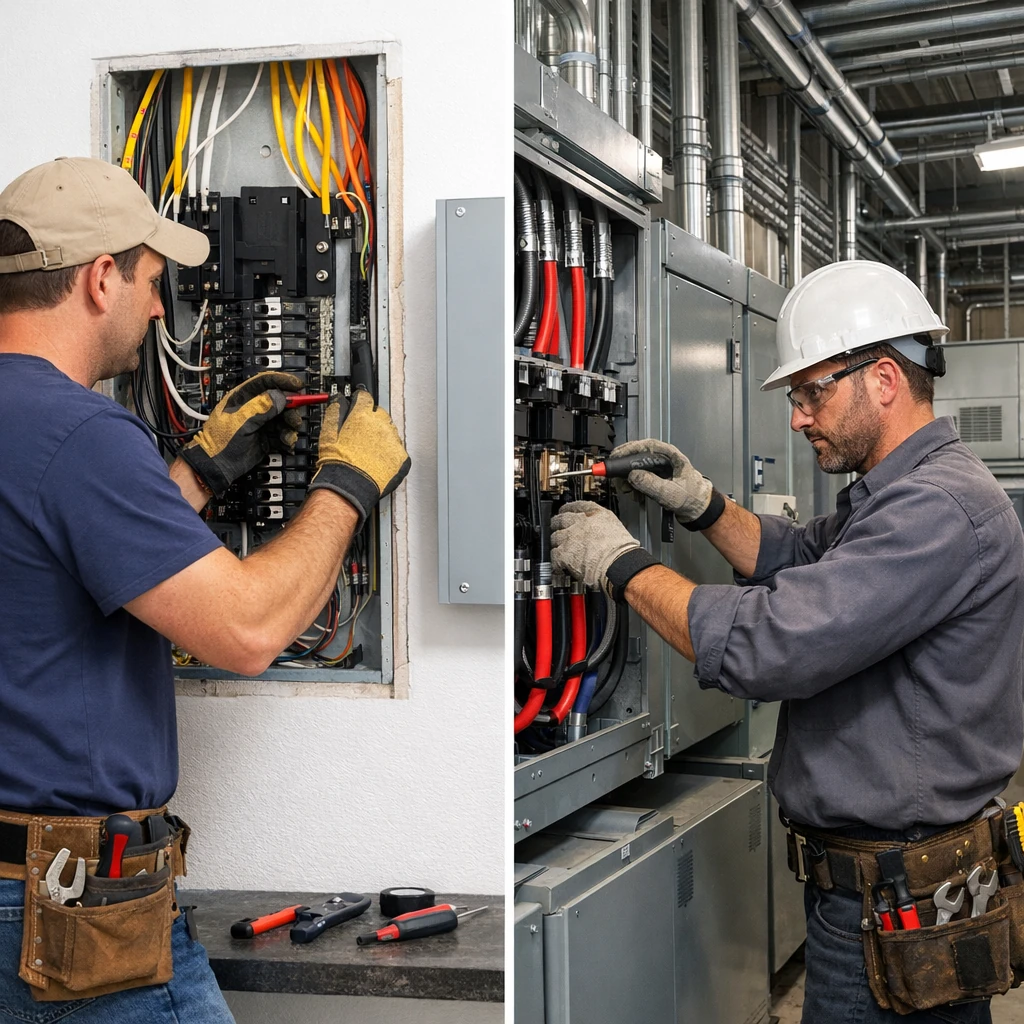
Choosing the right electrician for your project protects your property, budget, and peace of mind. Here’s exactly what you need to know to make an informed, safe decision—no matter if you’re a homeowner or managing a commercial property in Ontario.
- Commercial and residential electricians serve distinct environments—homes need flexibility and fast service, while businesses require specialists skilled in high-capacity, complex systems.
- Ontario’s Electrical Safety Code is non-negotiable—always verify your electrician is fully licensed, insured, and compliant to avoid fines, delays, and safety risks.
- System complexity and materials differ sharply—residential work relies on NM-B “Romex” cable and simple layouts; commercial jobs demand rugged, conduit systems and advanced tools to withstand heavy, continuous use.
- Documentation and planning are essential—expect basic floor plans and labels for homes, but detailed blueprints, schedules, and rigorous records for commercial builds to ensure compliance and prevent costly errors.
- Safety protocols scale with project size—residential pros follow code and PPE basics, while commercial teams implement Lockout/Tagout, Arc Flash assessments, and advanced backup systems for critical facilities.
- Continuous education and certifications set true professionals apart—choose electricians who commit to ongoing training, advanced safety credentials, and staying ahead of evolving codes and technology.
- Demand, wages, and advancement opportunities are strong—Ontario electricians are seeing a 7% rise in job growth and competitive salaries, with the highest rewards going to those with specialized expertise.
- Client communication and project dynamics differ—homeowners value personal service and speed, while commercial clients require formal updates, accountability, and strict documentation at every stage.
Partnering with a licensed, code-focused electrician is the smartest way to power your project—explore the full article to ensure your next electrical job is safe, efficient, and future-ready.
Introduction
Ever wondered why choosing the wrong type of electrician could cost thousands in rework—or even risk lives?
Picture this: A homeowner needs an urgent kitchen rewiring after an old fuse box fizzles out. Meanwhile, a hospital’s operating wing can’t afford a moment of downtime, demanding backup generators and meticulous project documentation.
Both situations require expert hands—but not the same skillset.
Across Ontario, licensed electricians stay in high demand as our homes get smarter and businesses scale up fast. Yet, there’s a world of difference between the work done in cozy living rooms and sprawling commercial complexes.
The stakes? Only your family’s safety, your property’s value, or your business’s uptime.
So what really sets a residential electrician apart from a commercial specialist?
You’ll discover:
- How skillsets, responsibilities, and safety protocols shift between home and business settings
- The impact of Ontario’s electrical safety codes on every job—whether it’s a bungalow, retail plaza, or high-rise office
- The core value of licensing, compliance, and transparent communication for your peace of mind
Knowing these distinctions isn’t just about getting the lights back on.
It’s about:
- Making informed hiring decisions (and knowing what questions to ask)
- Ensuring your upgrades, renos, and repairs stand the test of time—and code inspections
- Shielding your property and those who rely on it from hidden risks
From material choices to scheduling, documentation to client interaction, we’ll break down the what, why, and how—so you can confidently match your project to the right professional.
Curious which electrician your property truly needs—and why credentials matter more than ever?
Let’s look closer at the roles, training, and day-to-day realities that shape electrical safety and quality across Ontario.
Defining the Roles: Commercial vs. Residential Electricians
What Sets These Electricians Apart?
Commercial electricians and residential electricians are both experts in their field, but each specializes in a distinct work environment—and it shows in every detail of their day.
Residential electricians focus on private homes, condos, townhouses, and apartments. Picture a professional wiring a new kitchen, upgrading an old fuse box, or troubleshooting a tripped breaker in someone’s living room.
Commercial electricians work inside office buildings, retail plazas, hospitals, industrial sites, and public facilities. Imagine teams installing massive electrical panels, running conduit through concrete, or maintaining power for a busy hospital’s operating wing.
“When safety and project timelines matter, hiring the right licensed expert makes all the difference.”
Clients, Communication, and Code
Each role serves a unique set of clients and tailors their communication style to match:
- Residential electricians:
- Homeowners
- Renovation contractors
- Small developers
- Commercial electricians:
- Business owners
- Property managers
- Institutions and public sector clients
Ontario’s strict electrical safety codes shape both roles. Commercial projects are governed by more complex bylaws and often require in-depth permit processes, while residential work focuses on code compliance within personal living spaces.
Expect direct, in-home conversations from residential pros versus the formal, project-based meetings typical in commercial contexts. Residential jobs often demand on-the-spot problem-solving and client education, while commercial work involves pre-planning and ongoing coordination with construction teams.
“A single missed step in documentation or code compliance can cost thousands in rework—especially on commercial builds.”
Why Licensing, Insurance, & Compliance Matter
Only a fully licensed, insured, and code-compliant electrician can legally perform electrical work in Ontario. This protects not just projects, but lives and property.
Choose your electrician with care:
- Certification and insurance are mandatory—don’t settle for less
- Ask about experience with your specific type of facility
- Prioritize transparency, communication, and references
“Electrical safety isn’t optional—cutting corners now means risk and liability later.”
Licensed electricians bring peace of mind, quality assurance, and long-term savings—whether it’s your family at home or your entire business on the line. Knowing who to call (and why credentials matter) is the first step to a safe, code-compliant project.
Scope of Work and Typical Responsibilities
Contrasting Daily Tasks
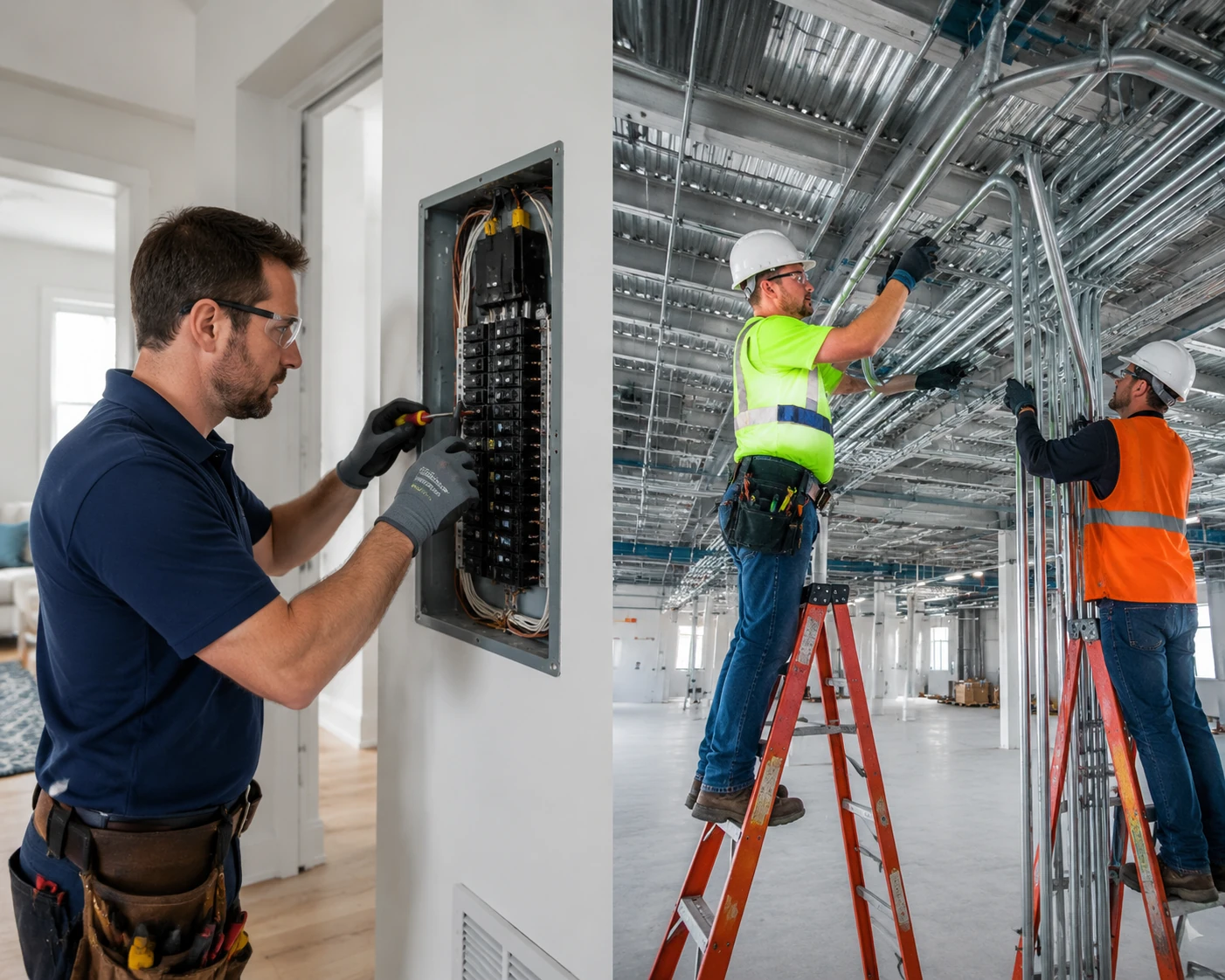
Commercial and residential electricians serve very different types of spaces, and their daily routines reflect this.
Residential electricians often begin their day with a checklist of service calls, moving between homes to diagnose issues, upgrade wiring, or respond to urgent power outages.
Commercial electricians, on the other hand, may spend weeks or months on a single job site—think hospitals, schools, or retail complexes—focused on high-capacity systems and frequently working as part of a large crew.
Residential Electrician: Core Services
In a typical week, homeowners might see a professional handling:
- Service calls and troubleshooting for outlets, panels, or lighting
- Wiring upgrades during home renovations or to meet code
- Emergency repairs for sudden power loss
- Rough-ins during new builds before drywall is installed
- Replacing outdated panels to support modern home technology
You’ll often find them working solo or on small teams, moving quickly from house to house.
Commercial Electrician: Typical Duties
The commercial environment demands a unique set of skills, such as:
- System design and large-scale installation for multi-storey properties
- Power distribution setup using advanced, three-phase circuits
- Preventive maintenance to minimize downtime in critical environments
- Installation and upkeep of backup generators and emergency systems
- Detailed documentation for every aspect of the electrical system
Here, electricians usually operate within large crews and on projects that can last for months.
Project Dynamics & Accountability
Job site dynamics vary:
- Residential electricians: move fast, interact directly with homeowners, and deliver detailed (yet simple) reports for each job
- Commercial electricians: must follow strict procedures, keep extensive documentation, and coordinate with architects, engineers, and facility managers
Every permit, change, or inspection must be rigorously recorded which helps prevent costly errors—especially in complex commercial settings.
Actionable Takeaways
- Choose a residential electrician for fast, flexible home service; commercial projects demand specialists skilled in complex, high-volume systems.
- Commercial jobs require meticulous records and teamwork, while residential work leans on personal service and adaptability.
- Picture this: One electrician arrives at sunrise to restore power in a home before breakfast—another starts a weeks-long hospital expansion to support thousands.
Clear division of roles ensures safety, compliance, and peace of mind—making it essential to pick the right expert for your property’s needs.
Electrical Systems: Design, Complexity, and Voltage
Home vs. Commercial: System Basics
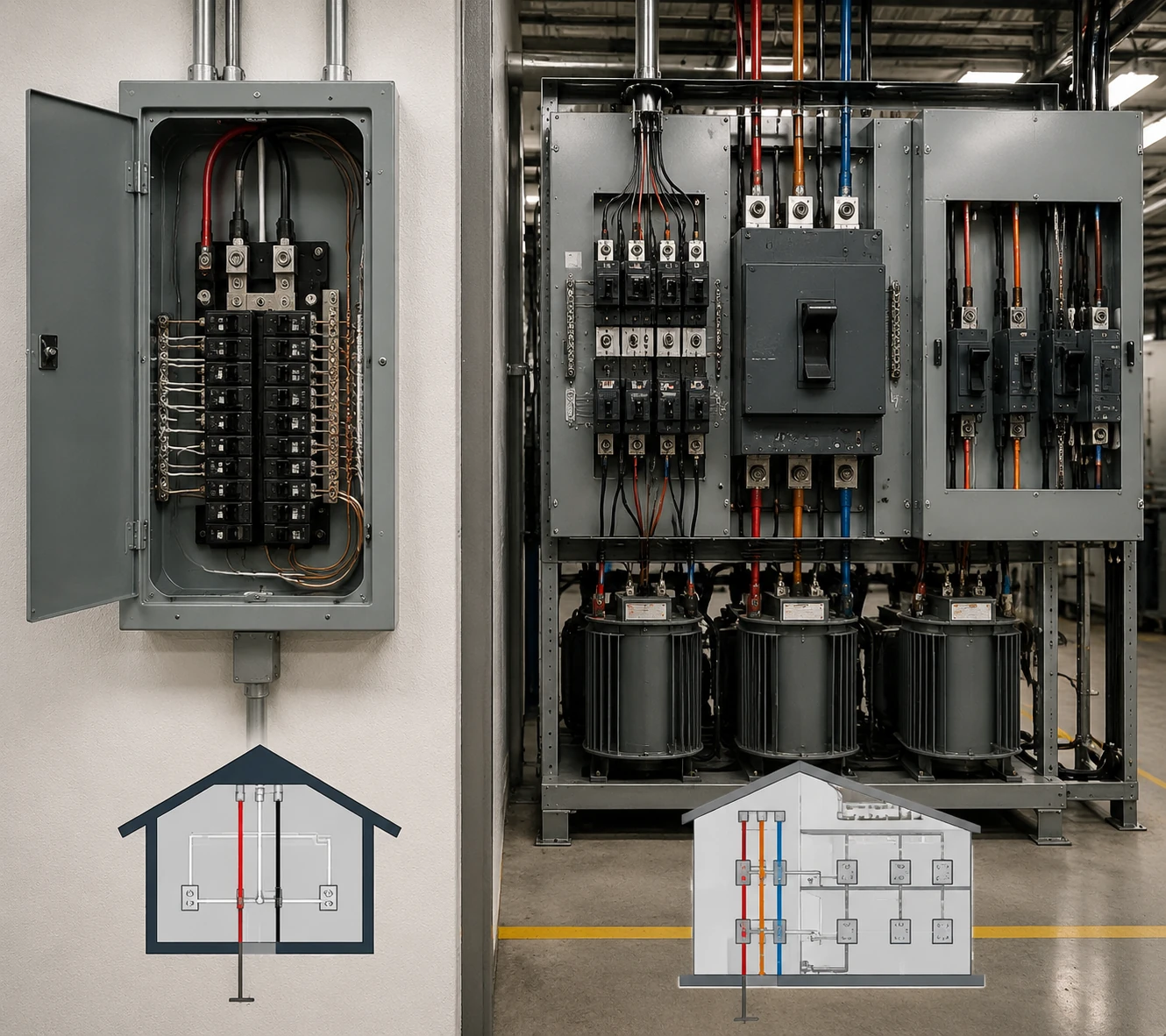
In Ontario, residential electricians work with systems designed for homes—think 120V/240V split-phase power.
This delivers steady, reliable electricity for standard appliances, lighting, and comfort.
By contrast, commercial spaces depend on three-phase electrical systems—running on 208V, 277V, or even 480V—built for higher power demands and larger footprints.
Key System Components: Residential
Most homes use:
- Split-phase (120V/240V) service:
- Two 120V hot wires plus a neutral.
- Allows for both small (lights, outlets) and larger loads (dryers, ovens).
- Panel boards and simple distribution layouts.
- Limited backup or redundancy (typically, just a surge protector or the occasional backup generator).
This setup is fast to install and maintain.
But it can’t support the heavy, continuous loads found in commercial environments.
Three-Phase Power: Commercial Advantages
Picture this: A bustling office building or hospital, lights bright, computers running 24/7—all relying on three-phase power.
Why three-phase?
- Efficient power delivery over greater distances.
- Handles larger equipment and HVAC without overloading.
- Supports complex backup systems—think automatic transfer switches, UPS (Uninterruptible Power Supply), or standby generators for emergencies.
These factors make it possible to power everything from elevators and labs to massive server rooms.
Real-World Impact: Installation and Maintenance
The technical jump means:
- Commercial installation requires specialized skills—planning for redundancy, careful balancing of power loads, and strict code compliance.
- Residential projects are simpler—often completed in a day or two, with straightforward troubleshooting.
“Small errors in commercial setups can lead to costly downtime or safety hazards—making experience and compliance absolutely non-negotiable.”
Recent industry data shows that downtime in a commercial facility can cost $100,000+ per hour. That’s why robust design and constant maintenance are standard.
Memorable Takeaway
Whether you’re powering a single kitchen or an entire hospital, understanding the difference in voltage, design, and system complexity is crucial.
Choose a licensed electrician who truly gets your environment—because electrical systems are not one-size-fits-all.
Wiring Materials, Installation Methods, and Equipment
When it comes to wiring materials, the difference between commercial and residential electricians is clear — and driven by Ontario’s strict electrical safety codes.
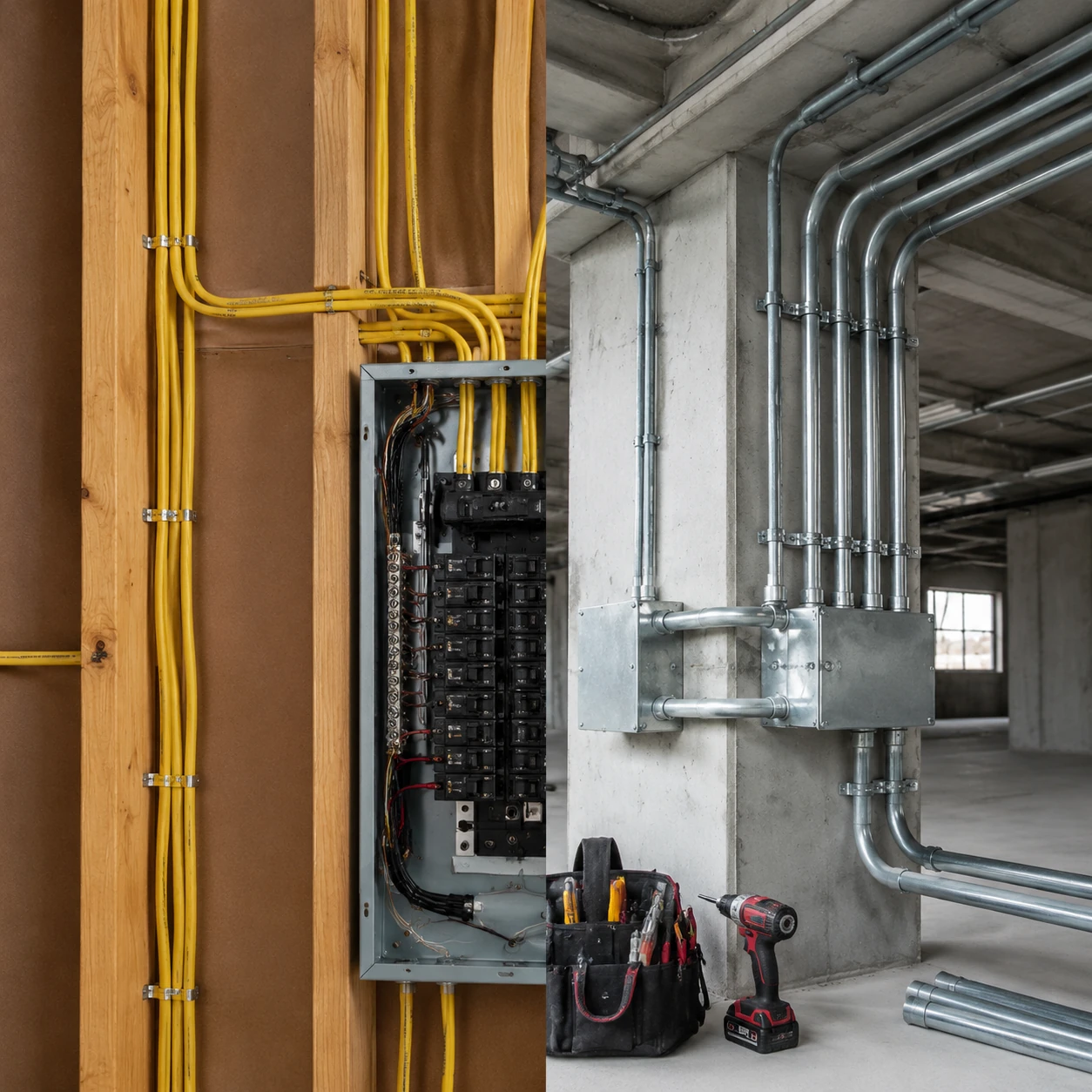
In most homes, NM-B “Romex” cable is standard. It’s lightweight, cost-effective, and flexible, making it easy to pull through wood studs and around typical house layouts.
Comparing Common Wiring Types
You’ll typically see the following materials in each setting:
- Residential electricians: Use NM-B (“Romex”) cable, designed for use behind drywall and in protected areas.
- Commercial electricians: Rely on THHN wires pulled through metal conduit (EMT or IMC) or MC cable, often routed through steel studs, masonry block, or concrete.
The switch to metal protection in commercial spaces isn’t just about following rules — it’s about withstanding wear and tear, protecting against fire, and ensuring code compliance in high-traffic, high-demand settings.
Installation Methods: Picture This
Step onto a residential job site and you’ll see cables quickly stapled alongside wood beams, ready for drywall.
Walk a commercial site, and it’s all about:
- Pulling individual wires through steel conduits,
- Installing heavy-duty junction boxes,
- Navigating tight plenum spaces above drop ceilings.
This rugged approach makes systems more resilient, upgradable, and safe in environments where hundreds or thousands rely on power every day.
Tools and Equipment: Precision Matters
Both electricians rely on the basics — wire strippers, voltage testers, drills — but commercial teams use advanced tools for tasks like:
- Bending and threading conduit,
- Torque-wrench tightening of panel connections,
- Megohmmeter testing for high-voltage safety checks.
“Choosing the right materials and tools isn’t just about cost — it’s about protecting what matters most: people, property, and business continuity.”
Code Compliance and Long-Term Value
Ontario’s Electrical Safety Code mandates sturdy, tamper-proof wiring for commercial projects, with strict penalties for shortcuts.
Every job comes down to:
- Material selection that meets or exceeds code,
- Professional installation that stands up to daily demands,
- A focus on safety and efficiency, not just speed.
Key Takeaway
The materials, methods, and tools used aren’t just technical details — they’re the difference between safe, reliable power and costly, risky mistakes. Quality wiring delivers peace of mind for years to come. Always insist on licensed professionals who prioritize code, safety, and the right materials for the job.
When planning home upgrades or troubleshooting electrical issues, working with experienced residential electricians services ensures your wiring, panel upgrades, and lighting installations meet Ontario safety standards while protecting your family and property.

Documentation, Blueprints, and Project Planning
Getting electrical work right in Ontario starts with precise documentation. Whether it’s a cozy home renovation or a sprawling office build, what’s on paper determines what’s possible on the job site.
Residential: Simplicity and Speed
For residential electricians, documentation focuses on clarity and efficiency.
- Basic floor plans show room layouts and breaker panel locations.
- Wiring diagrams map out how outlets, switches, and lighting connect.
- Clear labels for each receptacle make troubleshooting faster during and after installation.
A single oversight—like missing the placement of a key outlet—can mean drywall demolition and extra costs. That’s why licensed electricians never skip proper labeling or accurate as-builts.
“A 15-minute labeling job can save hours of costly rework in the future.”
Commercial: Complexity on Every Page
Projects in commercial settings come with a whole new level of blueprint detail and precision.
- Panel schedules track circuit loads and capacities for each area.
- Complex one-line diagrams illustrate how high-voltage systems and emergency backups interact.
- Full-system schematics break down lighting controls, fire alarms, data connections, and backup generators.
Picture this: a hospital upgrade where dozens of systems must function independently—and together. One missed detail in the plans could disrupt an ICU, costing thousands and risking lives.
“In commercial builds, the difference between success and chaos is a single line on a schematic.”
Permits, Inspections, and Local Law
Ontario’s permit and inspection process raises the bar for both fields.
- Every project—from a bedroom outlet to a data center—needs an Electrical Safety Authority (ESA) permit if new wiring is involved.
- Inspection milestones: rough-in and final, ensuring compliance throughout.
- Meticulous records mean less risk of delays, rejected permits, or fines.
Any deviation from code or incomplete paperwork can halt a $10 million build or a family’s renovation in its tracks. Compliance is not optional—it’s a brand promise.
Summary
Meticulous documentation isn’t just red tape; it’s the heartbeat of every safe and successful electrical project. Whether you’re building homes or powering critical commercial spaces, accuracy up front is the surest way to avoid rework, delays, and safety risks. Always insist on clear blueprints, updated schematics, and full compliance with Ontario’s regulations—because peace of mind truly starts with the plan.
Safety Standards and Code Compliance
Ontario Electrical Safety Code: The Foundation
Every electrical job in Ontario—no matter the size or location—must comply with the Ontario Electrical Safety Code (OESC).
This code sets out baseline safety standards for all installations, repairs, and upgrades.
Residential and commercial electricians both start from this foundation, but commercial work quickly demands extra layers of rigor.
Picture this: A residential electrician updates your kitchen wiring, following OESC guidelines. A commercial crew rewires an entire hospital wing, layering on advanced protocols.
—
Residential vs. Commercial: What’s Required?
Residential electricians typically:
- Follow the latest OESC updates and local building codes
- Use basic personal protective equipment (PPE) on the job
- Ensure all work is inspected for safety, often the same day
Commercial electricians must:
- Comply with the OESC, plus stricter standards like OSHA 30 training
- Implement Lockout/Tagout (LOTO) systems to safely de-energize equipment before work
- Conduct Arc Flash risk assessments to identify serious injury hazards
- Oversee installation and maintenance of backup/emergency systems for critical operations (think hospitals, data centers)
A missed step on a commercial site could impact hundreds of people, not just a single family.
—
Real-World Risks & the Power of Compliance
Electrical risks escalate with system complexity and site scale.
- At home: A single faulty outlet can cause a fire.
- On a commercial site: An arc flash incident or missed LOTO procedure can mean injuries, lost productivity, or six-figure damages.
Rigorous compliance means:
- Fewer injuries and claims
- Smoother inspections and fewer costly delays
- Peace of mind—for contractors, clients, and occupants alike
“Compliance isn’t just paperwork; it’s peace of mind in every wire and breaker.”
—
Consequences of Cutting Corners
Failing to meet standards can lead to:
- Hefty fines for contractors and property owners
- Insurance claim denials after an incident
- Delays in project completion—sometimes by weeks or months
- Legal liability for accidents, injuries, or code violations
Safety and compliance are non-negotiable, whether you’re rewiring a kitchen or lighting up a new commercial tower.
—
Ready to power your project the right way? Hiring a fully licensed, code-compliant electrician means peace of mind—and is your best assurance against costly, dangerous headaches down the line.
Training, Certifications, and Ongoing Education
Education and Licensing Requirements
Starting a career as an electrician in Ontario means following a clear path: formal education, apprenticeship, licensing, and on-the-job training.
Both residential and commercial electricians must:
- Complete a recognized electrical apprenticeship (typically 9,000 hours/5 years)
- Pass industry exams for licensing (309A for construction and maintenance)
- Work under a licensed journeyperson before striking out on their own
Picture this: an apprentice shadowing a master electrician, hands-on wiring practice, and safety drills until every step is second nature. Safety and code compliance aren’t just rules—they’re habits.
Advanced Training for Commercial Electricians
Commercial roles demand extra layers of training beyond the residential scope.
To work safely and efficiently on larger, more complex projects, commercial electricians often receive instruction in:
- High-voltage systems (208V, 277V, 480V, and beyond)
- Advanced troubleshooting for critical equipment and industrial machinery
- Industrial safety practices, including Arc Flash awareness and Lockout/Tagout (LOTO) protocols
Many commercial jobs, especially in hospitals or manufacturing, require extra safety certifications, like an OSHA 30 or specialized training for backup power systems.
“Mastery of high-voltage safety can be life-saving—commercial electricians must be unflinchingly precise.”
Specialized Certifications and Ongoing Learning
Some commercial and public projects also demand:
- Elevated clearances for government or institutional sites
- Certifications in specialized systems (e.g., fire alarms, emergency generators)
- Up-to-date first aid and fall prevention credentials
“Every year, code updates and new technology keep electricians sharp. Ongoing education isn’t optional—it’s the backbone of safety and quality.”
Commitment to Continuous Improvement
Electrical standards evolve as technology changes—from smart building integration to green energy solutions.
Staying current with the Ontario Electrical Safety Code, industry best practices, and emerging tools separates true professionals from the rest.
The right electrician never stops learning, because the safest hands are always getting steadier.
The difference between a licensed, certified electrician and everyone else isn’t just paperwork—it’s a commitment to excellence, safety, and client trust. For property owners and managers, this means peace of mind and protection you can see in every completed project.
Work Environment, Scheduling, and Client Interaction
Distinct Work Settings: Home Comfort or Corporate Scale
Picture this: residential electricians stepping quietly into living rooms, navigating kids’ toys, and repairing a faulty outlet by the family sofa.
In contrast, commercial electricians don hi-vis vests, working amid the buzz of coordinated crews on expansive job sites like hospitals, office towers, or retail centers.
Here’s how their environments typically differ:
- Residential: Private homes, apartments, condos—one-on-one with homeowners, often in active, furnished spaces.
- Commercial: Large facilities, new construction, multi-level structures—focused teamwork among several trades, sometimes for months.
“Every job site has its own rhythm—residential projects feel personal, while commercial sites run like clockwork.”
Scheduling and Job Flow: On Demand vs. By the Blueprint
Residential electricians manage a patchwork of daily tasks, including:
- Emergency service calls (think midnight power outages)
- Same-day troubleshooting or upgrades
- Unpredictable hours, driven by client needs
Commercial electricians, however, operate on a set schedule:
- Fixed project timelines—often months in advance
- Structured work hours, typically weekdays
- Large crews with divided responsibilities, ensuring projects stay on track
Fast fact: Most commercial electricians work regular daytime hours, while residential electricians may clock in late nights or weekends.
Customer Service: Tailoring the Experience
Service expectations shift with the setting:
- Homeowners value clear explanations, respect for their space, and prompt resolutions.
- Business clients expect detailed updates, strict scheduling, and professional documentation—backed by full compliance with Ontario codes.
Visual scenario: Imagine an electrician patiently walking a homeowner through their new kitchen lighting, versus presenting progress reports to a corporate property manager.
“Electrical work is more than wires—it’s trust, communication, and meeting people where they are.”
Core Brand Values in Action
Regardless of context, only licensed, insured, and code-compliant electricians should be trusted in your space.
Padi Electric’s team delivers:
- Professionalism: From clean uniforms to courteous explanations at every job.
- Clear communication: Timely updates and transparent quotes, whether for a bungalow or a business block.
- Safety-first mindset: Always upholding Ontario’s latest electrical codes and safety protocols.
When hiring an electrician, picture where they’ll be working, how urgently you need the job done, and what type of interaction will help you feel confident. The right fit blends technical skill with an adaptive, customer-first approach—essential whether you’re powering a new office tower or rewiring your forever home.
Industry Trends, Demand, and Compensation
Ontario’s Electrical Boom: Strong Demand in Both Sectors
Across Ontario, demand for skilled electricians is at an all-time high. Construction, renovations, and smart upgrades are surging in both commercial and residential spaces—fueling steady job growth province-wide.
National projections show continued expansion. The need for reliable electrical experts is up 7% in Ontario from last year alone.
Picture this: new commercial towers rising over downtown, solar-ready homes in every neighbourhood, and businesses rushing to future-proof their power systems.
Competitive Wages and What Influences Electrician Pay
Both roles offer attractive pay scales, with compensation reflecting experience, credentials, and specialty skills.
- Commercial electricians: Average $57,879/year
- Residential electricians: Average $54,425/year
Career advancements, such as obtaining specialized certifications or tackling complex projects, can boost these figures even higher. Master electricians working on high-voltage systems or major commercial builds may see six-figure incomes.
Key pay factors:
- Years of experience
- Advanced safety and specialty certifications
- Union affiliation and negotiated rates
- Type of employer and industry sector
“Ontario’s electricians are powering up, both in demand and earning potential.”
Evolving Trends: Electrification, Smarter Systems & Green Incentives
The industry is transforming fast:
- Electrification: More electric vehicles, heat pumps, and battery storage systems require expert installation.
- Smart tech integration: Homeowners and businesses expect automation, energy monitoring, and remote control.
- Sustainable upgrades: Demand for solar arrays, high-efficiency lighting, and LEED credits reshape both fields.
- Retrofits: Upgrading old infrastructure for energy savings is now a huge priority.
“Smart buildings and sustainable power aren’t just trends—they’re today’s standard.”
Career Paths, Advancement, and Future-Proof Skills
Licensed electricians in Ontario enjoy many options:
- Progress from apprentice to journeyperson to master electrician
- Branch into project management, inspection, or teaching
- Launch electrical service businesses or consult on major builds
The best pay—and most job security—goes to those who embrace continuous learning and code compliance.
If you’re entering the trade or hiring for your property, the future is bright. Ontario’s skilled electricians fuel everything from luxury condos to advanced labs—safely and efficiently.
Actionable Tip: Prioritize licensed, experienced professionals who stay ahead of the latest tech and safety codes. That’s the best way to power Ontario, the right way.
Choosing the Right Electrician: What Clients Need to Know
Picture this: you’re planning a new office build, or upgrading your family home—hiring the right electrician is not negotiable.
Each project type demands unique expertise, strict code compliance, and genuine accountability.
Key Checklist: Residential vs Commercial Electricians
Before you pick up the phone, run through this checklist to ensure you’re selecting the right professional for your needs:
- Project Type: Is the work for a private residence or a business or institutional site?
- License & Insurance: Only hire licensed and insured electricians—no exceptions.
- Relevant Experience: Ask for examples of similar completed projects.
- Ontario Code Knowledge: Confirm they follow Ontario Electrical Safety Code requirements.
- References & Reviews: Request recent client reviews or referrals, especially from similar projects.
“Not all electricians are created equal—matching expertise to your project could slash costly rework and safety risks.”
Why Underqualified Electricians Aren’t Worth the Risk
Cutting corners on credentials or experience can lead to:
- Electrical fires caused by improper wiring or overloaded circuits
- Failed inspections, costly project delays, and denied permits
- Unsafe installations that void insurance and create long-term hazards
Licensed, code-compliant electricians protect your property, your people, and your investment. In Ontario, improper electrical work is a leading contributor to house fires—don’t risk it.
Safety, Compliance, and Integrity Matter
Choose a contractor who puts your safety first:
- They’ll be transparent about permits, inspections, and all related costs
- Expect clear communication, consistent updates, and full documentation
- Look for a team certified in advanced safety protocols if your project is commercial or industrial
“In electrical work, quality and safety are non-negotiable—the cheapest quote today could cost you thousands tomorrow.”
Your Next Steps: Make It Easy, Make It Right
If you’re ever unsure or facing a complex job, reach out for expert guidance.
Licensed professionals can walk you through options, explain timelines, and set realistic expectations based on your exact needs and Ontario’s current safety standards.
The right electrician doesn’t just solve your problem—they deliver peace of mind for years to come. Prioritize integrity, compliance, and proven results—your property, safety, and budget depend on it.
Every electrical installation must comply with the Ontario Electrical Safety Code to ensure safety, prevent legal issues, and avoid costly inspection failures.

Conclusion
Choosing the right electrician is more than a box to check—it’s your safeguard for safety, compliance, and lasting value in every wire and panel.
Whether your project is a home upgrade or a large-scale commercial build, matching expertise to your unique needs ensures that your property, your people, and your investment are protected by true professionals.
—
Put these actionable strategies into practice:
- Insist on licensing and insurance. Only hire electricians fully certified in Ontario—never settle for less.
- Ask for project-specific experience. Request examples that match your property type or sector.
- Verify code compliance. Choose professionals who educate you on codes, permits, and comprehensive documentation.
- Prioritize clear communication. Expect transparent quotes, timelines, and progress updates every step of the way.
- Check references. Strong reviews and recent client referrals signal accountability and integrity.
—
Ready to take the next step?
- Assess your project: Define whether your needs are residential or commercial—this determines the right skill set.
- Compile your questions: Prepare to ask about credentials, experience, safety protocols, and compliance processes.
- Reach out to trusted professionals: Contact electricians who can speak confidently about your site, code requirements, and deliverables.
—
Electrical work is more than a service—it’s a promise to power your space safely and efficiently for years to come.
Trust in expertise, demand transparency, and invest in quality. When you power Ontario the right way, you invest in safety, peace of mind, and a job done right the first time.
Your next project deserves it.
Understanding the difference between residential and commercial electrical work is essential when planning upgrades, renovations, or large-scale installations. If you want a deeper understanding of commercial electrical systems, safety requirements, wiring methods, and how businesses manage high-capacity power demands, explore our complete guide on [What Does Commercial Electrical Mean? Complete Guide 2026]. This pillar resource breaks down everything property owners and managers need to know about commercial electrical services, compliance, and long-term safety planning.
FAQs
What is the difference between residential electricians and commercial electricians?
Residential electricians work primarily in homes, condos, and apartments, while commercial electricians specialize in office buildings, retail spaces, hospitals, and industrial facilities with more complex electrical systems.
Are residential electricians licensed in Ontario?
Yes. Residential electricians in Ontario must be licensed, insured, and compliant with the Ontario Electrical Safety Code to legally perform electrical work.
Can residential electricians work on commercial buildings?
Generally, commercial projects require electricians with specialized training in three-phase systems, conduit installations, and commercial safety procedures, although some licensed electricians may have experience in both sectors.
What wiring do residential electricians use?
Residential electricians commonly use NM-B cable, also known as Romex, which is suitable for home electrical systems and protected indoor environments.
Why are commercial electrical systems more complex?
Commercial buildings require higher voltage systems, larger power loads, backup generators, emergency systems, and extensive documentation to meet safety and operational demands.
How do I verify an electrician’s license in Ontario?
You can verify credentials through the Electrical Safety Authority (ESA) website to ensure the electrician is licensed and compliant.
Are commercial electricians paid more than residential electricians?
Commercial electricians often earn slightly higher salaries due to the complexity of the work, additional certifications, and larger-scale projects.