

Key Takeaways
Unlocking energy efficiency solutions for commercial buildings isn’t just about cost reduction—it’s the new standard for compliance, safety, and competitive advantage in Ontario’s commercial properties. These actionable insights highlight the smartest strategies, technologies, and compliance essentials you need now to boost savings, performance, and tenant satisfaction.
- Prioritize energy audits to uncover hidden inefficiencies and identify projects with rapid payback—Ontario properties often reduce utility bills by up to 40% following targeted upgrades.
- Upgrade to LED lighting with smart controls for up to 80% lighting cost savings, safer operations, and fast compliance with 2025 codes.
- Optimize HVAC systems using heat pumps, VRF, and programmable controls to boost energy efficiency by 300% and cut maintenance bills in half.
- Seal your building envelope with modern insulation, windows, and air sealing to lower heating and cooling loads by 15–35%—improving comfort, air quality, and ROI.
- Implement Building Automation and IoT solutions for real-time control and 5–25% building-wide energy savings, plus streamlined compliance and maintenance.
- Integrate renewable energy such as solar or geothermal for up to 75% lower energy bills and leverage Ontario’s incentives to accelerate ROI and emissions cuts.
- Engage your facility team and tenants with training and preventive maintenance, locking in efficiency gains, compliance, and occupant satisfaction.
- Measure your impact by tracking energy, cost, and CO₂ reductions—successful retrofits see payback in 2–7 years alongside substantial increases in property value and ESG performance.
Explore the full article for real-world case studies, Ontario-specific incentives, and a clear, step-by-step path to energy-efficient, compliant, and future-proof commercial buildings.
Introduction
What if you could cut your commercial building’s energy bills by a third—while making your property safer, more comfortable, and easier to lease?
That isn’t just a target. It’s the new expectation for Ontario property owners and managers as energy costs, tenant demands, and compliance standards all tighten at once.
Utility and energy expenses now make up 20–40% of an average building’s operating costs—and with Ontario’s energy rates climbing 7% annually since 2019, every wasted kilowatt is money and competitive edge lost.
If you’re facing pressure to meet new efficiency codes, keep tenants satisfied, or protect asset value, energy upgrades offer a proven way forward. Owners across Ontario are already seeing rapid payback from practical solutions like:
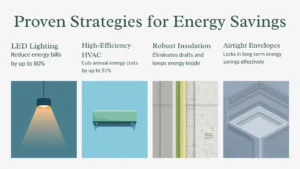
- LED lighting systems and smart controls that shrink lighting bills by up to 80%
- High-efficiency HVAC for up to 51% of a building’s annual energy costs—plus improved comfort all year
- Robust insulation and airtight envelopes that turn every draft-free room into a source of long-term savings
And that’s just the start. Forward-thinking managers are adopting smart automation, data-driven monitoring, and even on-site renewable energy to control costs, ensure code compliance, and deliver the sustainable spaces that tenants demand.
You’ll see exactly where the biggest opportunities (and quickest wins) are—from lighting retrofits to HVAC overhauls, insulation upgrades to building automation. We’ll break down not just how these strategies work, but why the timing for Ontario businesses couldn’t be more urgent—or more rewarding.
As expectations shift and requirements rise, choosing the right energy solutions is about much more than saving money—it’s about resilience, attracting clients, and powering your property the right way.
Ready to discover the business case behind smart energy efficiency? Let’s look at where real savings, compliance, and market advantage start for Ontario commercial buildings.
The Business Case for Energy Efficiency in Commercial Buildings
Energy efficiency is no longer just a good idea—it’s a business must in Ontario. Utilities and energy costs now make up 20-40% of a commercial building’s operating budget, directly impacting your bottom line and long-term asset value.
Smart property managers and building owners are under increasing pressure to hit sustainability targets and demonstrate environmental responsibility. In 2025, new codes require higher efficiency and stricter reporting, meaning compliance is no longer optional—non-compliance can lead to fines, lost incentives, and harder to attract tenants.
Direct Impact: Budgets, Regulations, and Reputation
Rising energy costs, evolving regulations, and growing demand for green workspaces put energy efficiency in the spotlight. Consider these drivers:
- Ontario’s energy rates have increased by 7% yearly on average since 2019
- Clients and tenants prefer properties with lower carbon footprints—81% of Canadian businesses see green buildings as a market differentiator
- Aligning with updated electrical safety standards directly links risk management with energy-saving projects
Key Efficiency Strategies Pay Off Fast
Picture this: A Toronto office tower completes an LED and HVAC upgrade. Within two years:
- Energy costs drop by 35%
- Maintenance bills are cut in half
- Payback period lands between 2–5 years, according to Canadian retrofit averages
Essential solutions include:
- LED lighting and smart controls (up to 80% lighting savings)
- High-efficiency HVAC upgrades (potential 300% improvement in heating/cooling performance)
- Improved building envelope insulation and air sealing (10-25% building-wide energy cuts)
Comfort, Value, and Safety Go Hand-in-Hand
Efficient buildings don’t just save money—they boost occupant comfort, productivity, and health, thanks to better air quality and consistent temperatures.
Upgrades also mean:
- Fewer emergency repairs
- Smoother compliance inspections
- Stronger long-term property value
Real Talk: Dollars, Compliance, and Modern Expectations
“Energy efficiency pays you back—in lower costs, safer operations, and stronger market appeal,” is a message more Ontario owners are sharing.
Imagine walking into a workspace powered by smart systems: lower bills, proud tenants, and effortless safety compliance.
Optimizing your building now protects your budget, reputation, and peace of mind—making energy efficiency the smartest investment a commercial property can make in 2025.
Lighting Upgrades: Moving Beyond Traditional Fixtures
LED Lighting Solutions
Switching to LED lighting is one of the simplest moves for Ontario businesses aiming for lower operating costs and sustainability.
LEDs are up to 80% more energy-efficient than traditional fluorescents or incandescents, cutting power bills and reducing maintenance needs.
Picture this: A newly retrofitted office replaces outdated panels with high-efficiency LED troffers and panels—bright, even light with zero flicker, and a lifespan that lasts decades, not just years.
Available LED options include:
- Troffers for drop ceilings and open offices
- High bays for warehouses or gyms
- Sleek linear panels and color-tunable fixtures for retail and hospitality spaces
Controllable color temperatures (from crisp cool white to warm inviting glow) keep workspaces comfortable and professional.
“Every kilowatt saved is a dollar earned—LEDs make that happen every single hour your building is open.”
Smart Controls and Sensor Integration
Elevate efficiency further with smart controls and sensors that only use energy when needed.
Modern systems can include:
- Occupancy sensors: automatically switch off lights in empty meeting rooms, yielding 24-50% energy savings on lighting
- Daylight harvesting: sensors dim fixtures when enough sunlight enters, blending comfort with efficiency
- Networked controls: enable remote scheduling, zonal dimming, and real-time insights for property managers
- Intuitive mobile dashboards for on-the-go access—no more guessing what’s left on after hours
A real-world Toronto college campus upgrade swapped outdated stairwell lights for LED fixtures with motion sensors. Result: safer pathways, less waste, and annual savings tallied in the thousands.
“Smart lighting is silent—and powerful—it cuts wasted energy with every empty corridor and empty office.”
Scannable Takeaways
- LED retrofits can reduce total lighting costs by up to 80%
- Combining occupancy sensors and networked controls unlocks another 24-50% savings
- Options fit any workspace, with fixture styles and color temperatures tailored for productivity
Upgrading to smart LEDs isn’t just about brighter lights—it’s a fast, measurable way to lower bills, boost safety, and keep your space looking sharp. This is how Ontario businesses light the path to efficient, modern, and compliant buildings.
HVAC Optimization: Cutting Costs and Improving Comfort
High-Efficiency HVAC Technologies
HVAC systems account for up to 51% of a commercial building’s total energy use. That means your heating and cooling decisions drive both operating expenses and occupant comfort every single day.
Switching to energy-efficient HVAC options delivers immediate and lasting results:
- Heat pumps and variable refrigerant flow (VRF) systems deliver up to 300% greater efficiency—moving more heat with less energy consumed.
- Energy recovery ventilation (ERV) systems reclaim up to 80% of outgoing energy from exhaust air, pre-conditioning incoming fresh air for extra savings.
- Chilled beams and modern heat recovery units reduce both noise and energy waste, helping you meet Ontario’s latest climate goals.
Variable speed drives optimize fans and pumps so equipment uses just the right amount of power, avoiding waste and noisy surges.
“Replacing an aging system with smart, efficient HVAC isn’t just a technical upgrade—it’s a direct path to lower bills and happier employees.”
Advanced Control Strategies
Today’s most effective buildings don’t just upgrade—they get smart about control. Here’s how:
- Zoning and programmable thermostats make it possible to heat or cool only the spaces in use, reducing energy use by 10-30% right off the top.
- Smart HVAC controls let you schedule, fine-tune, and automate system performance room by room, based on real-time occupancy or weather changes.
- Predictive maintenance via IoT sensors spots small issues before they turn into costly repairs or breakdowns.
A Building Automation System (BAS) connects all of this: monitoring, learning, and constantly optimizing your indoor climate.
Picture this: An Ontario office upgrades to BAS and sees utility costs drop, rooms feel more comfortable, and downtime practically disappears.
Real-World Impact and Inspiration
The Empire State Building’s HVAC retrofit is a Canadian business owner’s playbook. By combining high-efficiency heat pumps with BAS, they achieved energy savings of $741,000 USD every year, proving the value of strategic retrofits.
- Ontario property managers can apply these same methods for quick payback and easy wins.
- Even small upgrades, like sensor-controlled zoning, can start saving this quarter.
“A well-optimized HVAC system is one of the only investments that pays you back with every season.”
Prioritizing efficient HVAC isn’t just about comfort—it’s how Ontario businesses reduce risk, unlock savings, and outperform new compliance standards in 2025.
Strengthening the Building Envelope for Year-Round Efficiency
Insulation, Windows, and Air Sealing
Ask any building operator where real energy savings begin, and they’ll tell you: strong insulation and airtight windows aren’t optional—they’re foundational.
Modern commercial retrofits in Ontario now favor:
- Spray foam insulation for irregular spaces and rapid install
- Rigid board insulation for walls, roofs, and below-grade applications
- Low-E (low-emissivity) window glass to slash both heat loss in winter and heat gain in summer
- Weatherstripping and continuous air barriers to seal up drafts and unwanted leaks
A picture worth a thousand dollars: well-sealed, well-insulated buildings can see heating and cooling loads drop by 15-35%—sometimes more.
That means better indoor air quality and faster ROI. Many commercial owners in Ontario report full payback in 3–6 years just from insulation and window upgrades.
“Every draft you stop today is money you keep tomorrow.”
“Ontario’s toughest winters and muggiest summers have met their match.”
Passive Design and Natural Solutions
Why rely on machines when you can let the building work for you?
Modern energy strategies pair airtight envelopes with passive design elements that harness nature:
- Natural ventilation: Manual or automated operable windows, helping you catch a breeze instead of cranking the HVAC
- Solar orientation: South-facing glass for daylight, overhangs for shade—precision you can feel and see
- Daylighting techniques: Skylights, light shelves, and open-plan layouts to reduce reliance on electric lighting
These methods not only support Ontario’s energy code requirements but also create brighter, healthier spaces.
Picture this: a tenant walks in on a sunny winter day, greeted by warm sunlight—not a draft. That’s comfort, efficiency, and lease value, all in one upgrade.
“A well-designed building saves energy for decades, not just one season.”
Key Takeaways
Investing in insulation, window upgrades, and air sealing can cut a building’s energy use for heating and cooling by up to a third.
Pair these basics with passive design strategies to build future-ready properties that perform year-round.
These moves don’t just reduce bills—they make Ontario’s commercial spaces safer, healthier, and truly sustainable.
Smart Building Technologies and Automation
BAS and IoT: Real-Time Control for Ontario Businesses
Building Automation Systems (BAS) and Internet of Things (IoT) devices let you control and monitor every major system in your property—lighting, HVAC, plug loads—in real time.
Picture this: an office manager checks energy usage from a mobile dashboard, fine-tuning temperature and lighting zone by zone, right from their phone.
BAS and IoT integration can lead to:
- 5-25% building-wide energy savings just from centralized controls
- 30-50% reductions in highly integrated smart buildings
- Reduced downtime, thanks to remote troubleshooting and automated alerts
- Constant system health checks and alerts for needed maintenance
“One of the fastest ways to lower your building’s bills is to let data do the work—automate the small decisions, and you bank big savings.”
Analytics and Smarter Adjustments: The Power of AI
Data analytics and machine learning let BAS predict and adjust for the best efficiency.
Imagine AI noticing a drop in outside temperatures and automatically scaling back HVAC loads before staff arrive.
AI-driven energy management uncovers patterns that manual oversight can miss, like finding:
- HVAC working after hours
- Lights left on in rarely used areas
- Plug loads spiking on weekends
With AI, “your building gets smarter every season—anticipating needs before you even notice.”
Unified Energy Management Platforms: Streamlined Success
Unify your energy strategy with a single platform for all systems.
With one dashboard, Ontario property owners can:
- Coordinate lighting, HVAC, plug loads, and shading devices
- Zone and schedule power use hour by hour
- Quickly access data for utility incentive programs and meet compliance targets
Both small and large buildings now have scalable solutions, from simple scheduling to whole-building smart retrofits.
Real Ontario examples show smart automation producing:
- 20-43% savings on lighting and plug loads
- 10-25% energy reduction building-wide
- Payback in as little as 2-3 years from lower bills and maintenance costs
Adopting BAS and smart solutions now prepares buildings for future trends, safeguard compliance, and delivers savings that show up on your bottom line—letting your business “power Ontario, the right way.”
Renewable Energy Integration for Commercial Properties
Solar, Geothermal, and Wind Solutions
Commercial buildings in Ontario are unlocking powerful savings and sustainability with renewable energy systems—and 2025 is the tipping point for wider adoption.
Switching to solar panels slashes energy bills by up to 75%, with a typical payback window of 5-10 years for most business properties.
- Ontario’s commercial solar incentives make upgrades more accessible—covering up to 40% of project costs in some regions.
- For example, a mid-sized warehouse replacing 30% of its electricity with rooftop solar can see $20,000+ saved per year.
Geothermal heat pumps are game changers in energy use and emissions.
- Geothermal retrofits can trim heating/cooling costs by 26-70% and cut emissions up to 78%.
- These ground-source systems are ideal for larger sites and multi-unit complexes with year-round occupancy.
- “Picture this: An Ontario school’s geothermal upgrade wiped $60,000 off annual utility bills—right from year one.”
Wind energy remains a smart, niche solution for properties with suitable land and wind resources, primarily seen in rural or industrial parks.
Pathways to Net-Zero and Offsetting Utility Costs
The push toward net-zero buildings is reshaping Ontario’s commercial market—and the path is clearer than ever.
Combining envelope upgrades, smart HVAC, and on-site generation can deliver up to 90% energy use reduction.
- Pair renewables with battery storage for protection against utility outages and to benefit from demand-response incentives.
- “A retail plaza with on-site solar and air sealing upgrades cut peak grid dependence by half, drawing new tenants who value green credentials.”
Commercial properties are leveraging renewables to attract tenants, secure green branding, and future-proof their assets as codes tighten.
Making Renewable Energy Work for Your Building
Three steps help ensure a return on clean energy investments for Ontario’s property managers:
- Assess your site for solar, geothermal, or wind fit—use a licensed energy advisor.
- Calculate the combined ROI for envelope, system, and renewable upgrades.
- Apply for Ontario incentives early and document savings for compliance and marketing.
Commercial properties that integrate renewables outperform peers on savings and reputation. In today’s competitive market, the ability to show real progress toward net-zero—and cut utility costs—is the only way to power your business the right way.
Implementing Energy Efficiency: Audit to Action
Step-by-Step Approach
Starting with an energy audit puts you in control of your building’s future costs.
Qualified auditors use thermal cameras, monitoring equipment, and site walkthroughs to expose where power is being wasted, from outdated HVAC to inefficient lighting.
Every comprehensive audit should include:
- Review of energy bills
- Inspection of mechanical and electrical systems
- On-site measurement and direct feedback
- Prioritized report highlighting savings potential and compliance gaps
Picture this: An Ontario property manager discovers, after an audit, that an HVAC upgrade and lighting retrofit could shave up to 40% off annual utility bills—translating to thousands saved by next spring.
Prioritizing Upgrades and Ensuring Compliance
The smartest upgrades are chosen based on clear ROI projections, available Ontario rebates, and alignment with current electrical codes.
For actionable results:
- Focus on upgrades with paybacks under five years—like LEDs or smart controls
- Match improvements to ENERGYSTAR® standards and Ontario’s electrical safety requirements
- Plan all work so that electrical compliance isn’t an afterthought but a core part of the process
“Your next retrofit can cut energy use by half while boosting compliance and tenant satisfaction,” is a reality for many Ontario offices using these steps.
Staff Engagement and Preventive Maintenance
No solution lasts without buy-in. Training staff to spot waste and follow best practices locks in savings for the long haul.
Essential elements include:
- Clear signage and quick-tip guides for lighting/HVAC controls
- Facility team workshops on efficient scheduling and daily walkthroughs
- A preventive maintenance schedule for all major systems—think monthly filter changes, sensor checks, and periodic system re-commissioning
Continuous improvement is crucial. Use real-time monitoring dashboards to track progress, verify results, and adapt as your building evolves.
The Key Takeaway
A strategic audit, careful planning, and daily team involvement turn energy efficiency from a wishlist into an everyday reality. Prioritize projects with rapid payback, stay code-compliant, and empower your people—your bottom line and building performance will follow.
Measuring Impact: ROI, Savings, and Sustainability Success
Assessing Energy Efficiency Investments
Picture this: You’ve just retrofitted your commercial building with new LED lights, upgraded HVAC, and smart controls.
Now comes the question—how much are you really saving?
The most effective way to measure the impact is by looking at:
- Energy savings—track monthly utility bills before and after upgrades.
- Payback period—most commercial LED, HVAC, or solar projects in Ontario see returns in 2-7 years, with some solar retrofits recouping 75% of energy costs in a decade.
- Total cost of ownership—factor in reduced maintenance, repairs, and system longevity to see the full financial picture.
For retail or office buildings, these solutions can slash lighting and plug load energy by 20-43%, and building-wide consumption by 10-25%—real numbers your accountant and stakeholders will care about.
“Smart upgrades aren’t just about savings—they’re about future-proofing your investment.”
Environmental Impact and ESG Tracking
Today, every sustainability plan needs numbers.
- CO₂ emissions tracking—energy upgrades can cut annual emissions by up to 90% for net-zero conversions.
- ESG goals—reporting reductions in consumption and carbon supports certifications (like LEED) and increases tenant, investor, and customer appeal.
Imagine sharing your success: “This retrofit cuts our footprint by 78%—and we’re not stopping here.” That’s a headline for your ESG report, website, or lobby screen.
Navigating Incentives and Compliance
Ontario businesses can leverage:
- Local and federal rebates, energy grants, and incentive programs—these can cover 10-50% of initial project costs in 2025.
- Energy Star and electrical safety code compliance—guarantee that every upgrade follows strict safety and performance benchmarks.
- Complete documentation—prepare for inspections with digital records, before/after data, and maintenance logs to ensure continuous compliance.
Miss this, and you risk delays, missed savings, or even failed approvals—compliance is always part of the ROI equation.
Expect simple, direct instructions from local utilities or licensed electricians—no jargon, just actionable steps.
When you measure impact with the right data and incentives, energy efficiency upgrades become more than an expense—they become a strategy for profit, safety, and sustainability. Every Ontario business can—and should—quantify these returns.
Future Outlook: Trends and Innovations in Commercial Energy Efficiency
AI-Driven Building Automation: What’s Next
Picture this: A commercial building “learns” occupant patterns, weather shifts, and equipment trends, adjusting systems in real time.
AI and predictive analytics are now at the heart of the most advanced energy management. By 2025, up to 50% of smart buildings will use AI-powered controls to optimize lighting, HVAC, and plug loads around the clock.
Key innovations every Ontario facility manager should watch:
- Adaptive controls that sense and self-adjust for changes in occupancy, daylight, and temperature.
- Predictive maintenance systems that spot issues before equipment fails—preventing breakdowns and unplanned costs.
- Grid-responsive technology that syncs major systems with utility demand, earning savings and rebates during peak hours.
Each of these advances makes commercial properties safer, more cost-efficient, and resilient to unexpected events.
Preparing for Changing Codes and Expectations
Energy codes will keep pushing upward—Ontario’s standards are tightening, and carbon reduction targets aren’t slowing down.
Smart automation takes the guesswork out of compliance. Systems track performance, generate compliance reports, and flag inefficiencies for you.
Recent trends include:
- Building owners setting ESG goals that require transparent energy tracking and reporting.
- Local utilities offering demand response incentives—think $100,000+ annually for large facilities that dynamically reduce load during high-demand events.
Staying ahead of new regulations often means meeting safety and efficiency standards before they become mandatory.
Innovation as a Competitive Edge
Innovation in energy management is more than future-proofing. It’s about keeping spaces comfortable, tenants happy, and bottom lines healthy.
Ontario businesses leveraging cutting-edge energy tech see:
- 30–50% total energy savings in integrated smart retrofits.
- Faster payback periods—sometimes less than three years, even for multi-tenant buildings.
- Improved indoor comfort and safety, boosting tenant retention and property value.
“Smart building controls are the safety net for tomorrow’s electrical standards and the driver of today’s biggest operational wins.”
A building equipped for the future isn’t just efficient—it stands out, retains value, and positions your business as a community leader in sustainability.
Staying proactive with AI-driven, grid-responsive systems is now the gold standard for Ontario commercial properties aiming for lasting compliance, peak efficiency, and a notable market advantage.
FAQ
1. What are the most effective energy efficiency solutions for commercial buildings?
Effective solutions include LED lighting retrofits, high-efficiency HVAC upgrades, insulation and air sealing, smart building automation, and renewable energy integration. Each element reduces costs, improves comfort, and ensures compliance with Ontario’s evolving codes.
2. How much can commercial buildings save with energy efficiency solutions for commercial buildings?
Ontario properties can cut utility bills by up to 40% with targeted energy efficiency solutions for commercial buildings, including LED lighting, programmable HVAC systems, and IoT-based automation. Payback is typically 2–7 years depending on the scale of upgrades.
3. Why are energy efficiency solutions for commercial buildings important for tenant satisfaction?
Efficient buildings improve indoor air quality, maintain consistent temperatures, and reduce utility costs—key factors in tenant satisfaction. Incorporating energy efficiency solutions for commercial buildings demonstrates environmental responsibility and enhances the overall tenant experience.
4. Can renewable energy be integrated into energy efficiency solutions for commercial buildings?
Yes. Solar, geothermal, and other renewable energy sources can complement energy efficiency solutions for commercial buildings, lowering energy bills by up to 75% and accelerating ROI while reducing the building’s carbon footprint.
5. How do smart controls contribute to energy efficiency solutions for commercial buildings?
Smart lighting and HVAC controls adjust energy use based on occupancy and daylight, providing significant energy savings. They are integral to modern energy efficiency solutions for commercial buildings, allowing real-time monitoring, predictive maintenance, and enhanced operational efficiency.
Conclusion
Driving energy efficiency isn’t just an upgrade—it’s a strategic move that protects your bottom line, enhances comfort, and positions your building as a leader in Ontario’s evolving market.
You have the opportunity to unlock real savings, meet compliance confidently, and create spaces that tenants and stakeholders truly value.

Written by Roozbeh Nahreini
Roozbeh Nahreini is the founder and owner of Padi Electric Inc., an ESA-certified electrical contractor serving Aurora and the Greater Toronto Area. With 10+ years of hands-on electrical expertise and a team combining 50+ years of field experience, Roozbeh specializes in residential and commercial electrical solutions—from panel upgrades and EV charger installation to smart home integration and advanced diagnostics. His commitment to transparent pricing, code-compliant workmanship, and 24/7 emergency response has established Padi Electric as a trusted neighborhood contractor across Aurora, Richmond Hill, Newmarket, Vaughan, and the GTA.