
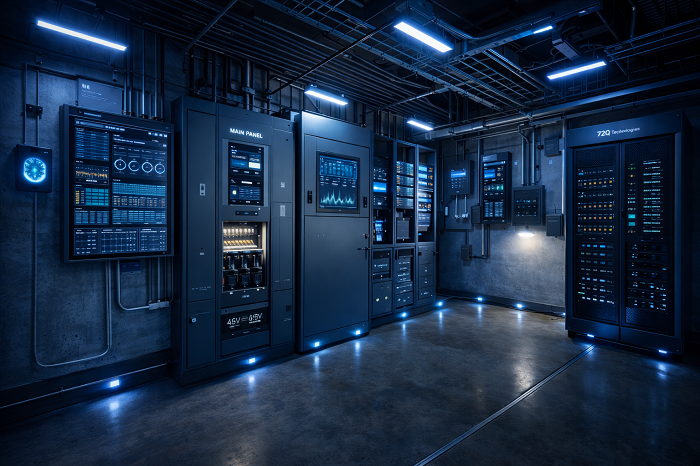
Emerging technologies in commercial electrical systems are transforming how Ontario businesses manage power, safety, and compliance heading into 2026.
- Smart energy management and IoT integration are essential—real-time sensors and EMS/BMS platforms slash downtime by over 40% and cut energy waste by up to 30%, delivering both safety and significant cost savings.
- 48V power architectures and ORV3 standards now dominate high-demand spaces like AI data centers, enabling higher rack loads (100 kW+), lower cooling costs, and streamlined compliance with Ontario’s evolving safety codes.
- AI-driven load management and battery storage systems can shave 20-30% off utility bills, providing grid independence, peak shaving, and seamless power during outages—crucial for competitive, resilient operations.
- Wireless power transfer and dynamic lighting reduce installation times by up to 30% and minimize trip hazards, while adaptive lighting enhances both safety and workplace productivity in offices and retail environments.
- Digital twins and advanced automation empower teams to optimize performance and prove compliance by simulating upgrades, detecting anomalies instantly, and automating regulatory reporting—turning what-if scenarios into no-surprise results.
- Building Information Modeling (BIM) and prefabrication deliver faster, more precise installations, minimizing on-site errors and saving up to 25% in labor time, all while referencing Ontario’s latest safety codes at every step.
- Continuous skills development and tech partnerships are now non-negotiable: over 70% of upgrades require advanced integration knowledge, with annual code updates and proof of training now expected for licenses and inspections.
Ready to power your next project the right way? Dive into the full article for a deeper look at Ontario’s safest, smartest, and most efficient commercial electrical systems for 2026 and beyond.
Introduction
Imagine stepping into an Ontario data center, where just one row of servers can pull more than 100 kW—enough power to light an entire street—yet every watt is tracked, cooled, and safeguarded in real time.
Commercial spaces aren’t just using more electricity; they’re demanding smarter, safer, and ultra-efficient systems as everything from AI workloads to dynamic lighting reshapes what’s possible—and what’s legally required.
But here’s the catch: Ontario’s new building codes, evolving sustainability targets, and next-gen tech all set a higher bar for business owners, property managers, and contractors. Falling short doesn’t just mean bigger bills—it opens the door to delays, risks, and non-compliance.
So, what does it take to future-proof your power and stay ahead in 2026? You’ll need to master a landscape where:
- Rapid electrification drives new loads in machinery, EVs, and HVAC
- Data-intensive industries make grid resilience and real-time monitoring non-negotiable
- Automation, smart sensors, and battery storage shift how systems are built and maintained
- Evolving compliance rules demand expertise, documentation, and certified skill sets
- New safety technology and wireless power redefine both design and day-to-day operation
Whether you’re tackling a retrofit, managing a portfolio, or planning Canada’s next showpiece data hub, you’ll find actionable insights here—
—From the rise of connected sensors and predictive maintenance, to integrating AI-driven microgrids, to the growing importance of software skills alongside breaker panels.
Staying competitive now means thinking beyond wires and switches.
Here’s how Ontario’s leading businesses, builders, and contractors are adapting to this new reality—and where the smartest investments are powering safety, compliance, and sustainable growth.

The New Landscape of Commercial Electrical Systems
Commercial Power is Getting Smarter—Fast
Ontario businesses are racing to upgrade their electrical systems as the demands of 2026 outgrow outdated infrastructure.
Three big shifts are driving this transformation:
- Rapid electrification of everything from machinery to heating
- Data-heavy AI centers requiring high-capacity, resilient grids
- Heightened sustainability goals and evolving safety rules
Think of an AI data hub in Toronto: racks exceeding 100 kW of load, cooled with energy-efficient 48V architectures, all monitored by smart sensors.
Why Codes and Compliance Matter More Than Ever
Evolving electrical codes in Ontario act as the blueprint for every safe, efficient project.
With regular updates, these codes:
- Mandate advanced energy management systems for modern buildings
- Require built-in safety features for grid-tied and decentralized power
- Set clear rules for integration with renewables, battery storage, and automation
A missed requirement can mean delays, cost overruns, or even unsafe conditions.
Who’s Most Affected? The New Hotspots
The explosion in smart tech adoption touches nearly every building type, but some are moving fastest:
- High-rise offices needing IoT-driven energy tracking and fault alerts
- Retail complexes with dynamic lighting and EV charging stations
- Industrial facilities upgrading to intelligent power distribution
- New AI data centers with megawatt-scale loads
- Mixed-use hubs blending residential, retail, and workspace in one
Across Ontario, the rush toward flexible, future-proofed electrical layouts is real—especially where uptime and efficiency mean profit or safety.
Specialized Knowledge Is Now Critical
Picture this: A technician steps into an illuminated, sensor-packed electrical room—a laptop shows live voltage, predictive fault warnings, and energy use trends.
Today’s contractor must bring:
- Deep code knowledge and certification
- Skill with software and automation systems
- Confidence in integrating legacy hardware with the latest IoT, renewables, or storage
“The difference between compliance and excellence isn’t luck—it’s preparation with the right expertise.”
What’s next? The era of soft skills plus software skills—the winning formula for Ontario’s safest, most resilient commercial spaces.
The big takeaway: In 2026, commercial electrical systems are complex, data-driven, and fast-evolving—success means adapting quickly, following Ontario’s codes, and staying ahead of changing demands.
Smart Energy Management and IoT Integration
IoT Sensors & Real-Time Monitoring
IoT sensors are now the nerve center of modern commercial electrical systems.
They track power use, building occupancy, and environmental factors—from temperature to humidity—24/7.
With this real-time data, property managers get:
- Instant alerts when faults, unusual consumption patterns, or equipment failures are detected
- Remote access via dashboards or mobile apps, no matter your location
- Predictive maintenance cues, spotting issues before they cause downtime or expensive repairs
Picture this: a downtown office tower where HVAC and lighting issues are flagged in real time—before tenants ever notice.
Downtime can be reduced by over 40% and repair costs drop thanks to early intervention.
A shareable insight: “Smart sensors can spot invisible threats in your building, keeping tenants safe and costs low.”
EMS & BMS: Seamless Building Integration
Energy Management Systems (EMS) and Building Management Systems (BMS) now link everything—lighting, HVAC, security, and main electrical panels.
Benefits for Ontario properties include:
- Unified control, all from one app or screen
- Fast energy waste detection, cutting utility bills by up to 30%
- Instant status checks for life safety and compliance needs
Ontario’s safety standards require up-to-date documentation and testable control systems; compliant EMS/BMS platforms make inspections and regulatory reporting easier.
Share this: “Seamless integration means safer, smarter commercial buildings—saving energy while protecting everyone inside.”
Dynamic Lighting & Wireless Distribution
Dynamic lighting systems react instantly to occupancy and daylight, optimizing brightness and color for each space—boosting employee focus and mood.
Key advances and benefits:
- Wireless power distribution trims cabling mess, lowering trip hazards and cutting install times by 20% or more
- Adaptive lighting cuts energy waste, often saving buildings 10-25% on electricity
- System flexibility simplifies workspace reconfiguration, ideal for growing offices or retail environments
Imagine a retail space where lighting shifts as shoppers move, and wireless sensors keep aisles clear for safety—no more tangled cords.
A quotable takeaway: “Adaptive lighting and wireless power are rewriting the rules for safer, more productive workplaces.”
Smart integration isn’t optional—it’s the new benchmark. With connected sensors and controls, Ontario’s commercial spaces achieve maximum safety, compliance, and cost savings, one upgrade at a time.
Advanced Power Architectures and High-Density Demands
48V Power Architecture & OCP ORV3 Standards
48V power systems are quickly replacing the old 12V and 24V setups in Ontario’s busiest commercial spaces.
This new industry standard is indispensable in AI data centers and energy-hungry buildings where racks now exceed 100 kW per unit—think high-performance computing, AI model training, and cloud services.
Picture this: a server hall powered by 48V architecture that slashes energy loss, eases cooling demands, and keeps your electrical room running at peak efficiency.
With OCP ORV3 (Open Compute Project Open Rack V3) standards now leading the way, contractors can safely design for extreme loads while simplifying upgrades down the road.
What used to take multiple panels and complex safety relays can now run on smarter, unified busbars, improving reliability for tenants and property owners alike.
Intelligent Power Management and Distribution
Modern power management is about more than just wiring and breakers.
Today, AI-powered monitoring transforms basic circuits into responsive, self-optimizing networks. Imagine Clarios CPMS or similar technology embedded in your building: your system learns to balance demand, predict faults, and trigger maintenance—all in real time.
Key features include:
- Integrated battery storage that smooths out peak usage and prevents costly power interruptions
- Dynamic load management that shifts energy use automatically when rates spike
- Remote diagnostics and predictive alerts that help minimize downtime and repair bills
In 2026, Ontario’s fastest-growing electrical applications are:
- Large-scale electric vehicle charging stations for commercial and public fleets
- High-density server farms where even a blip can cost thousands per minute
- Industrial automation lines with sensitive power needs and 24/7 operational pressures
Regulatory and Safety Considerations
With high-load environments, compliance isn’t optional—it’s mission critical.
Ontario’s evolving electrical codes now require:
- Thermal management protocols to avoid equipment overheating
- Ongoing documentation and monitored alarm systems for inspection-readiness
- Licensed professionals who are certified in both installation and digital system oversight
“Every kilowatt matters in 2026,” a phrase you’ll hear echo in boardrooms and at job sites alike.
The most future-ready Ontario properties are built on 48V designs, real-time intelligence, and a relentless focus on code compliance and safety. For property managers and renovators, the call to action is simple: prioritize these upgrades to stay competitive, efficient, and protected.
Grid Resilience and Decentralized Power Solutions
Microgrids and On-Site Generation
Picture this: An Ontario business continues operations during a citywide blackout—thanks to a smart microgrid.
A microgrid is a localized energy system that can operate independently from the main utility grid.
Key benefits for commercial sites include:
- Grid independence: Reliable power during outages.
- Cost stabilization: Producers lock in lower rates and avoid peak charges.
- Resilience: Fast recovery from grid failures.
Modern installations often combine:
- Solar panels and/or wind turbines for renewable energy production.
- Battery storage to capture excess power and provide backup.
- Seamless switching between grid and on-site supply when needed.
In Ontario, medical centers and data hubs increasingly deploy microgrids—keeping critical systems live while the rest of the area goes dark.
“Energy security is now a business necessity, not a luxury.”
—
AI Load Management & Battery Storage
Imagine software that predicts and neutralizes a looming power surge—before it happens.
AI load management uses real-time data to:
- Automatically balance grid and onsite energy usage.
- Anticipate outages and manage battery reserves accordingly.
- Enable energy arbitrage—charging batteries at low rates and discharging during price spikes.
Facilities can now shave 20-30% off utility bills by leveraging AI-driven storage and consumption strategies.
Strict compliance with Ontario’s evolving safety codes is crucial—new mandates require robust EMS (Energy Management System) integration and updated inspection protocols.
“AI is the most reliable apprentice you’ll ever have—quietly monitoring, always on duty.”
—
Megawatt Charging Systems & High-Capacity Switchgear
Commercial EV fleets are powering up with 1 MW+ megawatt charging systems—enough to fully recharge large vehicles in under an hour.
Building this capability means:
- Adding private substations for dedicated, high-volume flow.
- Upgrading to high-capacity switchgear built for continuous, intense loads.
- Navigating new grid agreements and local safety reviews.
Ontario’s logistics hubs and delivery centers are leading the way, using case-proven designs to avoid downtime and streamline charging for dozens of vehicles.
“A well-engineered charging hub turns electrical logistics from a bottleneck into a business edge.”
—
Today’s resilience-ready properties are built on a foundation of intelligent microgrids, AI-powered storage, and high-speed charging. To stay competitive in 2026, Ontario businesses need electrical partners skilled—both in innovation and strict code compliance.
Automation, Digital Twins, and Predictive Technology
Building Automation: Smarter, Safer Operations
Automation platforms are transforming commercial electrical systems by seamlessly managing lighting, HVAC, and even electrical safety protocols.
With self-adjusting controls and remote monitoring, modern systems can:
- Lower energy costs by up to 30% through dynamic responsiveness
- Auto-detect safety issues before they escalate
- Reduce risk of code violations by enforcing Ontario’s electrical standards in real-time
Picture this: A tech walks into a brightly lit Toronto office, confident that every circuit, sensor, and light is self-regulated for safety and efficiency.
“Automation isn’t an upgrade—it’s the new minimum for code-compliant operations.”
Digital Twins: Virtual Eyes on Every Asset
Digital twins create a living, digital replica of an entire facility’s electrical system—down to the last circuit breaker.
Through continuous real-time data, teams can:
- Instantly spot anomalies and optimize energy use
- Simulate upgrades or emergencies without ever touching a live panel
- Accelerate inspections by giving regulators verified digital fingerprints of system integrity
Leading Ontario firms now combine digital twins with BMS for rapid scenario modeling—so a weather-driven blackout is managed calmly, not chaotically.
This approach is “like test-driving future upgrades before spending a dollar.”
Smart Grids & Two-Way Communication: The Resilient Backbone
Smart grids use two-way communication to balance grid load, trigger demand response, and integrate renewables—all while tracking compliance with the latest safety codes.
In Ontario, dynamic grid systems:
- React to peak AI/data center loads with split-second accuracy
- Enable properties to sell surplus solar or battery power back to the grid
- Reduce outage times and cut costs with predictive forecasting
Scenarios for video: A high-rise blinks with backup lighting as a grid event is automatically routed—no manual switch thrown, no downtime logged.
Ontario leads the way with adaptive automation, digital twins, and resilient smart grids all wired for safety, efficiency, and future-proof compliance. For facility managers, the next essential move is investing in these tools to outpace risks and keep every system Ontario-code ready—no surprises, just seamless operations.
Emerging Design, Installation, and Safety Practices
Wireless Power Transfer and Safety Enhancements
Wireless power transfer is moving from concept to reality in Ontario’s most advanced commercial builds.
Picture this: offices and warehouses with no tangled cords, no tripping hazards, and equipment that recharges invisibly through embedded wireless pads.
Key benefits for property managers and contractors:
- Flexibility: Easily adapt or reconfigure spaces without tearing up floors or rewiring.
- Safety: Reduced physical hazards, fewer exposed conductors, and lower risk of electrical fires.
- Faster installs: Cut project timelines by 15-30% as installation requires less invasive work.
- Longevity: Wireless reduces wear and tear on connectors, extending equipment lifespans.
Clients often tell us, “I never realized how much productivity we lost fixing cable damage or scheduling re-installs.” In 2026, wireless isn’t futuristic—it’s practical, safe, and code-compliant when properly integrated.
—
Building Information Modeling (BIM) & Prefabrication
Imagine a commercial retrofit where every wire, panel, and outlet is virtually placed and checked before a single wall is opened.
BIM technology does that—offering:
- Precision: Digital plans minimize on-site errors and change orders.
- Speed: Prefabricated assemblies built off-site save up to 25% in labor time.
- Safer sites: Fewer tradespeople on-site means fewer accidents and disruptions.
- Full compliance: Models reference Ontario electrical safety codes at every design stage.
We recently used BIM to deliver a retail installation two weeks ahead of schedule with zero rework—a tangible gain in a fast-moving market.
—
Evolving Regulatory Landscape
Ontario’s regulations for 2026 focus on real-world safety and proof of compliance.
Contractors need to stay alert for:
- Mandated EMS/BMS: Building codes increasingly require Energy Management Systems and real-time monitoring.
- Distributed energy safety: New protocols address battery storage, microgrids, and rapid shutdown capability.
- Robust documentation: The ESA expects auditable digital records, not just paper logs.
Smart contractors are investing in recurring team training and using compliance checklists linked directly to the latest code updates.
—
Emerging tech is making design and installation faster, safer, and more data-driven—if teams understand and apply new tools. Ontario’s leaders know: “Safety and precision today prevent downtime and disasters tomorrow.” Prioritize up-to-date practices and your facility won’t just meet standards—it will set them.

The Road Ahead: Skills, Partnerships, and Future Challenges
Growing Demand for Specialized Expertise
The future of commercial electrical systems hinges on teams ready to adapt fast. Today’s electrician is no longer just a wiring specialist—software literacy, grid strategy, and tech integration are essential.
- Ontario’s evolving codebase now expects contractors to navigate everything from BMS software to real-time IoT dashboards.
- In 2026, over 70% of commercial system upgrades will require advanced programming or system integration skills.
Continuous education isn’t just smart—it’s required. Every major electrical standard will receive at least one update by 2027, and new equipment certifications are mandatory.
- Top-performing firms invest in annual upskilling, code seminars, and direct manufacturer training.
- Licensing and compliance checks are shifting: digital proof of ongoing education and code mastery is already the expectation.
No one goes it alone anymore. Building robust networks with tech providers and regulators is now vital.
- Contractors who collaborate with AI and equipment vendors solve problems faster and win more bids.
- Direct regulatory relationships mean quicker inspection approvals for clients.
“Tomorrow’s most reliable electrician will know both the circuit breaker and the software update menu.”
Addressing Hybrid Infrastructure Complexities
Old meets new in nearly every Ontario retrofit—95% of commercial upgrades involve mixing legacy gear with smart devices.
- Technicians must troubleshoot across “dumb” systems and next-gen automation, sometimes on the same job.
- Coordinating upgrades often requires zero downtime, especially in 24/7 business environments.
Key steps for successful integration:
- Create a detailed migration plan: Map current legacy systems against next-gen upgrades before touching a wire.
- Leverage predictive diagnostics: Use AI-powered monitoring to flag issues—before they cause downtime.
- Schedule maintenance cycles: Proactively blend cybersecurity reviews, wiring checks, and software patches into every quarterly visit.
Proactive system reviews are non-negotiable. From cyber-resilience to energy optimization, the best teams spot issues before the lights flicker.
Picture this: Your team simultaneously manages a 1980s panel and a brand-new 48V rack—with every device synced for predictive alerts and zero service interruptions.
Ontario’s electrified future belongs to contractors who master hybrid skills, foster partnerships, and treat every upgrade as both a wiring job and a digital puzzle.
Commercial Electrical Services
Conclusion
Emerging technologies are rewriting the rules for commercial electrical systems in Ontario, bringing unprecedented levels of safety, resilience, and efficiency to every build and retrofit. The advantage now lies with those who adapt quickly—merging technical skill, code expertise, and smart partnerships to meet tomorrow’s challenges head-on.
These advancing electrical landscapes require you to be more than compliant—you must become proactive, innovative, and ready to harness every new tool available.
Here’s how you can lead the charge:
- Prioritize code compliance and continuous education—ensure your team is always up to speed with Ontario’s evolving requirements.
- Integrate IoT, automation, and smart energy management into every new project and retrofit for immediate gains in safety, uptime, and efficiency.
- Partner with licensed experts who bring both technical mastery and digital know-how, blending old infrastructure with next-gen systems.
- Adopt predictive diagnostics and regular system reviews—catch issues before they escalate, and protect your investment.
- Embrace new design practices like wireless power and BIM to maximize flexibility, speed, and site safety.
Ready to future-proof your property—or your business? Start today by booking a comprehensive electrical audit, evaluating your current systems for gaps and upgrade opportunities. Reach out to a trusted, Ontario-licensed electrical partner who can guide you step by step.
The smartest properties—and most successful businesses—don’t wait for codes or crises. They set the benchmark.
Electrical Safety Authority (ESA)
“Every upgrade you make today powers your safety, savings, and success for the decade ahead. Ontario’s future is electrified—make sure you’re the one leading the way.”
FAQs
1: What are emerging technologies in commercial electrical systems?
Emerging technologies in commercial electrical systems include IoT sensors, AI-driven load management, smart grids, 48V power architecture, microgrids, battery storage, and digital twin modeling designed to improve safety, efficiency, and compliance.
2: How do these technologies impact Ontario building code compliance?
Ontario’s evolving electrical codes increasingly require real-time monitoring, energy management systems, documented automation, and certified integration of advanced electrical technologies.
3: Are emerging electrical technologies cost-effective for commercial buildings?
Yes. Most Ontario facilities see 20–30% energy savings, reduced downtime, and lower long-term maintenance costs when emerging technologies are properly implemented.
4: Which commercial buildings benefit the most?
Data centers, healthcare facilities, office towers, retail complexes, EV fleet hubs, and industrial facilities gain the highest ROI from emerging commercial electrical technologies.
5: Do these systems require specialized contractors?
Absolutely. Modern commercial electrical systems require licensed professionals trained in automation, software integration, and Ontario code compliance.

Written by Roozbeh Nahreini
Roozbeh Nahreini is the founder and owner of Padi Electric Inc., an ESA-certified electrical contractor serving Aurora and the Greater Toronto Area. With 10+ years of hands-on electrical expertise and a team combining 50+ years of field experience, Roozbeh specializes in residential and commercial electrical solutions—from panel upgrades and EV charger installation to smart home integration and advanced diagnostics. His commitment to transparent pricing, code-compliant workmanship, and 24/7 emergency response has established Padi Electric as a trusted neighborhood contractor across Aurora, Richmond Hill, Newmarket, Vaughan, and the GTA.