
Understanding residential electrician costs in 2026 empowers Ontario homeowners to make safe, cost-effective choices for every electrical project. These high-impact takeaways help you plan, budget, and evaluate service providers with complete confidence.
- Transparent, upfront pricing is now standard—expect detailed quotes outlining labor, material, and service call fees before work begins.
- Credentials drive cost and safety—apprentice rates start at $40–$60/hour, while master electricians command $90–$120+, reflecting expertise and code compliance.
- Emergency or after-hours calls significantly increase your bill—with rates rising 1.5x–2x compared to daytime jobs; schedule routine tasks during business hours to save.
- Common job pricing is clear—for example, an outlet replacement typically runs $150–$250 (including service fees), while panel upgrades range from $1,000–$3,000.
- Bundling multiple jobs in a single visit can push your value higher—combine repairs to lower per-item charges and minimize repeated service fees.
- Regional differences matter—urban Ontario areas often see higher hourly rates, and strict ESA code compliance can add necessary costs to ensure lasting safety.
- Always verify licensing, insurance, and written warranties—choose only companies with clear ESA accreditation and demonstrated project experience for ultimate peace of mind.
- Low bids can signal risk—if an estimate seems suspiciously cheap or vague, demand specifics and never compromise on compliance, documentation, or quality.
Use these insights to ask the right questions, compare quotes accurately, and value safety and expertise over shortcuts—your best investment is always electricians who power Ontario the right way. For deeper guidance, review the full article and take charge of your next electrical project with confidence.
Why Every Homeowner Needs to Know Their Electrician’s Price Tag
Ever get hit with an electrical bill that’s almost as shocking as a jolt from a faulty outlet?
Whether you’re searching for a qualified pro or planning your next renovation, one thing’s for sure: understanding how much a residential electrician really costs in 2026 is more than a budgeting task—it’s about protecting your home, your safety, and your investment.
Ontario homeowners and builders face choices every day: Is it worth paying a little more for a licensed electrician? Which questions actually reveal value, not just price tags?
Here’s what’s changed: Transparent, upfront pricing is now the industry standard—and you have more control than ever over how you spend. Every reputable electrical company should give you:
- Clear breakdowns for labor, materials, and service fees
- Honest explanations of hourly rates and flat-fee “menu” pricing
- Cost scenarios for both planned upgrades and late-night emergencies
It’s not just numbers on a page. Each quote reflects safety compliance, technician credentials, and long-term peace of mind—all must-haves for anyone living or building in Ontario.
Plus, today’s smart clients are demanding more: detailed local pricing tables, guidance for bundling jobs to save, and honest advice about what actually drives costs higher.
You’ll find answers to crucial questions, including:
- Which factors bump your bill—or help you save?
- How can you recognize fair pricing and spot red flags?
- What steps guarantee you’re hiring someone who powers your home the right way?
If you want real numbers, practical strategies, and the confidence to invest wisely—not just for today, but for the future—this guide gives it straight, without overpromising or confusing jargon.
Ready to see how electrician pricing works in 2026—and why what you pay can actually protect everything you value most?
Here’s how Ontario’s residential rates are set, and how you can use this knowledge to work smarter, safer, and with total clarity.
Understanding Residential Electrician Pricing Structures in 2026
Residential electrician pricing in Ontario—and across North America—now follows a robust structure built on transparency, accountability, and real client value.
Clients are increasingly requesting (and receiving) clear, upfront price breakdowns before any work begins, with modern estimates providing itemized details for material, labor, and call-out fees.
Core Pricing Models Explained
Pricing typically falls into three clear categories:
- Hourly rates (charged per technician, based on skill level)
- Service (call-out) fees (a flat cost just to assess or diagnose your issue)
- Flat-rate or menu pricing (set prices for common services, bundling labor and minimal materials)
A typical residential visit might involve a service call fee ($75–$200), plus hourly billing ($40–$120+) based on the electrician’s credentials.
For example, a quick outlet replacement could total $150–$250 even if completed in under an hour—primarily due to minimum charges and travel costs.
Licensing Levels and Their Impact
Electricians’ rates are tied closely to experience:
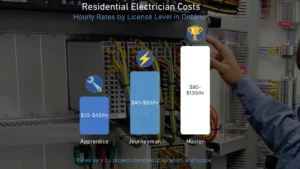
- Apprentice: $40–$60/hour
- Journeyman: $60–$90/hour
- Master electrician: $90–$120+/hour, sometimes with a $150+ minimum for the first hour
The higher the credential, the greater the cost—but also the assurance of code compliance and safety for your project.
Major takeaway: Always ask which licensing level is assigned to your job, since this directly impacts both price and workmanship quality.
Billing Scenarios: Standard vs. Emergency Rates
Cost structures change if you book:
- After-hours or weekend work: 1.5× standard pricing
- Holiday or late-night emergency visits: up to 2× regular rates
Picture this: What costs $200 for a daytime fix may run $350–$400 if scheduled for a Sunday night—mainly due to overtime pay and rapid response.
Most electricians now state these multipliers upfront in quotes, helping clients budget for urgent repairs or plan upgrades at the best possible value.
Visualizing 2026 Pricing for Smart Budgeting
| License Level | Standard Hourly Rate | Service Call Fee |
|---|---|---|
| Apprentice | $40–$60 | $75–$150 |
| Journeyman | $60–$90 | $100–$180 |
| Master Electrician | $90–$120+ | $150–$200 |
“Transparent, upfront pricing is now the industry norm—don’t settle for estimates that leave you guessing.”
Expect every professional, safety-focused electrical firm to explain these costs before they pick up a tool.
Key takeaway: Knowing how your electrician structures pricing isn’t just about money—it’s about ensuring safety, compliance, and total peace of mind.
Cost Ranges for Common Residential Electrical Jobs
Curious what you’ll pay for electrical work in 2026? Whether you’re planning a simple switch swap or a whole-house upgrade, knowing the numbers helps you budget with confidence.
The most-requested residential jobs have clear price bands across Ontario:
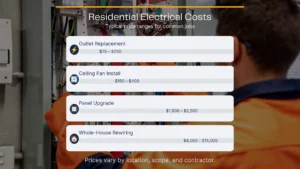
- Outlet or switch replacement: $100–$300 per outlet (typically $150–$250 with service fees)
- Light fixture install: $133–$414 for most, but premium fixtures run higher
- Ceiling fan install: $140–$350 (top of range for high or vaulted ceilings)
- Breaker or small panel work: $150–$500, depending on access and equipment
Even a quick fix usually starts around $150–$250 due to service call minimums.
Visualizing Pricing: Small & Medium Jobs
Picture this: You want to upgrade three outlets and add a basic ceiling fan.
- Service call fee: $75–$200
- Outlet upgrades: 3 × $100–$300
- Ceiling fan: $140–$350
- Total bill: Likely $400–$900+ (bundle pricing can reduce per-item labor)
Bundling small jobs in one visit is a smart way to save on overall labor charges.
Quotable tip: “Small jobs add up fast—ask about bundled rates for better value.”
Larger-Scale Home Electrical Projects
Big projects command bigger budgets—but also deliver lasting safety and future readiness.
- Panel upgrades (100A to 200A): $1,000–$3,000; higher for utility/permit coordination
- Whole-house rewiring: $2,500–$10,000+ (average 3-bedroom: $4,000–$8,000)
- General new wiring: $6–$8 per linear foot; structured wiring adds ~$2/ft
- EV charger install: $500–$1,500 (with hardware: $1,200–$3,500)
- Smart home upgrade: $200–$1,660 (small) or $4,000–$12,000 (full home)
- Backup generator install: $6,000–$11,000 including equipment
Code compliance, material choices, and project complexity (like older homes or hard-to-access areas) are the main drivers pushing costs higher.
Why Prices Vary—and What Impacts Your Bill
Factors that bump your total up or down:
- Material selection—Smart devices, stainless fixtures, and premium finishes cost more.
- Home quirks—Older wiring, plaster walls, or tall ceilings increase labor.
- ESA permits and inspections—Mandatory for most Ontario jobs, affecting both timelines and budget.
Quotable for sharing: “The right electrician makes every dollar count by getting the job done safely and up to code.”
Knowing these ranges means you can plan smarter, ask for detailed quotes, and prioritize jobs based on real value. The safest, most reliable work always begins with clarity, compliance, and a commitment to quality—so you get lasting peace of mind with every investment.
Key Factors Influencing Cost and Value
Understanding what drives residential electrician pricing in 2026 helps homeowners plan smart and avoid surprises.
Multiple factors are at play—some you control, many you don’t.
You’ll find that labor rates, material costs, code requirements, and project complexity shape the final bill every time.
Major Cost Drivers in 2026
Picture this: even for basic upgrades, your quote includes more than just time spent on-site. The main cost drivers you’ll see on estimates are:
- Labor shortages and rising wages – Ongoing demand pushes standard Ontario rates to $40–$100/hour, with higher costs for journeyman or master electricians.
- Material costs and supply chains – 2026 brings continued price swings on copper, breakers, and specialty gear due to global supply challenges.
- New safety codes and technology – Upgrades like AFCI/GFCI protection or smart-home integration routinely add $50+ per protected circuit or customized wiring.
- Permit and inspection requirements – The ESA in Ontario requires certified sign-off for almost all work, impacting both costs and project timelines.
Quotable takeaway: “In residential electrical, every quote is a blend of hands, hardware, and hard rules.”
How Home and Project Details Affect Price
Every house is unique—and so is every electrical job.
Expect costs to climb when:
- Your home is older, larger, or has tough access (think: finished basements, high ceilings, or knob-and-tube rewiring).
- The panel needs upgrading or capacity is maxed out—panel upgrades run $1,000–$3,000+ in Ontario.
- Complex work or after-hours scheduling is needed: emergency rates can run 1.5×–2× standard pricing.
“Repairing century-old wiring in Toronto will always cost more than a same-day outlet install in a new build.”
Technician Credentials, Reputation, and Workmanship
Licensed, insured electricians command premium rates for a reason.
- Higher credentials mean higher safety – Only qualified, ESA-certified pros can guarantee compliance and safety on Ontario projects.
- Reputation, documentation, and pride – Expect to pay more for teams with verifiable experience, local references, and a clean compliance record.
- Professional standards pay off: “The cheapest quote isn’t always the safest, and never the smartest bet for your home.”
Look for companies that “power Ontario, the right way”—always prioritizing safety, transparent documentation, and client satisfaction.
Regional Variations and Evolving Market Trends
Location changes everything.
- Urban areas see higher average labor costs (Toronto, Ottawa) versus small towns.
- Ontario’s unique codes and ESA oversight mean U.S. national averages often understate what you’ll pay locally—always request detailed local quotes.
- More firms now use flat-rate “menu” pricing for transparency: expect standardized pricing for outlets, panel work, and EV charger installs.
Pricing in 2026 stays elevated as electrification trends drive demand for expert work—EV chargers, battery backup, and smart systems are fueling the need for licensed skill.
—
Smart homeowners know that labor, materials, credentials, and compliance set the baseline for electrical costs—cut corners here, and you risk far more than money. When reviewing any quote, weigh the real value: long-term safety, proven expertise, and code-backed peace of mind.
Budgeting and Planning: How to Use 2026 Cost Data Effectively
Planning your next electrical project starts with crystal-clear numbers. In 2026, understanding electrician costs means you control both budget and expectations—no surprises when the invoice arrives.
Step-by-Step: Building Reliable Estimates
Break down your planning process in seconds:
- Identify the type of job: Small repair, bundle of upgrades, panel work, or whole-home modernization.
- Reference up-to-date price ranges:
- Single repair: $150–$300 for an outlet or light fixture (service fee included)
- Bundled workday: $400–$800 for several outlets, switches, and a fan
- Panel upgrades/circuits: $1,000–$3,000
- Whole-house rewiring: $4,000–$10,000+, especially for larger or older homes
- Factor in special costs: Permit, materials, and possible emergency surcharges.
Every line item matters—ask for a detailed quote breakdown that lists labor, parts, call fees, and permits.
Apples-to-Apples Comparisons: Get Local and Get Specific
Prices shift with region, licensing, and job scope. Always get at least 2–3 local estimates to spot outliers and discover your area’s going rates.
Make sure you’re comparing:
- Exact job scope
- Licensing/credentials
- Warranties or guarantees
- Timeline and post-service support
Picture this: Three contractors, three very different bottom lines. Only by lining up quotes side by side can you see who offers true value.
What to Ask Before You Say Yes
Protect your investment and home by verifying the essentials:
- Is your electrician fully licensed and ESA-compliant in Ontario?
- Are workmanship warranties and satisfaction guarantees provided in writing?
- Can they show proof of insurance and recent similar projects?
A higher upfront quote can be a smart move: Long-term safety, reliability, and future-proofed installations regularly outweigh a lower sticker price.
Key Takeaways and Checklist
Smart budgeting is about clarity and control, not just the lowest price.
Always review these before approving work:
- Scope of services quoted
- License and ESA status
- Warranty coverage and insurance proof
- Total cost (with breakdowns)
- Timeline and cleanup expectations
“Transparent pricing isn’t optional—it’s your right.”
“Qualified, insured electricians deliver safety you’ll never regret investing in.”
“If it sounds too good to be true, put safety first and ask for details.”
Build your project budget on quality, clarity, and trust—that’s the difference between a short-term fix and a long-term solution.
Strategic Overview: Saving on Electrical Services Without Compromising Safety
Maximize Value with Proactive Decisions
Choosing the right approach can mean the difference between lasting quality and costly mistakes.
Ontario homeowners can maximize value by looking beyond just the sticker price.
Bundling multiple small tasks in a single visit often provides real savings—many companies lower per-item rates when they complete several jobs at once.
Similarly, scheduling during regular business hours avoids premium fees, as after-hours and emergency work can cost up to twice the standard rate.
“Plan ahead and consolidate electrical work—the difference could be hundreds of dollars per visit.”
Reading Quotes, Spotting Red Flags, and Negotiating Clearly
A clear, detailed quote is a must.
When reviewing estimates:
- Check for itemized breakdowns: Look for transparent sources on labor, materials, and service call fees.
- Beware of suspiciously low bids: If it seems too good to be true, it might mean shortcuts or unlicensed work.
- Negotiate the scope—not just the price—and always confirm ESA licensing.
It’s smart to compare at least two to three local quotes; detailed comparison helps ensure you’re not trading safety for upfront savings.
“Transparency in pricing is a non-negotiable—never proceed without seeing exactly what’s included.”
Preventative Maintenance and When to Upgrade
Regular checkups help you avoid emergencies that can become both dangerous and expensive.
Some actionable steps:
- Book a yearly electrical inspection to catch problems before they escalate.
- Replace aging outlets, breakers, or panels as soon as they test faulty—delays often lead to higher costs.
- Ask your electrician about maintenance plans that prioritize safety and compliance.
A simple audit—walk through your home, check for flickering lights, warm switches, or frequent breaker trips—can flag urgent needs.
“An ounce of prevention saves on thousand-dollar headaches—invest in safety now, not after a crisis.”
Always Prioritize Safety, Not Short-Term Savings
Ontario’s electrical code compliance is not optional—never sacrifice safety to shave dollars off your bill.
Make sure warranty, inspection, and liability coverage are written into every service agreement.
For deeper guidance on saving without compromise, see: Practical Tips to Save Money on Home Electrical Services.
Remember: True value means getting the job done right, safely, and to code the first time—your family, property, and investment depend on it.
Choosing the Right Electrician: Balancing Affordability, Quality, and Trust
Choosing the right electrician in Ontario isn’t just about a low quote—it’s about protecting your home, your safety, and your investment.
Most reputable electricians share three traits: transparent pricing, clear credentials, and a proven commitment to safety.
For any residential project in 2026, start your search by looking for companies who:
- Display valid ESA licensing numbers and insurance
- Provide detailed quotes with clear line items—no vague bundles or surprises
- Showcase verified reviews and project photos, not just generic claims
Spot the Red Flags Fast
Shady operators tend to show their hand early. Watch out for:
- Unusually low estimates far below the $40–$100/hour standard
- Requests for large upfront cash payments or refusal to sign contracts
- No physical address, lack of branded vehicles or uniforms
- Incomplete answers about inspections, permits, or Ontario electrical codes
Picture this: You get a quote for a $3,000 panel upgrade—one company delivers a step-by-step run-down, another just hands you a total price on the back of a business card. Only one of these choices powers your home the right way.
Research and Reference Checks: Your DIY Vetting List
Before you agree to any work, always:
- Request and verify ESA licence numbers with Ontario’s Electrical Safety Authority
- Ask for references from similar local projects completed in the last year
- Confirm details about warranties, supplier partnerships, and after-care
- Review prior work—look for photo evidence of neat, code-compliant installations
These steps take minutes but can save thousands—“A single reference call turned my shortlist upside down.”
Balancing Cost vs. Value: More Than Just the Hourly Rate
In 2026, homeowners report that upfront, transparent pricing and a solid warranty consistently beat the cheapest bid in long-term satisfaction.
- Top-performing pros offer labor guarantees—not just installation, but safe operation years down the road
- Most trusted electricians provide clear start/finish timelines and communicate code requirements openly
- Beware: Low hourly rates can hide high-pressure upsells or shortcuts on permits and safety
Ontario Decision Tree: Who Should You Hire?
Here’s how to decide:
- For minor repairs: Any fully licensed journeyman or master with positive reviews and a $75–$200 service call fee is a safe bet
- For major upgrades (panel, EV charger, rewiring): Choose a team with at least 5+ years in business, ESA accreditation, and a record of completed permits
- For complex or time-sensitive projects: Look for transparent flat-rate quotes and guaranteed timelines
Real scenarios: Mary’s century home required knob-and-tube rewiring—a higher upfront investment, but a licensed contractor delivered peace of mind and a smooth ESA inspection.
The biggest shortcut isn’t price—it’s peace of mind. Always invest in credentials, transparency, and reliability.
Ultimately, Ontario’s best electricians combine code expertise, fair pricing, and accountability—giving you safety and service you can trust long after the job’s done.
Powering Your Next Project With Confidence and Clarity
The real value of understanding residential electrician costs in 2026 isn’t just a lower bill—it’s confidence and safety for your home and family. When you approach every upgrade or repair with knowledge, you protect your investment and ensure every dollar goes toward secure, code-compliant work.
By arming yourself with transparent pricing, local benchmarks, and the right questions, you keep the process firmly in your hands—turning what could feel overwhelming into a smooth, straightforward experience.
—
Here’s how you put this insight to work:
- Demand clarity: Request upfront, detailed quotes—breakdowns of labor, materials, and fees should be standard, not a bonus.
- Verify credentials: Check for valid ESA licensing and insurance for every electrician who enters your home.
- Plan strategically: Bundle multiple jobs into one visit to save on service call fees and get more done per dollar.
- Prioritize safety over shortcuts: Ask how each job meets Ontario’s codes and ensure all required permits and inspections are included.
- Compare—and ask questions: Collect at least two to three local estimates to understand your options and spot the best value.
—
Ready to move forward?
Take five minutes now to organize your project wish list and email a trusted electrician for a custom quote—or schedule a safety inspection if you haven’t had one in the last year.
Don’t leave quality—and peace of mind—to chance. Your next electrical decision is an investment in both security and your home’s future.
“When you insist on safety, transparency, and skill, you power Ontario the right way—and safeguard what matters most.”
FAQ
- What are the average residential electrician costs in Ontario?
Residential electrician costs in Ontario typically range from $40–$120+ per hour depending on the electrician’s license level, plus a service call fee of $75–$200 for most home visits. - Why do residential electrician costs increase for emergency calls?
Emergency and after-hours work raises residential electrician costs by 1.5x to 2x the standard rate, since technicians charge more for urgent evening, weekend, or holiday visits. - How can homeowners lower residential electrician costs?
You can reduce residential electrician costs by bundling multiple small jobs into one visit, scheduling during regular business hours, and comparing at least two to three local quotes. - Do residential electrician costs include permits and inspections?
Yes, most residential electrician costs in Ontario factor in ESA permits and inspection fees, since certified sign-off is required for almost all electrical work. - What factors most affect residential electrician costs for a panel upgrade?
Residential electrician costs for a panel upgrade depend on amperage (100A to 200A), home age, access difficulty, and whether utility or permit coordination is needed, typically ranging from $1,000–$3,000.

Written by Roozbeh Nahreini
Roozbeh Nahreini is the founder and owner of Padi Electric Inc., an ESA-certified electrical contractor serving Aurora and the Greater Toronto Area. With 10+ years of hands-on electrical expertise and a team combining 50+ years of field experience, Roozbeh specializes in residential and commercial electrical solutions—from panel upgrades and EV charger installation to smart home integration and advanced diagnostics. His commitment to transparent pricing, code-compliant workmanship, and 24/7 emergency response has established Padi Electric as a trusted neighborhood contractor across Aurora, Richmond Hill, Newmarket, Vaughan, and the GTA.