

Understanding the differences between commercial and industrial electrical services can help Ontario businesses make informed, cost-effective decisions about their properties’ power solutions. Here are the essential insights you need to choose the safest, most reliable path forward:
- Commercial vs. Industrial services diverge sharply in scope, expertise, and risk—industrial work demands advanced certifications, higher voltage (up to 35kV), and specialized safety protocols.
- Industrial projects often cost 40-60% more than commercial due to complex equipment, strict uptime requirements, and hazardous environments—making thorough planning and ROI analysis essential.
- Code compliance and safety are non-negotiable in both sectors—licensed Ontario electricians must follow provincial regulations, with industrial jobs requiring extra layers like arc flash studies and lockout/tagout protocols.
- Smart building automation and energy efficiency upgrades—like LED retrofits and intelligent controls—are priorities in both commercial and industrial spaces, helping cut costs and boost productivity.
- Ongoing maintenance, transparent communication, and clear timelines ensure minimal downtime—crucial for both public-facing businesses and nonstop manufacturing plants.
- Choosing the right contractor means demanding proof of licensing, relevant project experience, and a proven safety culture—never settle for less when it comes to compliance and uptime.
- Collaborative, client-focused electricians deliver value long-term through preventative service plans, clear documentation, and seamless project execution—protecting your operations and reputation.
- Always ask the tough questions—about certifications, safety audits, insurance, and 24/7 emergency protocols—so you’re never left in the dark when issues arise.
Explore the full article for a side-by-side comparison, practical budgeting tips, and expert guidance to power your Ontario facility the right way.
Understanding Commercial vs Industrial Electrical Services: Critical Differences for Ontario Businesses
What does an unexpected power outage cost your business—an hour of lost sales, or a full halt to your production line with every minute ticking upward in expense?
If you manage an Ontario retail location, office, or manufacturing plant, you know electrical reliability isn’t just a convenience—it’s a necessity. Yet, figuring out what level of electrical expertise your property demands is rarely straightforward. Commercial and industrial electrical services sound similar, but the risks, regulations, and costs couldn’t be more different.
The stakes are high—industrial electrical work in Ontario can cost up to 60% more than commercial projects, and downtime at the wrong moment can multiply expenses fast. Pair that with ever-tightening safety codes and new technologies like LED retrofits and smart automation, and it’s clear: choosing the right partner isn’t a luxury, it’s a safeguard for your equipment, people, and bottom line.
This guide is designed for:
- Homeowners taking on major renovations
- Property managers juggling tenant needs across offices or retail
- Business owners weighing cost, compliance, or future expansion
- Builders and renovation contractors aiming for bulletproof project planning
You’ll get a clear comparison of commercial vs. industrial electrical work, including real Ontario examples, key cost drivers, code requirements, and hands-on advice to protect your property and investment.
We’ll break down:
- Major differences in environments, equipment, and expertise
- Critical safety and compliance essentials
- What to expect from true professionals in each sector
- Practical questions to ask before choosing a contractor
Whether you’re navigating a retail retrofit or full-scale industrial upgrade, understanding these core differences ensures your electrical decisions are smart, safe, and future-ready.
Ready to see how commercial and industrial electrical solutions truly stack up—and why clarity could mean fewer headaches down the road? The answers start here, with a look at what defines each service and what it means for you.
Defining Commercial and Industrial Electrical Services
Commercial and industrial electrical services play central—but distinctly different—roles in powering Ontario’s businesses and industries.
If you run an office, retail store, or restaurant, you’re looking at commercial electrical services. These focus on keeping day-to-day spaces comfortable and code-compliant for employees and customers.
Step inside a manufacturing plant, warehouse, or factory, and you enter the domain of industrial electrical services. Here, power is about keeping production lines running 24/7—often at much higher voltages and with more complex systems.
Understanding Service Environments and Objectives
- Commercial environments: Offices, retail boutiques, banks, restaurants, hotels, and schools
- Industrial environments: Factories, logistics centers, food processing plants, auto assembly, refineries, power plants
Every project shares some core goals:
- Tenant and worker safety
- Strict code and regulatory compliance
- Energy efficiency
- Operational uptime and productivity
In commercial work, the focus is on reliable lighting, secure power distribution, emergency systems, and integration with smart building controls.
In industrial settings, the power demand is steeper. Expect systems like:
- High-voltage feeds
- Heavy machinery and automated production lines
- Custom control panels, generators, and robust backup systems
Roles, Expertise, and Project Examples
The difference isn’t just about buildings—it’s about expertise.
- Standard commercial projects: Upgrading office lighting, installing EV chargers, coordinating HVAC and fire alarms
- Advanced industrial projects: Laying out 35kV transformers, integrating robotics, synchronizing redundant power, wiring hazardous zones
Technicians in both sectors must be fully licensed and insured, but industrial electricians require advanced certifications for high-risk, high-voltage, and mission-critical work. In Ontario, every job is governed by rigorous safety codes designed to protect people and property at every stage.
Picture a real scenario: A retail complex in Toronto gets LED retrofits and automated access systems for 30% energy savings. Down the road, a food processing plant undergoes a production upgrade—requiring integrated safety interlocks and customizable process controls—where downtime isn’t tolerated.
Key Takeaways
- Commercial and industrial electrical services share basics like safety and code compliance, but differ dramatically in scope, scale, and expertise needed
- Costs and complexity rise fast on the industrial side, often running 40-60% higher due to specialty equipment and downtime sensitivity
- Choosing the right partner is about matching your project’s requirements with experience, proper certifications, and a proven safety record
Understanding where your property fits—and what level of expertise you need—helps you secure safe, reliable, and cost-effective electrical solutions for the long haul.
Key Differences Between Commercial and Industrial Electrical Services
Comparative Overview of Service Scope
Commercial electrical services keep Ontario’s offices, retail stores, and restaurants powered, focusing on safety, reliable lighting, and systems like HVAC and security.
Industrial services handle the demands of factories, plants, and warehouses, requiring complex equipment, heavy machinery hookups, and advanced automation.
Picture this: a retail renovation needs discreet, efficient lighting; a food-processing plant needs a rapid-response team for emergency motor repairs.
- Environments:
- Commercial: occupied, public, customer-facing
- Industrial: noisy, hazardous, production-driven
- Equipment Complexity:
- Commercial: standard panels, lighting, building systems
- Industrial: VFDs, PLCs, custom automation, high-voltage terminations
- Stakeholder Priorities:
- Commercial: safety, efficiency, tenant experience
- Industrial: uptime, compliance, equipment protection
Both sectors share strict code compliance and demand structured, safe cabling—but industrial projects add extra layers of expertise and planning.
Voltage Levels, Power Demands, and System Complexity
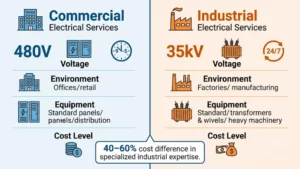
Commercial buildings use moderate voltages (typically 120V-480V) for lighting, computers, and HVAC.
Industrial facilities can operate up to 35,000V to power massive motors, conveyors, and production lines.
- Power Distribution:
- Commercial: balanced, multi-room layouts
- Industrial: heavy, centralized feeds with backup systems
- System Priorities:
- Commercial: building controls, efficiency
- Industrial: scalable automation, 24/7 operation, redundant protection
A power failure in a shopping plaza causes inconvenience—while downtime in a manufacturing plant means lost output and costly delays.
Compliance, Safety, and Regulatory Protocols
Ontario’s electrical safety codes form the baseline for both sectors, but industrial requires even stricter controls.
- Regulations Applied:
- Both: NEC, local Ontario standards
- Industrial: NFPA 70E, OSHA, arc flash studies, lockout/tagout protocols
- Worker Safety:
- Commercial: general safety, routine inspections
- Industrial: advanced training, specialized PPE, high-liability contexts
Industrial sites often conduct detailed arc flash risk assessments and require every crew member to hold advanced certifications.
Work Environment and Project Execution
Commercial work happens in clean, occupied spaces—think bustling offices or renovated hotels where aesthetics are paramount.
Industrial projects are often loud, high-pressure, and physically demanding, with hazards like heat, dust, and moving equipment.
- Logistics & Risk:
- Commercial: public access, regular hours, easy access controls
- Industrial: secure perimeters, permit systems, overlapping trades
- Stakeholder Communication:
- Commercial: property managers, tenants
- Industrial: plant engineers, safety officers
The need for transparent communication and professionalism runs through both environments—partners succeed when risks are managed and expectations are crystal clear.
The right electrical team understands that what works for a boutique retail build rarely applies in a 24/7 automotive plant—with safety, skill, and code compliance always non-negotiable. For clients, knowing these core differences means smarter project planning and a safer, more reliable result.
Commercial Electrical Services: Scope and Solutions
Typical Commercial Electrical Systems and Applications
Commercial electrical services keep Ontario’s offices, retail stores, restaurants, hotels, and schools safe and functional every day.
Most commercial properties rely on a set of core systems, including:
- Power distribution: Reliable panels that deliver 120V to 480V, designed for busy, shared spaces
- Lighting systems: Emergency, exit, and custom task lighting—enabling safety, code compliance, and flexible layouts
- Network cabling and surge protection for digital operations and sensitive equipment
- Fire alarm and access control installations to protect people and property
Picture a downtown Toronto office: new tenants require a retrofit of existing panels, updates to LED perimeter lighting for energy code compliance, and security upgrades after hours.
Smart integration is also trending:
- Building automation: HVAC controls, timed lighting, and advanced energy management
- Automated security: Cameras and sensors managed from a single app interface
At every stage, the focus is on efficiency, safety, and seamless business operations.
Specialized Solutions for Commercial Environments
Modern commercial needs go way beyond basic wiring.
Licensed commercial electricians deliver:
- Custom lighting design that highlights brand identity and improves employee productivity
- HVAC automation and panel upgrades for precise energy control
- Multi-tenant adaptability: Scalable systems that shift with changing occupancy or renovations
- Structured cabling for fast installation of Wi-Fi, security, and AV
Long-term service counts:
- Ongoing maintenance and 24/7 troubleshooting to resolve outages fast
- LED upgrades, EV charging, and building automation as technology adoption accelerates—over 60% of Ontario offices list smart upgrades as a key priority this year
- Preventative testing and safety audits to avoid fines and keep people protected
Imagine walking through a retail chain update: crews install new illuminated signage overnight without downtime, then conduct a quick arc-fault test for code compliance before doors open.
Immediate Takeaways for Ontario Businesses
- Code-compliant installations, energy-saving upgrades, and 24/7 support are hallmarks of effective commercial electrical service
- Trends like smart automation and LED lighting are becoming industry standards
- Work with licensed Ontario contractors to ensure all work is safe, high-quality, and future-ready
When you need professional expertise in a commercial property—whether it’s day-to-day support or a major technology retrofit—look for a team that knows how to keep your business powered, productive, and always compliant.
Industrial Electrical Services: Scope and Solutions
Typical Industrial Electrical Infrastructure and Systems
Industrial electrical projects operate at a different scale from commercial jobs—think high-voltage power up to 35,000V, specialized machinery feeds, and robust emergency systems.
Picture this: a food processing plant in Ontario powered by dedicated transformers, with machine-specific subpanels humming alongside overhead cable raceways.
Key components of modern industrial systems include:
- Dedicated high-voltage power supply lines
- Heavy-duty transformers and step-down equipment
- Individual machine feeds and custom busways
- Sophisticated control networks:
- PLCs (Programmable Logic Controllers)
- HMIs (Human-Machine Interfaces)
- VFDs (Variable Frequency Drives)
- Custom automation control panels
- Redundancy for mission-critical equipment (e.g., continuous production lines)
- Full spectrum of motors and onsite generators
- Monitoring and process instrumentation for real-time performance
- Industrial-grade wiring, tray systems, and secure cable management
- Backup generators and Uninterruptible Power Supply (UPS) for zero-downtime protection
A single manufacturing facility may rely on dozens of PLCs and 24/7 monitoring, making system reliability both a safety and productivity issue.
—
Specialized Solutions and Industry-Specific Requirements
Uptime is everything. Ontario’s industrial sector often invests 40-60% more in specialized electrical solutions than typical commercial projects—because even a brief outage can stall production and cost thousands per minute.
Top priorities include:
- Scheduled preventative maintenance programs, rapid-response breakdown coverage, and 24/7 troubleshooting protocols
- Seamless integration with heavy machinery, conveyor systems, advanced robotics, and process automation
- Stringent safety design:
- Arc flash mitigation (per NFPA 70E and Ontario safety codes)
- Hazardous location wiring (CSA Class I/II/III, such as in paint lines or chemical plants)
- Lockout/tagout protocols for worker safety
- Solutions for power quality issues—harmonics filtering, load balancing, surge suppression
- Adaptation to harsh conditions:
- Dust, moisture, and corrosive chemicals
- NEMA-rated and explosion-proof hardware
- Ongoing training and documentation for in-house maintenance staff—compliance isn’t a one-time event
Ontario examples: an automotive plant using heat-resistant cable for welding robots, or a logistics hub with real-time energy monitoring and backup power for critical sorting systems.
—
Knowing the right industrial electrical partner means choosing expertise in specialized safety, robust controls, and the unique demands of manufacturing uptime. The key takeaway: thorough planning, strict compliance, and custom solutions keep Ontario industry safely powered—no matter how complex the task.
Overlapping Services and Collaborative Approaches
When comparing commercial and industrial electrical work, several key services bridge both sectors and demand the same high standards—think of essentials like electrical code compliance, structured cabling, and reliable lighting systems.
Both environments rely on:
- Power distribution systems to ensure smooth daily operations
- Regular upgrades for energy efficiency, from LED retrofits to programmable controls
- Essential safety equipment: exit signage, emergency lighting, security alarms
Shared Technologies and Project Methodologies
Picture this: whether you’re lighting a retail store or running conveyor belts in a warehouse, energy monitoring and smart building systems are now standard.
Expect both commercial and industrial spaces to adopt:
- Building automation for lighting, HVAC, and security
- Surveillance cameras and access controls with remote management
- Data-driven energy audits to target savings and sustainability
Integrating these technologies sets the foundation for future-proofed facilities—no wonder smart building adoption is up 35% in Ontario since 2021.
Unified Service Providers and Referrals
Working with a provider who’s licensed in both fields offers strong advantages:
- Single point of accountability for multi-site property managers
- Streamlined projects—less downtime coordinating multiple contractors
- Access to broad expertise, from code interpretation to advanced automation
However, complex industrial equipment—like 35kV transformers or hazardous area wiring—often requires:
- Specialty certifications and factory training
- Additional insurance for high-risk installations
- Strategic subcontracting to experts in robotics or custom controls
Never hesitate to ask: “Does your team handle both environments directly, or do you partner with specialists?”
Ongoing Training, Communication, and Innovation
For both sectors, ongoing education is not optional. New safety codes, emerging technologies, and stricter standards mean licensed electricians are constantly upgrading their skills.
What sets the best apart?
- Transparent communication with documented processes, so clients understand every step
- Proactive project management—think regular progress reports and clear timelines
- Client-focused solutions tailored to real-world needs, not just code minimums
A truly collaborative approach delivers peace of mind, proven ROI, and safety confidence—whether your site is an office tower or a factory floor.
Clear communication, versatile expertise, and continuous learning ensure your project isn’t just completed—it’s future-ready and fully compliant.
Cost, Timeframes, and Value Considerations
Typical Cost Structures and Budgeting Factors
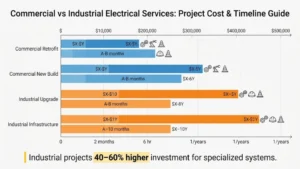
Industrial electrical projects in Ontario typically demand a 40-60% higher investment than equivalent commercial projects.
That’s because industrial work involves:
- Higher voltage systems (480V–35kV)
- Advanced controls and automation
- Specialized safety requirements and certifications
- Redundancy and uptime planning for continuous operations
Commercial services—think offices, retail, restaurants—generally involve more moderate power needs (120V–480V), with costs driven by:
- Project size and type (retrofit, upgrade, new build)
- Lighting, HVAC, and system complexity
- Code compliance and inspection needs
Budget planning can look vastly different by sector:
- Commercial upgrades (e.g., LED retrofits, server room additions) may run $10,000–$250,000+
- Industrial infrastructure overhauls push well above $500,000+, especially for automation, custom panels, or generator redundancies
Careful ROI analysis is crucial—energy savings, reduced maintenance, and fewer outages can often offset higher upfront costs.
“Investing in reliable electrical infrastructure means uninterrupted operations and long-term savings.”
“Budget smart: downtime and emergencies almost always cost more than planned improvements.”
Project Timelines, Downtime, and Scheduling
Commercial electrical projects typically operate within public hours, making off-hours work and phased schedules essential.
Picture this: an office tower in downtown Toronto, light fixtures replaced after work hours to keep tenants happy and operations flowing.
Industrial projects are a different beast:
- Many production plants run 24/7, leaving little room for shutdowns
- Any downtime can mean five- or six-figure losses per hour
Smart contractors deliver value with:
- Detailed job planning and scheduling
- Night/weekend shifts for minimal disruption
- Phased implementation plans—one facility wing or equipment line at a time
Typical Ontario project timelines:
- Commercial retrofits/expansions: 1 day to several weeks
- Industrial upgrades (e.g., control system installs): several weeks to months, depending on complexity
“Every hour of downtime avoided is dollars saved and headaches prevented.”
Value Takeaways for Owners and Managers
- Factor in both initial costs and lifecycle return—not just the price tag
- Always demand transparent timelines and risk mitigation strategies
- Choose contractors who plan for uptime and operational safety as much as technical scope
Smart project planning, code compliance, and experienced scheduling equal peace of mind, sustained productivity, and lower total cost—making the right investment choice crystal clear.
Choosing the Right Electrical Contractor for Your Needs
Selecting an electrical contractor in Ontario isn’t just about price—it’s about ensuring safety, compliance, and reliability for your business.
Look for contractors who are
- Fully licensed and insured under Ontario law
- Up-to-date with all Ontario electrical safety codes (ESA/CSA standards)
- Regularly trained in current regulations and safety protocols
The difference between commercial and industrial contractors? Specialized experience. Ask whether your contractor has a track record with projects like
- Offices, retail, or schools (commercial)
- Factories, warehouses, or high-voltage plants (industrial)
A seasoned contractor will know the difference between a 480V commercial panel and a 35kV industrial feed—and the stakes that come with each.
What Sets a Trustworthy Contractor Apart?
When evaluating your options, focus on
- Transparent quoting with no hidden extras
- Detailed project planning and schedules in advance
- Clear, consistent communication with all stakeholders
Picture this: A tenant build-out in a busy office versus planned downtime for machinery upgrades at a food processing plant. Each setting demands unique coordination and documentation.
Don’t overlook these essentials:
- A proven safety culture (ask about recent safety training and incident records)
- Ongoing education for teams (especially on changing codes or new tech)
- Valid proof of insurance and compliance with the ESA
Questions That Matter Before You Sign
Set up for success by asking:
- What certifications and licenses do your electricians hold?
- Can you show recent examples in environments like mine?
- How do you handle safety audits and code compliance?
- Who is the point of contact throughout the project?
- What is your protocol for after-hours or emergency work?
“The best partnerships are built on transparency, expertise, and trust.”
“Compliance today protects your uptime (and reputation) tomorrow.”
Long-Term Value: Why Relationships Matter
A client-focused approach delivers benefits beyond the initial project. Expect
- Preventative maintenance plans tailored to your site
- Clear documentation for every service call
- A responsive team already familiar with your environment
A reliable contractor does more than get the job done. They invest in safety, stay ahead of compliance, and protect your bottom line—so you can focus on running your business with confidence.
Making the Right Choice: Commercial vs Industrial Electrical Services for Your Ontario Facility
Choosing the right electrical partner isn’t just a line item—it’s an investment in your building’s safety, productivity, and long-term peace of mind.
Whether your project is a bustling commercial space or a high-demand industrial facility, clarity on service needs gives you control over cost, uptime, and compliance. The right approach sets a foundation for growth, compliance, and uninterrupted operations.
—
Key moves to secure the results you need:
- Prioritize licensed, Ontario-compliant contractors with specific experience in your project environment.
- Demand transparent estimates, upfront planning, and documented safety protocols—don’t settle for vague commitments.
- Match your contractor’s expertise to your facility’s real demands: commercial or industrial, each requires specialized knowledge.
- Budget not just for upfront costs, but for lifecycle value, preventative maintenance, and energy efficiency.
—
Next Steps
- Review your current electrical setup or pending project—does it require commercial comfort or industrial resilience?
- Connect with reputable contractors who showcase real Ontario project examples and a clean safety record.
- Ask targeted questions about certifications, compliance, and 24/7 service capabilities before you commit.
- Schedule a site assessment to identify risks, efficiency gaps, or planning opportunities before work begins.
—
Every solid electrical project starts with the right questions and the right team—and ends with safety, value, and future readiness. When you power your property the right way, you protect what matters most: your people, your business, and your peace of mind.
“Be the force behind a safer, smarter Ontario—choose excellence, demand integrity, and make every connection count.”
FAQ
1. What are the key differences between Commercial vs Industrial Electrical Services?
Commercial vs Industrial Electrical Services diverge sharply in scope, voltage, and expertise. Commercial vs Industrial Electrical Services serve different environments: commercial focuses on offices, retail, and restaurants using 120V–480V power, while industrial handles factories and plants operating up to 35,000V. Commercial vs Industrial Electrical Services demand different skill levels—industrial requires advanced certifications for high-risk work, specialized safety protocols like arc flash studies, and complex automation systems like PLCs and VFDs.
2. How much more expensive are Commercial vs Industrial Electrical Services in Ontario?
Industrial electrical projects in Ontario typically cost 40–60% more than equivalent commercial installations due to the complexity and uptime demands of Commercial vs Industrial Electrical Services. Commercial vs Industrial Electrical Services pricing reflects different scopes: commercial retrofits and upgrades range $10,000–$250,000+, while industrial infrastructure overhauls often exceed $500,000+. The higher investment in Commercial vs Industrial Electrical Services is justified by specialized equipment, redundancy planning, and the critical nature of continuous operations in manufacturing.
3. What safety and compliance requirements apply to Commercial vs Industrial Electrical Services?
Both Commercial vs Industrial Electrical Services must comply with Ontario electrical safety codes and NEC standards, but Commercial vs Industrial Electrical Services in industrial settings demand additional layers. Industrial applications require arc flash risk assessments, lockout/tagout protocols, hazardous area wiring certifications (CSA Class I/II/III), and NFPA 70E compliance under Commercial vs Industrial Electrical Services standards. Commercial vs Industrial Electrical Services in office or retail environments focus on general safety, routine inspections, and standard code compliance.
4. How do project timelines differ between Commercial vs Industrial Electrical Services?
Commercial vs Industrial Electrical Services have dramatically different scheduling needs. Commercial electrical projects typically take 1 day to several weeks, often scheduled after business hours to minimize disruption, while Commercial vs Industrial Electrical Services in industrial settings can span weeks to months. Industrial facilities running 24/7 operations mean Commercial vs Industrial Electrical Services contractors must plan night/weekend shifts and phased implementations to avoid costly production downtime. Careful scheduling is essential for both, but Commercial vs Industrial Electrical Services in manufacturing demand far more strategic planning.
5. What certifications and expertise should I look for when choosing between Commercial vs Industrial Electrical Services?
Selecting the right contractor depends on matching their expertise to your needs. Commercial vs Industrial Electrical Services contractors must all be fully licensed and insured under Ontario law, but Commercial vs Industrial Electrical Services specialists differ in focus. For commercial work, look for experience with offices, retail, LED retrofits, and building automation; for industrial applications, verify expertise with high-voltage systems, machinery feeds, automation controls, and hazardous area wiring. Ask contractors specifically about their Commercial vs Industrial Electrical Services portfolio in environments matching your project.

Written by Roozbeh Nahreini
Roozbeh Nahreini is the founder and owner of Padi Electric Inc., an ESA-certified electrical contractor serving Aurora and the Greater Toronto Area. With 10+ years of hands-on electrical expertise and a team combining 50+ years of field experience, Roozbeh specializes in residential and commercial electrical solutions—from panel upgrades and EV charger installation to smart home integration and advanced diagnostics. His commitment to transparent pricing, code-compliant workmanship, and 24/7 emergency response has established Padi Electric as a trusted neighborhood contractor across Aurora, Richmond Hill, Newmarket, Vaughan, and the GTA.