

Looking to understand how 3-phase 240V systems power Ontario’s homes, businesses, and critical facilities? Here are the core concepts and practical insights you need for safe, compliant, and future-ready electrical upgrades—delivered in a format that’s fast to scan and act on.
- 3-phase 240V delivers up to 73% more capacity than single-phase with only one extra wire, providing smoother motor operation and reliable power for demanding equipment.
- Strict Electrical Safety Authority (ESA) compliance is non-negotiable—clear panel labeling, color-coded wiring, and licensed electrician oversight are required for every installation.
- Open Delta and 120/240V 3-phase setups enable buildings to power both standard outlets and heavy machinery from a single service, supporting mixed-use and small commercial sites efficiently.
- Balanced loads and 3-pole breakers are essential—overloaded circuits or misidentified “wild legs” can cause costly downtime or hazardous conditions.
- Key applications include large HVAC, industrial motors, elevators, and EV fast chargers, making 3-phase 240V the backbone for commercial, industrial, and growing mixed-use developments.
- Availability depends on location—urban Ontario offers easy access, while rural upgrades may need costly infrastructure additions and advanced planning with your utility.
- Annual maintenance and thermal imaging significantly reduce hazard risks—regular inspections catch hot spots, loose connections, and load issues before they escalate.
- Investing in 3-phase 240V pays off with up to 5–10% energy savings and longer equipment life, delivering ROI in under five years for many Ontario businesses.
Ready to future-proof your property and ensure total safety? Trust licensed, code-compliant professionals for every upgrade—and explore the full article for in-depth guidance on powering Ontario, the right way.
Power Your Commercial Space: The 3-Phase 240V Advantage
Ever noticed the quiet, confident hum powering a bustling condo gym, a Toronto manufacturing floor, or even the lifts in a downtown office tower? Behind that reliability is a sophisticated workhorse: 3-phase 240V electricity—the gold standard for delivering safe, balanced, and high-capacity power across Ontario’s commercial and advanced residential spaces.
For builders, property owners, and facility managers, choosing the right electrical system is about more than staying “up to code.” 3-phase 240V isn’t just about raw power—it means longer equipment life, lower energy costs, and smooth operation for everything from industrial HVACs to fast EV chargers.
If you’ve ever:
- Faced flickering lights or stalled elevators during peak hours
- Needed to run woodworking equipment, chillers, or high-speed charging stations
- Searched for a solution that scales alongside your growing business needs
—you’ve already seen the limitations of single-phase setups.
Here’s what you can expect to gain:
- A clear understanding of how 3-phase 240V works and why it outperforms typical home power
- Guidance on the variety of system configurations used in Ontario, including safety essentials
- Insight into the practical benefits—up to 73% more capacity with nearly the same wiring footprint
- Real-world examples of where these systems fuel Ontario’s progress, from commercial towers to custom garages
What makes a 3-phase system so valuable isn’t only numbers—it’s the confidence you have when licensed experts label every panel, check every breaker, and ensure your workspace is safe, efficient, and ready to grow.
If safety, compliance, and reliability are priorities for your next project, you’re about to get expert, no-nonsense answers tailored for Ontario’s standards.
Let’s break down how 3-phase 240V delivers power—and peace of mind—where it matters most.

Understanding 3-Phase 240V systems power
A 3-phase 240V electrical system delivers power using three alternating currents, each precisely offset by 120°, creating a stable, continuous power flow.
This setup is the backbone for many Ontario commercial spaces, supporting everything from large HVAC systems to heavy-duty machinery where reliability and efficiency are non-negotiable.
Unlike single-phase (typical household) power, 3-phase offers:
- Consistent, balanced energy for demanding equipment
- Noticeably smoother motor operation (less vibration and wear)
- Up to 73% more capacity with only one extra wire compared to single-phase
- Reduced risk of sudden voltage drops that interrupt operations
You’ll notice: Commercial buildings, data centers, and workshops commonly rely on three-phase to avoid power ‘pulses’ that cause flickering lights or equipment strain.
Ontario’s ESA and North American electrical codes require all 3-phase installs to meet strict labeling, grounding, and inspection standards for maximum workplace safety.
—
System Configurations and Wiring
| Configuration | Phase-to-Neutral | Phase-to-Phase | Use Case | Phases |
|---|---|---|---|---|
| Open Delta | 120V (A/C), 208V (B) | 240V | Small/mixed-use commercial | 3 |
| 120/240V 3-Phase | 120V | 240V | Standard outlets + equipment | 3 |
| 415Y/240V Wye | 240V | 415V | Large industrial (international) | 3 |
Ontario and most of North America use several key 3-phase 240V wiring setups:
- Open Delta (3-phase 4-wire or “wild leg”):
- Two transformers, three phases
- Phase-to-neutral: 120V (A or C), 208V (B, the “wild leg”)
- Phase-to-phase: 240V
- Ideal for small or mixed-use commercial buildings
- 120/240V 3-phase 4-wire:
- Phase-to-neutral: 120V
- Phase-to-phase: 240V
- Supports both standard outlets and powerful equipment from the same panel
- 415Y/240V Wye (rare, international):
- Phase-to-neutral: 240V
- Phase-to-phase: 415V
- Provides even higher capacity, mostly for large industrial complexes abroad
Panels must feature:
- Clear phase labelling—never mix up a wild leg
- Color-coded conductors per Ontario code
- Proper wire gauge and bonding for safety
- ESA-required signage and approved panels
Picture this: A licensed technician applies bright safety labels and checks every breaker during post-install inspection—a step that prevents costly, dangerous mistakes.
—
Voltage Relationships and Calculations
In daily maintenance, understanding voltages is crucial:
- Open Delta:
- 120V from A or C to neutral
- 208V “wild leg” (B) to neutral—always flagged for safety
- 240V between any two phases
- 120/240V 3-phase:
- 120V phase to neutral
- 240V phase to phase
- 415Y/240V:
- 240V phase to neutral
- 415V phase to phase
Key Practices:
- Use 3-pole breakers to trip all phases together, protecting motors and balanced loads
- Balance loads across all legs to avoid overheating and wasted energy
- 200A service example:
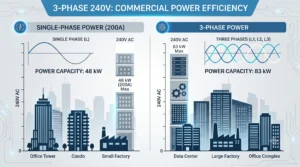
- Single-phase max ≈48kW per leg
- Three-phase total ≈83kW (using √3 multiplier)
Always employ licensed, ESA-certified electricians for “wild leg” systems—208V neutral can cause severe damage if handled incorrectly.
—
A 3-phase 240V system means serious power and serious responsibility: it powers Ontario’s commercial engines with efficiency and demands expert, code-compliant installation. Always use licensed professionals and insist on crystal-clear labels for every new circuit.
Where 3-Phase 240V Systems Are Used
Key Commercial and Industrial Applications
3-phase 240V systems are the backbone of modern Ontario commercial spaces. They’re essential where reliability and heavy power demand meet—think large office buildings, manufacturing plants, and busy retail complexes.
You’ll frequently spot 3-phase 240V systems powering:
- Large HVAC units (chillers, rooftop air conditioners)
- Industrial motors, pumps, conveyors, welders, and machinery
- Elevators and escalators across multi-storey buildings
- Data centers and server rooms needing round-the-clock balanced power
- High-capacity lighting in schools, arenas, and hospitals
Walk into a Mississauga production floor—the conveyor lines and chillers all run quietly and efficiently thanks to balanced 3-phase supply. In Toronto commercial retrofits, upgrading to 3-phase 240V routinely unlocks space for more machines and higher capacity.
Shareable insight: “For anything with a big motor or the need for constant, reliable power, ask for three-phase.”
Supporting Residential and Mixed-Use Environments
While rare in typical homes, 3-phase 240V finds a home in:
- Larger apartment buildings needing common area HVAC or shared laundry systems
- Mixed-use developments (condos with retail or commercial amenities)
- Workshops or garages requiring heavy-duty equipment or fast EV charging
If you’re building a custom home with a woodworking shop, or considering high-speed EV chargers, 3-phase 240V can make the upgrade seamless. Code in Ontario requires clear metering and isolation if single-phase loads remain—licensed electricians must size panels, mark “wild legs,” and balance loads for safety and efficiency.
Picture this: a luxury loft with both a busy gym and shared parking garage EV chargers—all smoothly powered and all safely separated by compliant metering.
Quotable tip: “Three-phase means running big equipment at home without flickering lights or tripping breakers.”
Utility Availability and Installation Constraints
Getting 3-phase 240V is all about what your local utility provides and how close you are to existing infrastructure.
Here’s how it breaks down in Ontario:
- Urban areas and industrial parks: 3-phase is standard and usually a request away
- Rural locations: May require costly upgrades or new lines—expect longer timelines
- Open Delta installations: Cost-effective for smaller commercial sites needing both 3-phase and typical 120/240V loads without a full utility overhaul
Before making the leap:
- Consult your local utility: Will they support your planned upgrade?
- Plan for permitting: ESA approval and city permits ensure safety and compliance
- Hire a licensed electrician: Only professionals can design and install to code—especially with the “wild leg” present in certain setups
“Powering Ontario, the Right Way” starts with a professional site visit—real experts, real advice.
Takeaway: 3-phase 240V is the power solution for serious commercial needs and future-proofed mixed-use projects—just make sure your utility and team are ready, and always insist on licensed, code-compliant installation.
Safety, Compliance, and Best Practices
Code Compliance and Safe Installation
Safety isn’t optional—it’s the foundation. Every 3-phase 240V installation in Ontario must follow the Electrical Safety Authority (ESA) rules and the Canadian Electrical Code.
Expect every reputable electrician to:
- Label all panels and circuits clearly, showing phase details and warning about the wild leg where applicable
- Install the right 3-pole breakers and matching disconnects designed for balanced, three-phase loads
- Pay special attention to “wild leg” management in Open Delta systems—marking the high leg (usually orange) and strictly following neutral wiring and bonding rules
In a typical Open Delta setup, you’ll see:
- 120V to neutral from A and C phases
- 208V from the high (B) leg to neutral—this is a genuine shock hazard if not identified clearly
All systems require:
- Correct wire color codes: e.g., red/black/blue for phases, white for neutral, green for ground (as per Canadian code)
- Proper grounding and bonding: to ensure system safety and clear fault paths
Only licensed and insured electricians should perform these installs.
“No shortcuts. No compromises. Trust only qualified professionals.”
Preventing Hazards and Ensuring Long-Term Reliability
The most common hazards in three-phase panels include:
- Shock risk from misidentified wild leg voltages
- Overloaded circuits from poor load balancing
- Arc flash if equipment isn’t installed or maintained to code
Every panel should carry warning labels and be reviewed during inspection.
To prevent issues:
- Test phase voltages with a meter anytime you open a panel
- Inspect for hot spots or unusual smells (a sign of overheating or arcing)
- Confirm that all breakers and connections are secure and tight
Maintaining and Troubleshooting 3-Phase 240V Systems
Regular maintenance ensures your system’s health.
Key steps include:
- Schedule annual inspections to check insulation, breaker operation, and panel labeling
- Thermal imaging for large systems—catching hot spots before they escalate
- Phase sequence and voltage checks to ensure everything stays balanced
Watch for these warning signs:
- Unexpected breaker trips
- Equipment running hot or noisy
- Lights flickering in certain areas
Promptly addressing these can prevent major outages or damage.
“Picture this: A technician with thermal imaging gear checks your service panel, chasing down hot spots before anyone notices a flicker.”
Actionable Safety for Every Owner
The best commercial electrical systems run invisibly—because they’re safe, compliant, and always maintained.
Always use licensed, ESA-compliant professionals who know Ontario’s standards.
If you’re unsure about your system’s safety or labeling, don’t guess—schedule an expert inspection.
Protect your business, property, and team with uncompromising safety and professional maintenance. That’s powering Ontario, the right way.
Comparing 3-Phase 240V Systems with Other Power Solutions
Where Single-Phase Shines—and Where 3-Phase Takes Over
For most Ontario homes, a single-phase 120/240V service is standard, delivering what’s needed for daily appliances, lighting, and modest HVAC systems.
Step into larger commercial spaces or any building with motors over 5 HP—think manufacturing plants, condo lobbies, or data centers—and you’ll likely need the robust, balanced power of 3-phase 240V.
Picture this: A neighbourhood workshop adds CNC machines and heavy pumps. Single-phase quickly maxes out, while 3-phase eats up those loads with smoother starts, higher capacity, and 83 kW on a 200A service—almost twice what single-phase handles.
- Single-phase:
- Ideal for houses, small offices, and light-duty shops
- Lower upfront installation and easily available
- Best for loads under 7.5 HP
- 3-phase 240V:
- Powers large HVACs, elevators, industrial tools, and EV fast charging
- Up to 73% more load capacity with nearly the same wiring footprint
- Essential in most commercial and critical-use buildings
Beyond 240V: When Higher Voltage or International Systems Matter
Ontario commercial builds sometimes use 600V or 480V three-phase to run huge motors, reduce current, and minimize voltage drops across large sites.
You’ll see 415Y/240V systems mostly overseas—rare in Ontario except for specialized imports or legacy sites.
Visualize this side-by-side:
- 3-phase 240V: Ubiquitous for medium to large commercial power in Ontario
- 3-phase 600V: High-demand industrial setups, less common, special gear needed
- 415Y/240V: Occasional international equipment compatibility
Scalability math: A 3-phase 240V install often enables future upgrades—more machines, extra EV chargers—without a full panel overhaul.
Cost, Value, and Long-Term Payback
While 3-phase 240V installations cost more upfront (usually 15–25% over single-phase), clients report:
- Reduced equipment stress—motors run cooler, last longer
- Energy savings: Up to 5–10% better efficiency for heavy load scenarios
- ROI for managers: Faster recoup via extended equipment life and fewer maintenance calls
Quick stats: Open Delta 3-phase handles both 120V and 240V loads, letting property managers serve offices and machinery from one service.
A recent Ontario redevelopment saw a payback period under 5 years based just on HVAC and elevator efficiency gains.
The Bottom Line—What You Can Use Right Now
If your project pushes past small office size, investigating 3-phase 240V is a smart, future-ready move—especially for properties aiming to add high-powered systems or scale operations.
“The right power system lets your business grow into its future.”
Optimizing your facility’s electrical backbone isn’t just a tech question—it’s a decision about efficiency, reliability, and long-term value tailored to Ontario’s electrical safety codes.
Secure Your Facility’s Future with 3-Phase 240V Expertise
Choosing a 3-phase 240V system isn’t just about powering up—it’s about building efficiency, reliability, and peace of mind directly into your commercial or mixed-use property.
You get more than added capacity: you secure smooth operation for critical equipment and long-term compliance, delivered with the highest standards in Ontario electrical work.
—
Key steps to move forward confidently:
- Consult your local utility to confirm 3-phase availability before planning upgrades.
- Require all installations to meet ESA and Canadian Electrical Code standards for maximum safety—never skip labeling or wild leg identification.
- Hire only licensed, experienced electricians with a proven track record in 3-phase systems.
- Schedule annual maintenance and thermal checks to keep your investment running safely and efficiently.
- Balance and clearly label every panel and circuit to protect both equipment and your team.
—
Ready to act?
- Reach out for a site assessment from fully licensed professionals—get expert advice tailored to your space and goals.
- Ensure your next build or upgrade includes detailed labeling, safety signage, and thorough post-installation inspection.
- Make professionalism, compliance, and future capacity your benchmarks—don’t settle for shortcuts.
—
Powering Ontario the right way isn’t just a motto—it’s a commitment.
Secure your property’s future with expert electrical design, careful attention to safety, and true accountability. Every great project starts with the right power at its core.
“Invest in quality, demand compliance, and watch your business thrive—because the right power system fuels everything that comes next.”
FAQ
1. What is a 3-phase 240V system and how does it work?
A 3-phase 240V system delivers power using three alternating currents, each offset by 120°, creating stable continuous flow. 3-Phase 240V systems power Ontario’s commercial spaces with noticeably smoother motor operation, reduced voltage drops, and up to 73% more capacity than single-phase with only one extra wire.
2. How much more capacity does 3-phase 240V deliver compared to single-phase power?
3-Phase 240V systems power approximately 83 kW on a 200A service versus roughly 48 kW for single-phase—representing a 73% capacity increase. This efficiency makes 3-phase ideal for large HVAC, industrial motors, elevators, and data centers where consistent, balanced power is non-negotiable.
3. What are Ontario’s safety and compliance requirements for 3-phase 240V installation?
Every 3-phase 240V system must follow Electrical Safety Authority (ESA) rules and Canadian Electrical Code standards. Licensed electricians must label all panels clearly, identify wild leg hazards, install 3-pole breakers, use color-coded conductors, and schedule post-install inspection—ensuring your system is safe, code-compliant, and reliable long-term.
4. Where is 3-phase 240V available in Ontario, and what are the costs?
Urban Ontario and industrial parks offer standard 3-phase 240V access, while rural locations may require costly infrastructure upgrades. Installation costs typically run 15–25% higher than single-phase, though properties recoup the investment within 5 years through energy savings, extended equipment life, and reduced maintenance when 3-Phase 240V systems power demanding loads.
5. What ROI can Ontario businesses expect from upgrading to 3-phase 240V?
Businesses report 5–10% energy efficiency gains, cooler-running motors with extended lifespan, and faster returns through fewer maintenance calls. Recent Ontario projects saw payback periods under 5 years based on HVAC and elevator efficiency alone, making 3-phase 240V systems power a smart, future-ready investment for commercial growth.

Written by Roozbeh Nahreini
Roozbeh Nahreini is the founder and owner of Padi Electric Inc., an ESA-certified electrical contractor serving Aurora and the Greater Toronto Area. With 10+ years of hands-on electrical expertise and a team combining 50+ years of field experience, Roozbeh specializes in residential and commercial electrical solutions—from panel upgrades and EV charger installation to smart home integration and advanced diagnostics. His commitment to transparent pricing, code-compliant workmanship, and 24/7 emergency response has established Padi Electric as a trusted neighborhood contractor across Aurora, Richmond Hill, Newmarket, Vaughan, and the GTA.