

Commercial Electrical Services Ontario are evolving rapidly in 2026, driven by stricter codes, smart technology, and rising energy demands across commercial buildings.
- Commercial electrical services demand licensed expertise—only 442A-certified electricians can legally handle Ontario’s high-voltage, multi-phase jobs, ensuring code compliance and workplace safety.
- Rigorous regulatory adherence is non-negotiable—all projects must follow the Ontario Electrical Safety Code, require ESA permits and inspections, and feature complete documentation at every stage.
- Three-phase power and advanced systems provide the backbone for uninterrupted operations, enabling critical uptime for hospitals, data centers, and large-scale offices.
- Proactive maintenance and annual inspections are essential for risk reduction, with detailed reviews by certified pros cutting downtime and keeping operations safe, legal, and efficient.
- Smart technology and sustainability upgrades—like EV charging, solar panels, and energy management systems—drive down costs by up to 40% while boosting compliance and supporting green objectives.
- Project costs are often 10x higher than residential work due to the need for specialized equipment, multi-phase power, and strict safety protocols; transparent quoting and credentials are essential.
- Choosing the right partner means verifiable licenses, real project portfolios, and ongoing support—ensure clear communication and regular safety training for every technician onsite.
- Real-world results show the value of LED retrofits, automation, and modern backup systems, with Ontario businesses citing energy savings of 15–35%, improved uptime, and stronger compliance.
For a deeper dive into powering Ontario the right way—with safe, reliable, and future-ready solutions—explore the full guide to commercial electrical services for 2026.
Introduction
What’s the real cost of a split-second outage in an Ontario business? For an office tower, it’s lost productivity. For a warehouse, stalled shipments. For a hospital, the stakes are higher still—uptime isn’t a preference, it’s a lifeline.
If you’re a property manager, builder, or business owner, you already know: commercial electrical systems aren’t just larger—they’re fundamentally more complex, tightly regulated, and critical to every safe, thriving workspace.
Yet, it’s easy to miss the unseen backbone—from seamless emergency lighting to future-ready EV charging and smart automation, today’s electrical infrastructure is changing fast. Ontario’s codes update every three years. Energy costs rise, compliance gets stricter, and tenants expect smarter, greener, always-on power.
Choosing the right electrical partner can mean the difference between unplanned downtime and uninterrupted growth. When commercial projects regularly run 10x the cost of residential work, every detail—safety, documentation, technology, certification—matters more than ever.
Here’s what you’ll gain as you read:
- Clarity on what differentiates commercial electrical work—so you know what to demand in your next project
- Guidance through standards, safety codes, and compliance pitfalls unique to Ontario
- A clear-eyed look at 2026’s top trends: from smart systems and EV infrastructure to energy management and sustainability
- Actionable insights into qualifications, career paths, and what to expect from top-tier contractors
No vague promises—just transparent, safety-focused expertise to help you make informed decisions, maximize your investment, and power your property the right way.
Now, let’s pull back the panel cover: discover exactly how today’s commercial electrical services are keeping Ontario’s schools, offices, and businesses safe, compliant, and future-ready.
Understanding Commercial Electrical Services
Commercial electrical services power Ontario’s offices, retail spaces, schools, hospitals, warehouses, and factories—all with unique, mission-critical demands.
These services differ sharply from residential work: they handle much bigger systems, higher voltages, and must comply with strict codes and recurring inspections.
“Picture this: a shopping mall’s network of lighting, HVAC, digital signage, and escalators—all linked by robust, code-compliant wiring. That’s commercial electrical in action.”
What Makes a Space “Commercial”?
Commercial environments include:
- Offices and tower blocks
- Retail spaces—from boutiques to malls
- Healthcare campuses and clinics
- Warehouses and logistics centers
- Industrial/production facilities
Wherever safety, reliability, and uptime matter, specialized commercial electrical services keep these spaces running.
Core Service Categories
Professionals in commercial electrical offer:
- Installation of panels, wiring, lighting, automation, and new systems
- Upgrades for efficiency (think LED lighting, EV charging, or smart controls)
- Maintenance and proactive inspection for risk mitigation
- Troubleshooting issues from flickering lights to power faults
- Strict code compliance with the Ontario Electrical Safety Code and all legal standards
Fact: Commercial job costs can be 10 times higher than residential work due to specialized equipment, engineering design, and the scale of compliance requirements.
Why Certification and Safety Matter
Only licensed pros—like Ontario’s 442A-certified electricians—are legally authorized for this high-voltage, multi-phase work.
Expect contractors to:
- Provide verifiable proof of licensing and insurance
- Prioritize crew and workplace safety with PPE and up-to-date training
- Maintain deep knowledge of evolving codes and documentation standards
Every reputable provider puts safety, regulatory compliance, and reliability first.
What to Expect from a Commercial Electrical Contractor
When hiring, clients should look for:
- Transparent quoting and upfront project scopes
- Ongoing communication and milestone updates
- A portfolio of successful, code-compliant projects
“Quality commercial electrical work is about powering business growth without risk or disruption—always by the book, always on time.”
Takeaway: When your business’s safety and uptime are on the line, demand a commercial electrical partner whose work is licensed, inspected, and trusted by industry leaders across Ontario.
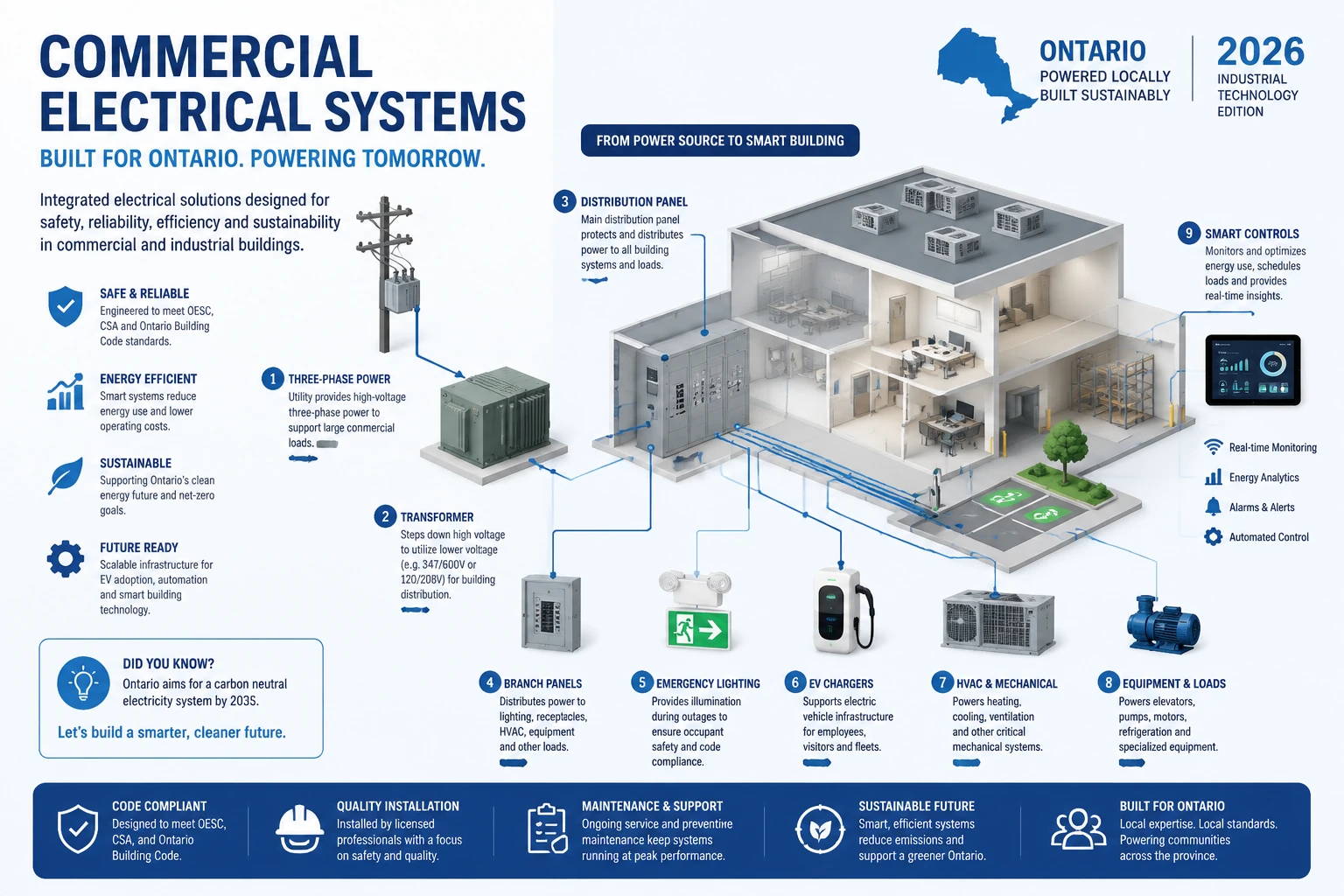
Key Components of Commercial Electrical Systems
Electrical Infrastructure and Equipment
Commercial properties depend on power systems built for scale and safety. While homes use 120/240V single-phase power, most commercial sites operate on 208 or 480V three-phase systems, providing 2–4 times the capacity needed to run everything from elevators to industrial machinery.
Picture this: in a bustling data center, three-phase power ensures uninterrupted performance for racks of servers, while a hospital relies on the same system for critical lifesaving equipment.
Essential building blocks include:
- Main panels and subpanels for distributing large power loads
- Transformers to adapt incoming utility voltages
- Commercial-grade wiring methods, often inside metal conduit for added protection
- Distribution boards for managing multiple circuits safely
Specialized Commercial Installations
Unlike residential setups, commercial spaces require unique safety measures.
- Emergency and exit lighting for safe egress in the event of power loss
- Integrated fire alarm systems for regulatory compliance
- Backup generators to ensure operations during outages
You’ll also find robust circuit protection devices—breakers, surge protectors, and load management systems—to meet code and prevent downtime.
Common Commercial Electrical Applications
Here’s where powerful infrastructure meets everyday needs. Businesses rely on high-capacity circuits for:
- Large HVAC systems, zone lighting controls, and specialized manufacturing equipment
- Kitchens, data centers, or tech labs demanding dedicated, high-amperage feeds
Key essential services also include:
- Egress lighting mandated by safety codes
- Advanced security systems
- Life-safety installations that must always remain operational, even during emergencies
Maintenance and Inspections for Risk Reduction
It’s not just about installation—regular inspections and proactive maintenance are the backbone of safe, reliable operations.
Best practice for Ontario includes:
- Annual compliance checks
- Detailed visual assessments by 442A-certified electricians
- Scheduled upgrades for aging equipment or evolving code standards
Fast Facts and Immediate Takeaways
- Three-phase power is often the unsung hero behind commercial uptime and capability.
- Emergency systems—like fire alarms and exit lights—are legally required for most workplaces and must meet Ontario’s strict Electrical Safety Code.
- Ongoing inspection isn’t just smart—it’s mandatory risk management.
Knowing which systems and services are critical means you’ll never overlook the backbone of every safe, efficient commercial environment. Expect these core components as standard in any credible commercial electrical project—because powering Ontario the right way always starts with the right foundation.
Key Differences: Commercial vs. Residential Electrical
Commercial electrical work isn’t just “bigger”—it’s fundamentally different from residential jobs in every way that matters.
Scope and scale diverge sharply: commercial services often mean full-building upgrades, major energy management programs, or system-wide renovations—far beyond home lighting swaps or outlet repairs.
Project Demands and Compliance
In commercial environments like office towers, factories, or hospitals, jobs involve:
- Complex renovations spanning multiple floors or entire facilities
- Integrated energy controls for lighting and HVAC
- Upgrades powering 100+ workstations, heavy machinery, or data servers
Homes, by contrast, might only need single-room rewiring or appliance circuit fixes.
Compliance is relentless: Commercial jobs must always follow the Ontario Electrical Safety Code, with:
- Frequent, detailed inspections throughout the project
- Rigorous documentation requirements before, during, and after installation
- Ongoing routine checks for safety and compliance
Every stage is tracked. Missing a permit or inspection can mean costly delays.
Expertise, Credentials, and Risk Profiles
Commercial electricians must be 442A-certified, experienced with 208/480V three-phase power—often up to 4x higher capacity than home systems.
These specialists tackle:
- High-voltage panels and subpanels
- Backup power and redundancy systems crucial for critical businesses
- Dense wiring, network integration, and emergency systems
Residential electricians usually work with lower voltages and less complex layouts.
Costs, Customer Expectations, and Critical Uptime
Costs soar for commercial jobs—often 10x that of residential. Reasons include:
- Specialized engineering and design
- Commercial-grade materials and equipment
- Multiple inspection and testing phases
Clients expect:
- Long-term, disruption-free performance
- Zero-tolerance for downtime
- Full transparency and post-project support
Ask any Ontario property manager: there’s no margin for error when a lighting failure could halt a warehouse, or an outage threatens hospital safety.
Picture this: A restaurant loses power during rush hour—not just an inconvenience, but lost revenue and spoiled goods. Commercial electrical work builds in redundancy so that simply doesn’t happen.
Takeaway: Commercial electrical projects demand advanced skill, strict code adherence, more investment, and zero compromise on uptime or safety. Choosing a certified, accountable partner isn’t optional—it’s essential for every Ontario business powering for growth in 2026.
For a deeper understanding of modern systems, compliance requirements, and emerging technologies, you can explore our detailed pillar resource on Commercial Electrical Services Ontario, which breaks down everything from licensing standards to smart infrastructure upgrades for 2026. This guide is designed to help property managers and business owners make informed decisions about safety, efficiency, and long-term electrical planning in commercial environments.

Regulatory Standards and Safety in Ontario
The backbone of every commercial electrical project in Ontario is strict adherence to safety and regulatory codes.
Ignoring these isn’t just risky—it exposes businesses to massive liability and operational shutdowns.
Ontario Electrical Safety Code: The Non-Negotiable Standard
Every commercial job must comply with the latest Ontario Electrical Safety Code (OESC).
This code sets the baseline for:
- Wiring methods and installation standards
- Circuit and equipment protection
- Emergency systems, life-safety, and egress lighting requirements
For larger, specialized projects, contractors also reference the Canadian Electrical Code and key North American standards.
Picture this: An Ontario business fails to update exit lighting to current code—after a routine inspection, they face costly repairs, possible fines, and even a halt on operations until fixed.
Permitting, Inspections, and Documentation
No permit? No power. The law requires all commercial electrical work to be:
- Properly permitted before starting
- Inspected by the Electrical Safety Authority (ESA) at defined milestones
- Documented through as-built plans, test results, and compliance reports
Inspections aren’t a one-off—they’re triggered by renovations, upgrades, or periodic regulatory requirements.
Safety Protocols: Every Project, Every Day
On-site safety is non-negotiable.
Crews follow a mandated system, including:
- Lockout/tagout procedures for every main panel service
- Mandatory PPE: gloves, insulated tools, arc-flash gear
- Safety signage and hazard notifications on active worksites
- Scheduled, certified safety training for all team members
Licensed electricians (like 442A-certified pros) are legally accountable for jobsite practices and must stay up to date.
Ongoing Education and Compliance: Staying Ahead
Regulations change fast. By 2026, new OESC updates will mandate energy management provisions, enhanced data reporting, and stricter service documentation.
Forward-thinking contractors invest in:
- Regular code update seminars
- Digital compliance platforms for documentation and quick data retrieval
- Safety briefings for both staff and clients
“Compliance isn’t a one-time thing—it’s a continuous process that protects people and businesses every day.”
“Every corner cut on compliance is a shortcut to risk.”
“You can spot a professional by their documentation as easily as their tool belt.”
Staying current with standards doesn’t just keep your property legal—it’s how Ontario businesses avoid shutdowns, insurance nightmares, and real-life hazards on the ground.
Compliance is the difference between a safe operation and a story on the evening news.
Top Trends and Emerging Technologies in 2026
Smart Electrical Systems, IoT, and AI
Today’s commercial properties are prioritizing smart electrical systems that combine IoT sensors, AI-driven analytics, and automated controls.
These technologies enable:
- Real-time monitoring of power usage, temperature, and faults
- Automated scheduling for lighting, HVAC, and critical loads
- Remote diagnostics and predictive maintenance that lower operating costs
Adoption rates are soaring in industrial and office facilities as companies target higher uptime and energy efficiency.
Picture this: A facility manager checks live energy stats from their phone, spotting issues before they cause faults—this is the reality for over 40% of new Ontario builds entering 2026.
Electric Vehicle (EV) Infrastructure
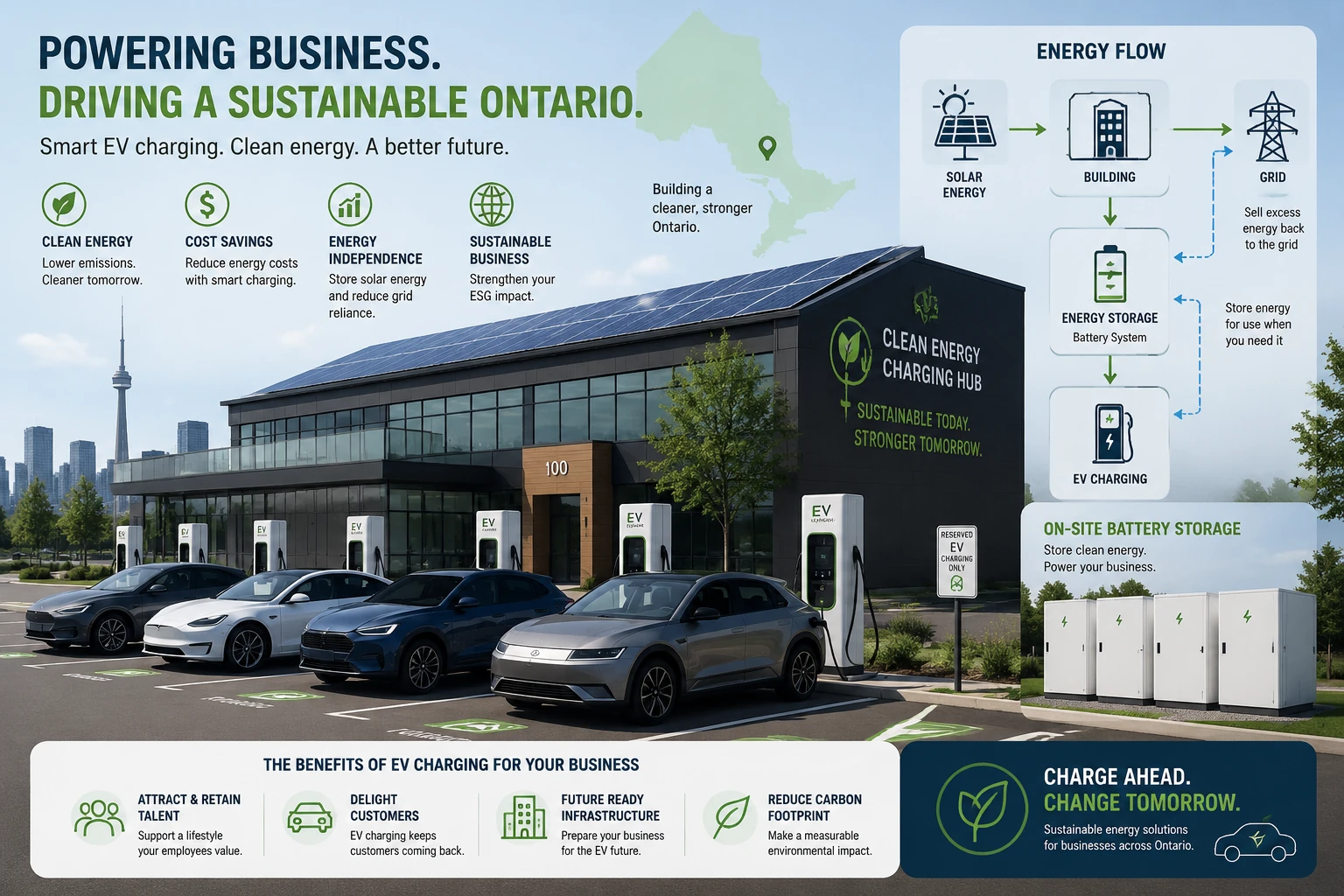
The demand for EV charging stations in commercial lots is growing fast.
Workplaces and fleet hubs are:
- Installing Level 2 and Level 3 chargers to meet sustainability targets
- Navigating installation and retrofit hurdles, especially in older buildings lacking spare capacity
- Tapping into Ontario and North America’s aggressive climate goals—where EV charger installs surged 60% last year
Imagine a business where green vehicle fleets charge overnight, all monitored by an integrated dashboard.
Renewable Energy and Sustainability Measures
Businesses are actively investing in:
- Solar panel installations and grid-tied battery storage
- LED retrofits and smart controls for every lighting zone
- Achieving green certifications like LEED and Energy Star, now a deciding factor in commercial leasing and upgrades
Commercial electrical teams play a critical role in helping buildings move toward net-zero emissions.
One shareable fact: Green retrofits and renewables can cut utility bills for Ontario businesses by up to 40% over five years.

Energy Management Systems (EMS) and Grid Modernization
Larger properties now rely on energy management systems (EMS) to:
- Analyze and automate building-wide power use
- Support demand response and optimize load during peak hours
- Integrate seamlessly with smart grids and backup power for uninterrupted operation
EMS upgrades deliver measurable benefits: lower energy costs, increased reliability, and rapid troubleshooting—all essential for business continuity.
New federal and provincial investments are making it easier than ever to modernize your building’s infrastructure.
Staying ahead with advanced electrical systems means boosting your energy savings, meeting tough codes, and building for the future—three priorities every Ontario business can act on right now.
The Commercial Electrical Market Outlook
Market Size, Demand Drivers, and Industry Growth
Commercial electrical services are booming, with the U.S. market topping $25 billion in 2024 and Ontario’s segment mirroring this rapid growth.
By 2034, forecasts show the North American electrical services market reaching $294.6 billion, a jump powered by:
- Construction booms—new business parks, logistics hubs, and smart buildings are driving demand
- Data center expansion—cloud, 5G, and AI growth require massive power upgrades
- Nationwide electrification—from EV charging to heat pumps, more sectors are going all-electric
- Clean energy investments—solar panels, battery storage, and LED retrofits are now standard in new projects
Federal and Ontario-specific programs (like IIJA/IRA funding and local grid renewal efforts) inject billions into upgrades, making energy resilience and future-ready infrastructure non-negotiable for commercial clients.
“Every major renovation now asks about EV charging, automation, and smart power from day one.”
Cost Structure and Investment Planning
Commercial electrical projects are more than just wire and labor; they’re sophisticated investments with stringent safety and compliance demands.
Your budget will typically break down as:
- Labor/contracting—up to 50% of costs, reflecting the need for 442A-certified professionals and advanced skills
- Materials and technology—think heavy-duty cable, energy management systems, backup generators, and high-capacity panels
- Compliance and inspections—multiple permit and inspection rounds are mandatory, often adding 10-20% for documentation/safety testing
- Engineering and project management—crucial for planning, integration, and regulatory approvals
Expect commercial jobs to run up to 10x the cost of similar residential projects due to:
- Larger scale (thousands of amps, not dozens),
- Redundancy requirements (emergency power, backup supplies),
- Precision documentation for insurance and liability
Visualize this: A typical Ontario retail upgrade—with new LED lighting, panels, and a small fleet EV charger—often ranges from $60,000 to $250,000+, especially in urban centers.
“Budgeting for smart tech and resiliency isn’t a luxury—it’s how you future-proof your building.”
Commercial electrical investment today means staying competitive, compliant, and ready for the next decade of change. Prioritizing skilled electricians, code adherence, and future-ready upgrades is the actionable path Ontario businesses must take.
Choosing a Commercial Electrical Partner: What to Look For
Selecting the right commercial electrical contractor determines not just your project’s safety, but the long-term reliability of your business infrastructure.
Expect every provider to hold valid licensing, 442A Electrical Certification, and comprehensive liability insurance—these are not optional in Ontario.
Credentials That Protect You
Before any work begins, confirm these essentials:
- Ontario Master Electrician License
- 442A Commercial/Industrial Electrician Certification
- Proof of insurance and WSIB clearance
- Documented adherence to the Ontario Electrical Safety Code
A certified team means safer installs, smoother inspections, and full regulatory compliance.
Signs of a Reliable Electrical Partner
Trustworthy contractors stand out by:
- Providing clear, transparent quotes with no hidden fees
- Showcasing recent, relevant project portfolios—think real office retrofits or EV charger installs, not generic stock images
- Demonstrating a relentless focus on site safety
- Citing regular safety training and ongoing education for every technician
“Professionalism is verified by the jobs they’ve finished, not what they promise during a sales call.”
What to Ask Before You Hire
Don’t settle for vague answers—ask questions like:
- How many large-scale projects have you managed this year?
- Do you specialize in modern systems like smart controls and EV infrastructure?
- Can you walk me through your compliance and inspection process?
- What’s your plan for ongoing support after the initial installation?
Picture this: You’re expanding your facility’s data center. You want a contractor who can upgrade you to 480V three-phase service with zero downtime, keeps the documentation airtight, and delivers future-ready power capacity.
Looking Beyond Today: Future Support
Choose a partner who:
- Offers maintenance programs for reliability and risk mitigation
- Is proactive about upgrades for new codes and tech trends
- Advises on sustainability investments (think solar panel integration or energy management systems)
“A top-tier contractor doesn’t just install panels—they help power your next decade of growth.”
Choosing wisely gives you peace of mind and ensures your investment meets Ontario’s evolving electrical, safety, and environmental standards. Rely on clear certification, proof of reliability, and a shared vision for safe, future-ready workplaces.
We also provide [Commercial Electrical Installation] for large-scale facilities across Ontario.
Real-World Examples and Project Spotlights
Ontario’s Commercial Electrical Success Stories
Picture this: a downtown Toronto office transformed with LED retrofits and smart automation for lighting and HVAC controls, slicing energy costs by 23% within six months.
In Ottawa, a distribution hub gains around-the-clock reliability after installing a new emergency power system—seamlessly stepping in during outages so operations never skip a beat.
In the last year alone, Ontario businesses investing in smart commercial upgrades frequently cite:
- Energy savings of 15–35% due to efficient controls
- Improved uptime and safety thanks to modern backup generators
- Smoother day-to-day operation from tailored maintenance plans
Service in Action: EV Charging, Office Retrofits, and More
Trusted electricians are wiring the future—think sprawling EV charger installations for commercial fleets in Mississauga.
Restaurants and condo towers in Hamilton now report fewer power disruptions after subpanel upgrades and targeted surge protection.
Recent commercial projects in Ontario typically include:
- Custom EV charging solutions for staff and public parking
- Office-to-healthcare space retrofits, ensuring clinics meet strict life-safety code compliance
- Emergency and egress lighting improvements for warehouses, boosting both productivity and worker confidence
Real Technicians, Real Results
Every project features licensed, 442A-certified electricians photographed on site, working with visible PPE and proper signage—showing the value of firsthand expertise over generic “stock” images.
Clients say things like:
- “We can finally grow our business knowing our power is safe and reliable.”
- “The team’s communication and focus on compliance set them apart.”
- “Upgrades paid for themselves in a year—energy savings and peace of mind.”
Takeaway: Safety, Savings, and Reliability You Can See
Whether you manage an industrial site, a busy office, or a specialty clinic, these Ontario project spotlights prove that modern electrical services deliver quantifiable savings, real compliance, and powerful peace of mind.
Investing in compliant, future-ready upgrades today means your operations stay safer, smoother, and more resilient—just like these real-world results.
Education, Training, and Career Pathways in Commercial Electrical Work
Start with Mandatory Training and Certification
Becoming a commercial electrician in Ontario begins with a formal apprenticeship—usually 9,000 hours of paid training over roughly five years.
You’ll need a Certificate of Qualification (C of Q) and, for commercial or industrial projects, a Red Seal and 442A (Industrial Electrician) or 309A (Construction & Maintenance) designation.
Key steps include:
- Registering with the Ontario College of Trades
- Completing secondary school (math and tech credits recommended)
- Signing on with a licensed sponsor or employer
- Attending in-class training at an accredited college or trade school
- Passing a formal written exam for certification
Only licensed electricians can legally perform or supervise commercial work—this keeps clients safe and compliant.
—
Core Competencies for the Commercial Sector
Expect to handle complex systems, high-voltage panels, and critical life-safety devices.
You’ll develop hands-on, in-demand skills in areas such as:
- Blueprint reading and circuit design
- Diagnosing and repairing three-phase power (208/480V)
- Working with emergency lighting, fire alarms, backup generators, and control systems
- Mastering load calculations, energy management, and code compliance
- Safe use of PPE, lockout/tagout protocols, and site documentation
Picture this: You’re on a bustling hospital retrofit, coordinating a team through live power upgrades—precision and safety aren’t optional, they’re mission-critical.
—
The Fast-Evolving Tech Landscape
Staying ahead means embracing continuous learning. Ontario’s code updates every three years—missing a change can mean costly mistakes.
You’ll need to keep pace with:
- Smart building controls, IoT systems, and energy analytics
- EV charging infrastructure, solar/battery integration
- New safety protocols and digital inspection/reporting tools
Training never stops; employers often require annual safety refreshers and tech updates.
—
Opportunities in a Booming Market
By 2034, North America’s electrical market will top $290 billion, with commercial work leading the surge in Ontario.
Today’s demand is sky-high for:
- Certified project managers for large upgrades
- Technicians with advanced green and smart tech credentials
- Specialists in energy management and grid modernization
“Future-focused electricians are shaping Ontario’s most sustainable workplaces—your skills are the backbone of tomorrow’s commercial landscape.”
—
Building a career in commercial electrical means investing in lifelong learning, advanced credentials, and a dedication to code-compliant quality—your expertise is powering Ontario, the right way.
Conclusion
Commercial electrical services are more than just a technical necessity—they’re the backbone of every safe, efficient, and future-ready business space in Ontario.
Making proactive choices now lays the groundwork for uptime, compliance, and long-term cost savings, giving you the confidence to grow without risk or disruption.
—
Key takeaways for powering your next commercial project:
- Insist on 442A-licensed electricians for all commercial work—safety and compliance aren’t negotiable.
- Prioritize documented code compliance and clear communication from your contractor at every stage.
- Invest in smart upgrades—like EV charging, energy management systems, or LED lighting—to drive efficiency and future-proof your space.
- Schedule routine maintenance and inspections to minimize downtime and extend equipment life.
- Verify real project experience—request portfolios and references that show proven results, not stock promises.
—
Next steps you can take today:
- Review your current electrical setup for potential upgrades or inefficiencies.
- Contact a certified commercial electrical partner to discuss your goals—ask about code compliance, sustainability, and custom solutions.
- Book a site assessment to identify safety gaps and opportunities for smart technology integration.
—
Every decision you make about your building’s electrical backbone impacts safety, productivity, and growth potential.
Choose expertise. Demand transparency. Build for tomorrow.
When you power up the right way, you’re not just turning on the lights—you’re brightening Ontario’s future for everyone who depends on your business.
Commercial systems must follow the Ontario Electrical Safety Code as outlined by the Electrical Safety Authority.
FAQ
What are commercial electrical services?
Commercial electrical services involve the installation, maintenance, repair, and upgrading of electrical systems in businesses, offices, warehouses, hospitals, retail stores, and industrial facilities. These services include lighting, power distribution, three-phase systems, EV charging stations, backup generators, and code-compliant safety systems.
Why are commercial electrical services important in Ontario?
Commercial electrical services Ontario businesses rely on are essential for workplace safety, energy efficiency, operational uptime, and compliance with the Ontario Electrical Safety Code. Proper electrical systems help prevent downtime, reduce liability risks, and support modern technologies like automation and smart energy management.
What is the difference between commercial and residential electrical work?
Commercial electrical systems are larger, more complex, and operate on higher voltages than residential systems. Commercial projects often involve three-phase power, advanced safety requirements, emergency backup systems, and strict inspections, while residential electrical work focuses on smaller-scale household systems.
Do commercial electricians in Ontario need certification?
Yes. Commercial electricians in Ontario must hold proper licensing and certifications, such as the 442A Industrial Electrician or 309A Construction & Maintenance Electrician certification. Licensed electricians ensure all work meets provincial safety regulations and ESA requirements.
What is three-phase power in commercial buildings?
Three-phase power is a high-capacity electrical distribution system commonly used in commercial and industrial facilities. It provides more efficient and reliable power for large equipment, HVAC systems, elevators, manufacturing machinery, and data centers.

Written by Roozbeh Nahreini
Roozbeh Nahreini is the founder and owner of Padi Electric Inc., an ESA-certified electrical contractor serving Aurora and the Greater Toronto Area. With 10+ years of hands-on electrical expertise and a team combining 50+ years of field experience, Roozbeh specializes in residential and commercial electrical solutions—from panel upgrades and EV charger installation to smart home integration and advanced diagnostics. His commitment to transparent pricing, code-compliant workmanship, and 24/7 emergency response has established Padi Electric as a trusted neighborhood contractor across Aurora, Richmond Hill, Newmarket, Vaughan, and the GTA.