

Cost Factors in Commercial Electrical: What Ontario Businesses Need to Know
Understanding the real cost drivers in commercial electrical services empowers Ontario businesses to budget smartly and make informed hiring decisions. Here’s what matters most when reviewing quotes and planning your next project—the essentials for safe, compliant, and high-quality results:
- Labor dominates total costs, often accounting for 40%–60% of your project budget; investing in skilled, licensed electricians prevents expensive mistakes down the line.
- Electrician rates in Ontario range from $50–$150/hour, with higher prices reflecting job complexity, licensure level, and safety requirements for each project.
- Material quality and sourcing strategy make a significant impact—premium-grade wiring, panels, and fixtures ensure long-term reliability, while effective supplier relationships can reduce spend by up to 15%.
- Equipment rentals and advanced tools may be required for complex work; these are included in transparent quotes to avoid unexpected surcharges later.
- Overhead, insurance, and compliance fees are built-in realities—quality contractors itemize costs for ESA compliance, liability protection, and admin, reflecting true project demands.
- Contingency allowances protect your investment by covering surprises like outdated wiring or unforeseen building challenges—a key part of every reputable estimate.
- Clarity in quoting matters: ask for a detailed breakdown of labor, materials, overhead, and compliance so you can judge value—not just price alone.
- Transparent, safety-first workmanship—not shortcuts—keeps your business powered reliably; a typical office rewire may cost $6–$8 per square foot, but the right partner delivers lasting peace of mind.
Scan these insights before your next commercial project to demand transparency and quality—then dive deeper in the full article for actionable guidance tailored to Ontario’s standards.
What Drives Commercial Electrical Services Costs in Ontario
Ever seen two electrical quotes for the same project differ by thousands—and wondered what’s driving the gap?
Navigating commercial electrical costs isn’t just about the bottom line. It’s about avoiding budget blowouts, ensuring your site stays safe, and working with licensed pros who keep your Ontario business fully compliant. One misunderstanding on costs can lead to surprise fees, expensive mistakes, and code violations you simply can’t afford.
Whether you’re a property manager planning a renovation or a business owner growing your space, every dollar spent should deliver value you can trust—today and for years to come.
Here’s the secret: Transparent quotes break down not just the “how much,” but the “why.” Understanding the key drivers behind every number puts you in control, helping you compare bids fairly and spot the difference between a quick fix and a long-term, reliable investment.
In just a few minutes, you’ll learn:
- What factors make up the true cost of commercial electrical services—from labor to materials, overhead to compliance
- How contractors prioritize transparency, safety, and workmanship to protect your business
- What to watch for in estimates to avoid hidden fees or risky shortcuts
- Why paying for quality now can eliminate headaches and hazards down the line
All with clear, jargon-free explanations designed for decision-makers—not just electricians.
Curious why an office rewire can run $6–$8 per square foot, and what really sets a reliable contractor apart? Let’s break down the numbers, expose the real costs (and savings), and show you how to budget with clarity—so your business stays powered, safe, and hassle-free.
Understanding the Core Cost Factors in Commercial Electrical Services
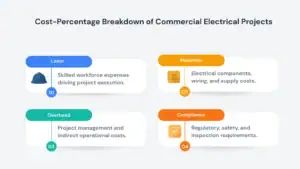
Knowing exactly what drives costs in commercial electrical projects helps Ontario businesses budget with confidence and avoid surprises. Every quote breaks down into four primary areas: labor, materials, overhead, and project complexity.
Expect most reputable contractors to prioritize transparency—explaining not just “what it costs,” but “why it costs that much.”
Labor: The Largest Investment
Labor is the single biggest line item, often making up 40%–60% of commercial job costs.
- Electrician hourly rates in Ontario typically range from $50–$150/hour, depending on experience, licensure, and the job’s complexity.
- Team structure matters: Master electricians, journeymen, and apprentices all play specific roles, and high-risk or complex environments command premium rates.
- Labor costs reflect not just the time on tools, but also:
- Project duration and travel
- Overtime needs
- Required crew size
- Coordination and regulatory documentation
Skilled labor prevents costly rework—paying for expertise now often eliminates headaches later.
Material and Equipment Costs
Material expenses add up fast, driven by both the quality you select and the scope.
- Common items include wiring, breakers, panels, outlets, switches, and connectors.
- Sourcing strategies (like buying from specialty supply houses or big-box retailers) can impact costs by as much as 15%.
- Bulk purchasing or strong supplier relationships reduce per-unit spend.
- Higher-grade materials mean fewer repairs and safer sites, despite greater upfront investment.
- Equipment rentals for lifts, advanced tools, or test instruments may also factor in.
Choosing better materials often equals safer, more reliable commercial spaces—don’t cut corners.
Overhead, Compliance, and Hidden Expenses
Every reliable quote includes overhead costs:
- Insurance (liability, workers’ comp)
- Fleet vehicles and fuel
- Tools, equipment, and their depreciation
- Office rent and utilities
- Admin support and estimating software
- Permits, inspections, and ESA (Electrical Safety Authority) compliance fees
Also, expect built-in contingency allowances to cover surprises like outdated wiring or unexpected building issues.

Compliance with Ontario’s safety codes isn’t optional—it’s a core driver of project costs and peace of mind.
Key Takeaway
When reviewing estimates, insist on a breakdown that details labor rates, material choices, expected overhead, and compliance commitments. Picture this: A modern office rewire might quote $6–$8 per square foot, but the real value comes from transparent pricing, certified expertise, and safety-first workmanship—so your business runs without risky electrical shortcuts.
“Smart clients don’t just compare bottom lines—they compare the story behind every number.”
Cost Factors in Commercial Electrical: What Ontario Businesses Need to Know
Ever seen two electrical quotes for the same project differ by thousands—and wondered what’s driving the gap?
Navigating commercial electrical costs isn’t just about the bottom line. It’s about avoiding budget blowouts, ensuring your site stays safe, and working with licensed pros who keep your Ontario business fully compliant. One misunderstanding on costs can lead to surprise fees, expensive mistakes, and code violations you simply can’t afford.
Whether you’re a property manager planning a renovation or a business owner growing your space, every dollar spent should deliver value you can trust—today and for years to come.
Here’s the secret: Transparent quotes break down not just the “how much,” but the “why.” Understanding the key drivers behind every number puts you in control, helping you compare bids fairly and spot the difference between a quick fix and a long-term, reliable investment.
In just a few minutes, you’ll learn:
- What factors make up the true cost of commercial electrical services—from labor to materials, overhead to compliance
- How contractors prioritize transparency, safety, and workmanship to protect your business
- What to watch for in estimates to avoid hidden fees or risky shortcuts
- Why paying for quality now can eliminate headaches and hazards down the line
All with clear, jargon-free explanations designed for decision-makers—not just electricians.
Curious why an office rewire can run $6–$8 per square foot, and what really sets a reliable contractor apart? Let’s break down the numbers, expose the real costs (and savings), and show you how to budget with clarity—so your business stays powered, safe, and hassle-free.
Understanding the Core Cost Factors in Commercial Electrical Services
Knowing exactly what drives costs in commercial electrical projects helps Ontario businesses budget with confidence and avoid surprises. Every quote breaks down into four primary areas: labor, materials, overhead, and project complexity.
Expect most reputable contractors to prioritize transparency—explaining not just “what it costs,” but “why it costs that much.”
Why Commercial Projects Cost More Than Residential Work
Commercial electrical projects almost always carry a higher price tag than residential jobs, and the reasons go beyond simple square footage. Commercial spaces—offices, retail units, warehouses, and multi-tenant buildings—typically require heavier electrical loads, three-phase power systems, and more complex panel configurations to support equipment like HVAC systems, commercial refrigeration, or specialized machinery.
Building codes also apply differently. Commercial properties are held to stricter ESA (Electrical Safety Authority) standards and often require additional permitting, inspections, and coordination with property management, fire safety systems, and other trades on site. This added coordination takes time, and time is money.
For businesses across Aurora, Markham, Vaughan, Richmond Hill, and Thornhill, understanding this distinction early helps set realistic budget expectations before quotes even arrive—and prevents the sticker shock that comes from comparing a commercial estimate to a residential one.

Labor: The Largest Investment
Labor is the single biggest line item, often making up 40%–60% of commercial job costs.
- Electrician hourly rates in Ontario typically range from $50–$150/hour, depending on experience, licensure, and the job’s complexity.
- Team structure matters: Master electricians, journeymen, and apprentices all play specific roles, and high-risk or complex environments command premium rates.
- Labor costs reflect not just the time on tools, but also:
- Project duration and travel
- Overtime needs
- Required crew size
- Coordination and regulatory documentation
Skilled labor prevents costly rework—paying for expertise now often eliminates headaches later.
How Project Scope Shapes the Labor Bill
Not all commercial jobs require the same crew size or skill level, and this is where quotes can vary widely between contractors bidding on the same project. A small tenant fit-out with a handful of new outlets and light fixtures might only need one or two electricians for a day or two. A full commercial rewire, panel upgrade, or new construction build-out, on the other hand, may require a multi-person crew working over several weeks, with a master electrician overseeing code compliance and permit sign-off at every stage.
Timing also plays a role. Projects that need to happen after hours or on weekends—common for retail spaces or restaurants that can’t afford daytime downtime—often carry overtime premiums. Businesses that can offer contractors flexible scheduling sometimes see meaningful savings simply by avoiding rush or after-hours rates.
Material and Equipment Costs
Material expenses add up fast, driven by both the quality you select and the scope.
- Common items include wiring, breakers, panels, outlets, switches, and connectors.
- Sourcing strategies (like buying from specialty supply houses or big-box retailers) can impact costs by as much as 15%.
- Bulk purchasing or strong supplier relationships reduce per-unit spend.
- Higher-grade materials mean fewer repairs and safer sites, despite greater upfront investment.
- Equipment rentals for lifts, advanced tools, or test instruments may also factor in.
Choosing better materials often equals safer, more reliable commercial spaces—don’t cut corners.
Why Material Grade Matters More in Commercial Settings
In a commercial environment, electrical systems typically run longer hours under heavier loads than in a home, which makes material quality a bigger factor in long-term cost. Cutting corners on wiring gauge, panel capacity, or connector quality might shave a few hundred dollars off an upfront quote, but it often shows up later as flickering lights, tripped breakers, or premature equipment failure—all of which mean additional service calls and downtime for your business.
Established contractors typically build relationships with trusted supply houses, which not only helps control material costs but also ensures products meet current ESA and Ontario Building Code standards. When comparing quotes, it’s worth asking exactly which brands and grades of materials are being used, since “materials included” can mean very different things depending on the supplier.
Overhead, Compliance, and Hidden Expenses
Every reliable quote includes overhead costs:
- Insurance (liability, workers’ comp)
- Fleet vehicles and fuel
- Tools, equipment, and their depreciation
- Office rent and utilities
- Admin support and estimating software
- Permits, inspections, and ESA (Electrical Safety Authority) compliance fees
Also, expect built-in contingency allowances to cover surprises like outdated wiring or unexpected building issues.
Compliance with Ontario’s safety codes isn’t optional—it’s a core driver of project costs and peace of mind.
The Real Cost of Skipping Permits or Compliance Steps
It can be tempting to work with a contractor who quotes a lower price by skipping permits or inspections, but this shortcut rarely pays off. Unpermitted electrical work can void insurance coverage, create liability issues if something goes wrong, and cause major complications if you ever sell or lease the property, since unpermitted work typically has to be exposed, inspected, and corrected retroactively.
ESA compliance fees and inspection costs are a small fraction of a total project budget, but they protect a business from far larger risks down the line. A contractor who builds these costs transparently into their quote from the start—rather than treating them as an afterthought—is generally a stronger sign of reliability than one who appears cheaper on paper.
How to Compare Commercial Electrical Quotes Fairly
Because commercial electrical quotes can vary so widely, side-by-side comparisons only work when you’re comparing apples to apples. Two contractors quoting the same job can arrive at very different numbers depending on what’s included, what’s assumed, and how much contingency is built in.
When reviewing multiple quotes, look for:
- A clear breakdown of labor, materials, overhead, and compliance costs—not just a single lump sum
- Confirmation that ESA permits and inspections are included, not billed separately later
- Details on the grade and brand of materials being used
- Whether contingency for unforeseen issues (like outdated wiring behind walls) is already factored in
- The contractor’s licensing status and insurance coverage, confirmed in writing
A lower quote that leaves out permits, uses lower-grade materials, or has no contingency plan often ends up costing more once change orders start arriving mid-project.
Key Takeaway
When reviewing estimates, insist on a breakdown that details labor rates, material choices, expected overhead, and compliance commitments. Picture this: A modern office rewire might quote $6–$8 per square foot, but the real value comes from transparent pricing, certified expertise, and safety-first workmanship—so your business runs without risky electrical shortcuts.
“Smart clients don’t just compare bottom lines—they compare the story behind every number.”
Powering Your Next Project with Confidence
Clear, upfront understanding of commercial electrical service costs puts you in control—empowering you to plan with confidence, avoid unnecessary setbacks, and keep your organization protected. Transparent pricing isn’t just about numbers; it’s about building trust and ensuring every investment delivers safety, compliance, and peace of mind for your business.
Stepping into your next project, keep these essentials in focus:
- Insist on a detailed estimate that breaks down labor, materials, overhead, and compliance—never settle for vague pricing.
- Prioritize certified, safety-first electricians who follow Ontario’s regulations; the right team dramatically reduces risk and rework.
- Ask about material options and their long-term benefits—investing in quality pays dividends in reliability and fewer disruptions.
- Make sure your contractor includes contingencies for surprises, from old wiring to unforeseen building issues.
- Stay engaged throughout the process—regular communication prevents scope creep and keeps you informed every step of the way.
Ready to move forward?
- Gather at least two clear, itemized quotes for your next job—compare more than just price; look for clarity and expertise.
- Schedule a consultation to discuss your project’s specifics, and ask questions about safety, compliance, and material options.
- Bookmark this guide, and share it with your team or network—empowered clients drive better project outcomes.
When it comes to commercial electrical work, transparency isn’t just a feature—it’s the foundation. Power your business with informed choices, skilled partners, and a commitment to safety that never takes shortcuts.
Electrical excellence isn’t just in the wiring—it’s in every informed decision you make along the way.
FAQ
- How much do commercial electrical services cost in Ontario?
Commercial electrical services in Ontario typically range from $50–$150 per hour for labor, with a full office rewire costing $6–$8 per square foot depending on complexity, materials, and compliance requirements. - What factors affect the price of commercial electrical services?
The cost of commercial electrical services depends on labor, material quality, overhead, ESA compliance fees, and project complexity, with labor alone accounting for 40%–60% of the total budget. - How can I get an accurate quote for commercial electrical services?
Request a detailed, itemized breakdown from any provider of commercial electrical services, covering labor rates, material costs, overhead, and contingency allowances so you can compare bids fairly. - Are licensed electricians required for commercial electrical services in Ontario?
Yes, Ontario businesses should only hire licensed professionals for commercial electrical services to ensure ESA compliance, workplace safety, and long-term reliability. - Why do commercial electrical services quotes vary so much between contractors?
Quotes for commercial electrical services vary based on labor rates, material sourcing strategies, overhead costs, and how thoroughly a contractor accounts for contingencies and compliance.

Written by Roozbeh Nahreini
Roozbeh Nahreini is the founder and owner of Padi Electric Inc., an ESA-certified electrical contractor serving Aurora and the Greater Toronto Area. With 10+ years of hands-on electrical expertise and a team combining 50+ years of field experience, Roozbeh specializes in residential and commercial electrical solutions—from panel upgrades and EV charger installation to smart home integration and advanced diagnostics. His commitment to transparent pricing, code-compliant workmanship, and 24/7 emergency response has established Padi Electric as a trusted neighborhood contractor across Aurora, Richmond Hill, Newmarket, Vaughan, and the GTA.