

Commercial Electrical Installation Services are the foundation of safe, compliant, and uninterrupted business operations across Ontario.
- Always require licensed electricians—Ontario law mandates licensed, insured professionals for all commercial work to ensure compliance and safety on every project.
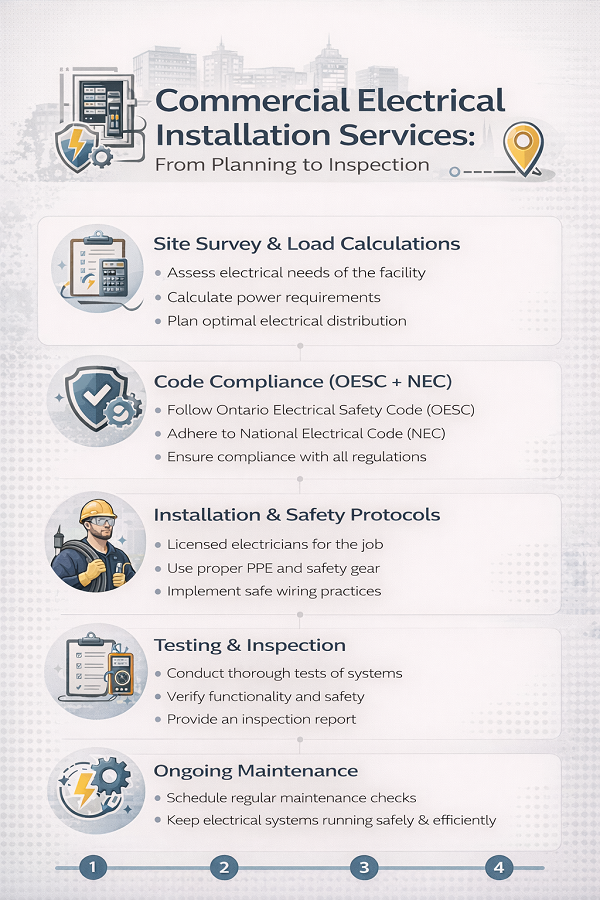
- Code compliance isn’t optional—Rigorous adherence to the Ontario Electrical Safety Code (OESC) and NEC standards avoids costly inspection failures, fines, and business downtime.
- Comprehensive planning prevents delays—Kick off every project with a full site survey, load calculations, and engineered schematics, ensuring smooth execution and future scalability.
- Installations must be tailored for your business—From LED lighting that can cut energy use by 40% to specialized emergency and automation systems, choose solutions that match your specific needs and industry.
- Safety is non-negotiable—Strict PPE, lockout/tagout, and QA protocols reduce risk, protect people, and set your facility up for long-term reliability and peace of mind.
- Insist on thorough testing and documentation—Demand detailed as-built drawings, test records, and transparent inspection reports at project close for code compliance and future upgrades.
- Ongoing maintenance pays off—Routine inspections and service scheduling reduce emergency repairs, extend asset life, and maintain insurance compliance.
- Choose partners who communicate and educate—The best contractors provide clear project plans, open updates, and fast post-installation support, ensuring your facility is always “powered the right way.”
Choosing the right commercial electrical installation partner is a strategic move—review the full guide to ensure your next project is smart, safe, and future-ready.
Introduction
One overlooked electrical code violation can shut your business down for days—and cost you thousands in lost revenue. For Ontario property managers and business owners, the difference between a grand opening and a failed inspection often comes down to the quality of your commercial electrical installation.
Imagine upgrading your workspace with smart lighting that slashes energy costs by 40%—or navigating a project so smooth, every panel, emergency light, and system passes on the first try. When your operation depends on compliant wiring, reliable power, and safety-first design, there’s zero room for shortcuts.
If you’re planning new construction, a renovation, or a tenant fit-out, it’s not just about getting the lights on—it’s about:
- Ensuring every install meets Ontario’s strict codes
- Reducing downtime and headaches with future-ready solutions
- Choosing a contractor who stands behind their work with real, transparent documentation
The right electrical partner safeguards your reputation, protects occupants, and keeps your business running no matter what. And with 73% of inspection failures tied to preventable mistakes, knowledge and preparation are your most valuable assets.
In this guide, you’ll discover exactly what sets commercial electrical installation apart—from planning and compliance, to specialized systems and ongoing maintenance—so your next project is safe, efficient, and built for Ontario’s unique demands.
Let’s take a closer look at what goes into a successful commercial electrical installation—and how you can avoid costly setbacks from the start.
Understanding Commercial Electrical Installation Services
Commercial electrical installation is all about equipping business spaces—like offices, retail, warehouses, and restaurants—with the right power, lighting, and control systems. This work is far more complex than what you’d find in a typical home.
Unlike residential setups, commercial projects demand higher power capacities, advanced safety standards, and strict code compliance. Systems need to be scalable, future-ready, reliable under heavy loads, and safe for diverse users.
A single commercial installation touches every corner of your operation: When done professionally, you limit downtime, enhance safety, and keep your business compliant. Did you know? Non-compliant installs can shut down your operations—costing thousands per day.
What’s Included in Commercial Installations?
Expect a comprehensive approach. The main service categories are:
- Wiring and cabling (for power, data, and specialized equipment)
- Equipment installation (panels, disconnects, HVAC controls)
- Power distribution and panels (main and subpanels, load centers)
- Lighting systems (LED, high-bay, emergency, and automated controls)
- Control and automation systems (building management, energy monitoring)
- Safety implementations (grounding, emergency lighting, egress signage, fire alarms)
- Specialty systems (EV charging, healthcare, industrial hazardous locations)
Picture this: An Ontario retail tenant fit-out includes smart lighting that cuts energy use by 40%, a safety-compliant power distribution system, and labeled emergency exits, all inspected and approved before opening day.
When Are These Services Needed?
You’ll need commercial installation services for nearly every change to your business space, including:
- New construction projects—core electrical infrastructure from the ground up.
- Renovations and upgrades—modernizing wiring, lighting, or equipment.
- Tenant fit-outs—customizing units for new businesses or layouts.
- Compliance retrofits—bringing older facilities up to code and insurance standards.
If your facility is expanding, switching tenants, or updating old systems for safety/efficiency, it’s time to call in the experts. A single faulty breaker or missed code requirement can result in failed inspections or even insurance claim denials.
What Sets Commercial Electrical Installs Apart?
Faultless commercial installs keep Ontario’s businesses open, safe, and future-ready. The most successful projects always start with licensed pros who value code compliance, clear documentation, and consistent communication.
Ready for your project to power up the right way? Choose a partner who puts safety, integrity, and customer satisfaction first. That’s how Ontario businesses stand out—and stay powered.
Regulatory Compliance and Industry Standards
NEC, Provincial Codes, and Local Amendments
Every commercial electrical installation in Ontario must follow rigorous safety codes. The National Electrical Code (NEC/NFPA 70) sets the standard for safe electrical design and installation across North America.
In Ontario, the Ontario Electrical Safety Code (OESC) is paramount. It integrates NEC guidance but adds provincial requirements tailored to our environment and industries.
Local compliance is not optional. The Authority Having Jurisdiction (AHJ) has the final say, and oversight is strict. Failing an AHJ inspection can lead to:
- Costly project delays and rework
- Hefty fines for non-compliance
- Liability for accidents or downtime
Picture this: Inspectors at a new downtown Toronto site flag outdated wiring and improper labeling—work halts until all corrections are made, costing days or even weeks.
“Meeting code isn’t just a legal box—it’s the foundation for safe, uninterrupted business operations.”
Key NEC Articles for Commercial Installations
The NEC is loaded with rules, but a few articles define commercial projects:
- Article 210: Branch circuits (“Size conductors at 125% of continuous loads”)
- Article 220: Load calculations (“Factor in occupancy and equipment diversity”)
- Article 250: Grounding/bonding (“Proper equipment grounding conductor sizing is non-negotiable”)
- Article 430: Motors (“Require overload protection at 115-125%”)
- Article 700: Emergency systems (“All feeders must be 90-minute fire-rated”)
- Article 517: Healthcare (“Demand isolated ground systems for patient safety”)
| NEC Article | Focus Area | Notable Requirement |
|————-|——————–|———————————————-|
| 210 | Branch Circuits | 125% sizing for continuous loads |
| 220 | Load Calculations | Occupancy-based demand factors |
| 250 | Grounding/Bonding | Equipment grounding conductor sizing |
| 430 | Motors | Overload protection at 115-125% |
| 700 | Emergency Systems | 90-minute fire rating for feeders |
| 517 | Healthcare | Isolated ground systems |
Top causes of failed inspections include:
- Improper clearances (Art. 110.26)
- Inadequate grounding
- Missing or mislabeled emergency separations
- Overcurrent protection issues
Seventy-three percent of failures are tied to these avoidable missteps.
Licensing, Certifications, and Quality Standards
Never gamble on unlicensed or uninsured contractors—Ontario law requires licensed electricians for all commercial work.
Key checkpoints for every project:
- Proof of ESA-licensed electrical contractor status
- WSIB and $5M liability insurance
- Up-to-date certifications and industry training
Smart business owners go further: They insist on:
- Contractors who use National Electrical Installation Standards (NEIS) for workmanship
- Proactive scheduling of inspections and transparent documentation
- Teams dedicated to ongoing safety, code updates, and communication
“Trust isn’t built on the lowest bid—it’s built on visible credentials and clean, compliant work, every time.”
Staying 100% code-compliant protects you from legal trouble, unexpected downtime, and high repair bills. The right electrical partner ensures your project meets today’s standards—and stands up to tomorrow’s inspections.
The End-to-End Installation Process
Project Planning and Design
Proper planning is the difference between a smooth, code-compliant installation and a costly, disruptive project.
The process always begins with:
- Comprehensive site survey to assess current electrical infrastructure
- Needs assessment: square footage, intended use, specialty equipment
- Code and standards review based on the latest Ontario Electrical Safety Code (OESC)
- Engineered drawings and electrical schematics developed by certified professionals
- Permitting: applying for municipal and OESC-required permits
Each commercial project requires precise load calculations, factoring in:
- Demand factors for occupancy, usage, and specialized equipment
- Voltage drop limits (keep under 3% for efficiency per NEC/CSA best practices)
- Future-proofing to support expansions or tech upgrades without major rewiring
Collaboration is key—experienced electricians coordinate with architects, engineers, and trades to ensure the electrical design works seamlessly with the overall build.
“Every successful installation starts with a blueprint that leaves nothing to chance.”
—
Pre-Installation and Site Preparation
Before tools come out, the site must be ready and safe.
Key steps include:
- Setting up temporary power so other contractors and equipment can operate during the build
- Securing the work zone with barriers, signage, and hazard controls
- Selecting only UL/CSA-approved materials to guarantee compliance and safety
- Pre-installation safety checks following lockout/tagout (LOTO) and PPE protocols
Consistent updates to all project stakeholders on:
- Detailed timelines
- Risk and contingency planning for supply chain or weather delays
- Site access scheduling to prevent overlap and downtime
“Picture a real technician double-checking every outlet, wearing safety-yellow gloves, while blueprints and schedules guide the entire team—this is project readiness in action.”
—
Core Installation Activities
#### Main Service Installation
A commercial main service involves:
- Installing the service entrance (where utility power enters)
- Mounting main panels, busbars, and bonding/grounding to OESC code
- Designing power distribution to match the type of business—think robust systems for manufacturing, balanced circuits for offices, retail-ready setups
#### Wiring and Conduit Systems
Electrical ‘arteries’ are routed using:
- PVC, EMT, or metal conduit for wet/hazardous spaces
- Raceways, tray, or cable methods for open office or retail ceilings
- Busways in large-scale industrial builds
Code-mandated outlet spacing, GFCI/AFCI protection in wet and general areas, and expansion-friendly routing are critical.
#### Equipment and Device Installations
Installers:
- Mount panels, breakers, and disconnects—separating emergency circuits from normal power
- Fit lighting fixtures (LED, task, high-bay) for function, efficiency, and code
- Connect specialty equipment: HVAC controls, EV chargers, high-voltage machinery as needed
—
System Testing, Inspection, and Documentation
Thorough testing protects people and property—and minimizes costly callbacks.
Installers perform:
- Voltage and phase verification
- Continuity/insulation resistance testing for all circuits
- Ground fault testing to ensure every emergency system is protected
At project end:
- Detailed documentation of all test results
- As-built drawings for future reference and modifications
- Third-party or AHJ inspections (often required by Ontario law)
- Closing out punch-list items for full compliance and handover
“A passed inspection is more than a checklist—it’s proof your project will power your business safely for years.”
—
A professional commercial installation always follows these rigorous stages, giving you safety, compliance, and peace of mind. When every step—design, prep, install, and testing—is handled with detail and forethought, your facility is ready for anything Ontario’s business world demands.
Specialized Installation Categories
Lighting Systems
Lighting impacts safety, comfort, and energy efficiency—it’s more than just flipping a switch in a commercial environment.
Choose from options like:
- LED lighting for significant energy savings and longer life.
- High-bay fixtures ideal for warehouses and gymnasiums.
- Emergency and exit lighting that keeps people safe during outages, meeting Ontario’s rigorous life-safety codes.
- Occupancy/vacancy sensors that reduce unnecessary usage and help trim hydro bills.
Smart lighting and programmable controls allow businesses to lower costs by scheduling use for off-hours or adapting to natural daylight.
Picture this: a retail shop automatically dims fixtures when the sun’s out, while a warehouse lights up only active aisles—energy savings in action, every day.
Power Distribution and Panel Upgrades
Electrical distribution is the backbone of any commercial project.
Key services include:
- Main service upgrades and sub-panel installations for larger or multi-tenant spaces.
- Future-ready solutions: installing capacity for EV charging or solar integration without costly redo work.
- Code-compliant circuit separation so emergency systems are always prioritized—critical for healthcare, hospitality, or assembly occupancy buildings.
A modern office might need three separate panels: one for critical IT, one for lighting, and one for emergency systems, all kept isolated for code and safety.
Safety and Emergency Systems
Commercial safety is non-negotiable—and required by law.
Essential components:
- Fire alarm system wiring and coordination with monitoring vendors.
- Emergency lighting, exit signs, smoke and CO detectors for client and staff protection.
- Backup power installs (generators, UPS, battery storage) to ensure your business stays powered when it matters most.
- Communication wiring for overhead paging or intercom systems, keeping everyone in the loop.
When the lights go out, emergency egress systems guide people to safety—compliance isn’t just smart, it’s mandatory.
Control, Automation, and Monitoring Installations
Building automation and monitoring turn ordinary spaces into smart, efficient environments.
Services can include:
- Building Management Systems (BMS) that control HVAC, lighting, and security in one place.
- Energy monitoring setups so you know exactly where your power is going.
- Surge protection and power quality solutions to protect sensitive equipment from spikes and outages.
A restaurant, for instance, can monitor fridges, lighting, and HVAC in real-time—saving money and avoiding headaches before they start.
Industry-Specific Installations
Every industry has unique code and operational demands.
- Healthcare: isolated ground circuits, redundant power, and wiring designed to minimize infection risk.
- Industrial/warehouse: explosion-proof and chemical-resistant wiring for hazardous locations, high-voltage distribution to support production lines.
- Retail/hospitality: specialized power for point-of-sale, accent lighting to create ambiance, and security wiring to protect guests and assets.
Picture a hospital operating room with dedicated circuits and rigorous safety layers—installation done right saves lives and prevents downtime.
Specialized systems are what separate a code-compliant project from one that’s truly future-ready. The right partner ensures every installation is tailored for function, reliability, and long-term success.
Safety, Quality Assurance, and Ongoing Maintenance
Risk Management and Safe Work Practices
Every commercial electrical project begins—and ends—with strict attention to workplace safety and risk control.
All technicians must wear PPE (Personal Protective Equipment), such as gloves, arc-rated clothing, and face shields, to protect against electrical shock and burns.
Key protocols include:
- Lockout/tagout (LOTO) to prevent accidental energization during maintenance or installation
- Clear rules for live work: Only licensed professionals, with safety spotters and documented procedures, can work on energized systems
- Strict documentation, from permits and installation records to routine maintenance schedules
It’s standard to distribute updated safety communication for every project, ensuring property managers, staff, and on-site teams all know current hazards and emergency protocols.
“Safety isn’t just a requirement—it’s the cornerstone of every successful installation.”
Quality Assurance and Inspection Protocols
High-quality installations mean far more than passing inspection; they provide long-term reliability and peace of mind.
Ontario data shows that 73% of failed inspections stem from issues like:
- Insufficient clearances (NEC Article 110.26 violations)
- Missing or incorrect equipment labels
- Overcurrent protection mistakes
Every project should follow a documented QA program, which includes:
- Internal audits and external third-party inspections
- Regular retraining on code updates and best practices
- Review and continuous improvement after every job, from panel labeling to conduit support
“Picture this: A newly renovated office passes its inspection on the first try, thanks to thorough internal QA checks—this kind of ‘inspection ready’ work sets your business apart.”
Maintenance Planning and Lifecycle Support
Proactive electrical maintenance isn’t optional—it directly impacts uptime, safety, and the lifespan of your building systems.
Benefits of regular maintenance include:
- Less unscheduled downtime and emergency repairs
- Safer environments for tenants, employees, and equipment
- Early upgrades for energy efficiency or code compliance, so your investment stays future-proof
Actionable maintenance steps:
- Create a detailed service calendar with dates for inspections, system tests, and required repairs
- Keep service and as-built records organized and accessible for future upgrades
- Schedule periodic reviews to assess needs for new lighting, panel capacity, or EV charging integration
“Regular, documented inspections are your best defense against surprise outages—and key to a safer, smarter building.”
When you insist on safe practices, robust QA, and smart maintenance, you protect your investment today and set the stage for reliable operation in the years ahead. If you’re not sure your site’s protected, ask your electrical partner for a safety and maintenance review—it’s a simple step that could make all the difference.
Choosing a Professional Commercial Electrical Installation Partner
Evaluating Contractor Qualifications
Choosing the right installation partner isn’t just about price—it’s about protecting your business, staff, and investment.
Always look for proof of:
- Licensed Master Electricians in Ontario
- WSIB coverage and up-to-date liability insurance ($2M+ is standard for commercial work)
- Active certifications and safety training (e.g., ESA registration)
Ask for:
- References from recent commercial clients and real project case studies
- Track record of passing inspections and meeting tight project deadlines
- Transparency with project planning, detailed cost estimates, and realistic timelines (avoid vague bids that hide risks)
When contractors meet these benchmarks, you protect your operation from costly mistakes, safety hazards, and delays. As one Ontario property manager said, “Vet your electrical contractor like you would your CFO—your building’s future depends on it.”
Collaborative Communication and Customer Focus
A professional installation partner goes beyond tools and wire—they’re your project’s safety net and trusted advisor.
Insist on these non-negotiables:
- Clear, written proposals outlining scope, pricing, and materials
- Open communication—expect weekly updates and documented change orders
- As-built records, test results, and warranty documentation provided at project close
Top-tier contractors stand by their work with prompt post-installation support, fast response on warranty issues, and resources for future upgrades. Case in point: 73% of inspection failures stem from miscommunication or incomplete documentation—demand transparency at every step.
Think of your contractor as a risk-reducer: a partner who anticipates bottlenecks, keeps your site compliant with Ontario’s ever-changing electrical codes, and turns complex installations into smooth handoffs.
The Instant Takeaway
Hiring the right commercial electrical installer is about more than compliance—it’s a decision that touches every aspect of your business’s uptime, safety, and reputation. Insist on licensing, transparency, and ongoing service, and you’ll build a partnership that powers your facility the right way, every day.
Three questions to ask now:
Are they fully licensed?
Can they prove a track record with Ontario commercial projects?
Do they create clarity—not confusion—at every step?
According to the Electrical Safety Authority (ESA), most commercial shutdowns are linked to preventable code violations.
Conclusion
A successful commercial electrical installation isn’t just a box you check—it’s the backbone of your business’s safety, reliability, and long-term success. The difference between costly downtime and confident operation always comes down to picking partners and practices that put safety, compliance, and long-term value first.
To ensure your next project delivers reliable power and peace of mind, remember these industry-proven essentials:
- Insist on proof of licensing, insurance, and recent Ontario commercial experience—don’t settle for promises; demand documentation.
- Demand a fully detailed scope of work, clear cost breakdowns, and straightforward communication from your installer.
- Prioritize regular maintenance and documentation to avoid hidden hazards and ensure years of safe, efficient operation.
- Leverage energy-efficient upgrades—smart lighting, panel capacity, and automation—to cut costs and increase uptime from day one.
- Collaborate with your installation partner on proactive project planning to future-proof your business for code, technology, and growth.
Ready to move forward with confidence? Start by gathering your site records and booking an accredited safety assessment—action today safeguards tomorrow.
Ask direct questions, review credentials, and walk your space with a certified pro. Your business deserves safe, polished electrical work that’s built to last—and so do the people who rely on you.
Power your business the right way: with integrity, expertise, and lasting peace of mind. Because in Ontario, safety isn’t just compliance—it’s your competitive edge.
For long-term reliability, commercial facilities should pair new installs with regular commercial electrical safety inspections to prevent downtime.
FAQ
What are commercial electrical installation services?
Commercial electrical installation services cover the design, installation, testing, and maintenance of electrical systems in business properties such as offices, retail spaces, warehouses, and healthcare facilities.
Do commercial electrical installation services require licensed electricians in Ontario?
Yes. Ontario law requires all commercial electrical installation services to be performed by licensed and insured electricians registered with the ESA.
How long do commercial electrical installation services take?
Project timelines vary based on building size, system complexity, and inspections, but proper planning significantly reduces delays.
What codes apply to commercial electrical installation services in Ontario?
Installations must comply with the Ontario Electrical Safety Code (OESC), NEC standards, and all local AHJ requirements.
Why is maintenance important after commercial electrical installation services?
Routine maintenance prevents failures, ensures ongoing code compliance, and extends the lifespan of commercial electrical systems.

Written by Roozbeh Nahreini
Roozbeh Nahreini is the founder and owner of Padi Electric Inc., an ESA-certified electrical contractor serving Aurora and the Greater Toronto Area. With 10+ years of hands-on electrical expertise and a team combining 50+ years of field experience, Roozbeh specializes in residential and commercial electrical solutions—from panel upgrades and EV charger installation to smart home integration and advanced diagnostics. His commitment to transparent pricing, code-compliant workmanship, and 24/7 emergency response has established Padi Electric as a trusted neighborhood contractor across Aurora, Richmond Hill, Newmarket, Vaughan, and the GTA.